FOR IMMEDIATE RELEASE
Contact: Joe O’Leary | Joe.OLeary@cga.ct.gov | 508-479-4969
March 9, 2026
Today, the Public Health Committee passed legislation out of committee seeking to connect individuals with opioid use disorder with additional strategies to improve their condition, advancing new alternative methods of care intended to help those suffering.
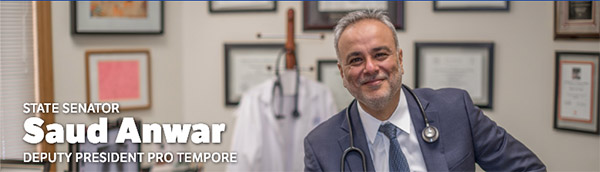
“We’re at a potential turning point in our battle against the opioid crisis in Connecticut, but we could lose the ground we’ve gained if we don’t continue advocating for new solutions,” said State Senator Saud Anwar (D-South Windsor), Senate Chair of the Public Health Committee. “Direct connections to opioid antagonists and treatments that can help bring people into recovery are huge advantages we can utilize – I’m encouraged by the prospect of better ensuring those in need have access to programs that can and will help them.”
Senate Bill 365, “An Act Establishing A Bridge Program For Emergency Treatment and Recovery Navigation For Persons With An Opioid Use Disorder,” would see hospitals begin to provide buprenorphine or methadone, chemicals used to treat opioid use disorder and partially reverse opioids’ effect, to patients who present to emergency departments with symptoms of opioid use disorder.
The bill would change measures to allow buprenorphine or methadone’s administration without requiring the patient’s admission to the hospital as long as the drug is medically given and the patient consents. The patient would also be offered access to opioid antagonists upon discharge from the ED and would be offered a referral to local treatment programs or community providers.
If a patient is treated with methadone, they must be referred to a methadone treatment program and provided with a letter with exact details on their most recent methadone receipt. The bill does not require provision of medication and provides flexibility for clinicians to exercise professional judgment.
This legislation received strong support in public comments from recovery experts and medical professionals. Rebecca Allen, director of recovery advocacy for the Connecticut Community for Addiction Recovery, testified that many people with substance use disorder visit emergency departments, but are discharged without receiving information about recovery care or services. CCAR’s use of a similar model in its efforts has helped thousands of people reconnect with care, which Allen said would provide further benefits when expanded to a larger audience.
The Hartford County Medical Association testified that nonfatal opioid overdoses and emergency department visits remain high in Connecticut and signal missed opportunities for intervention, even noting people who survive overdoses without connections to evidence-based treatment are more likely to overdose and die in the future. However, buprenorphine and treatment can reduce mortality and stabilize lives.
“SB 365 helps convert what too often is a missed opportunity into a moment of hope and connection to ongoing recovery supports,” the Association testified.
Share this page: