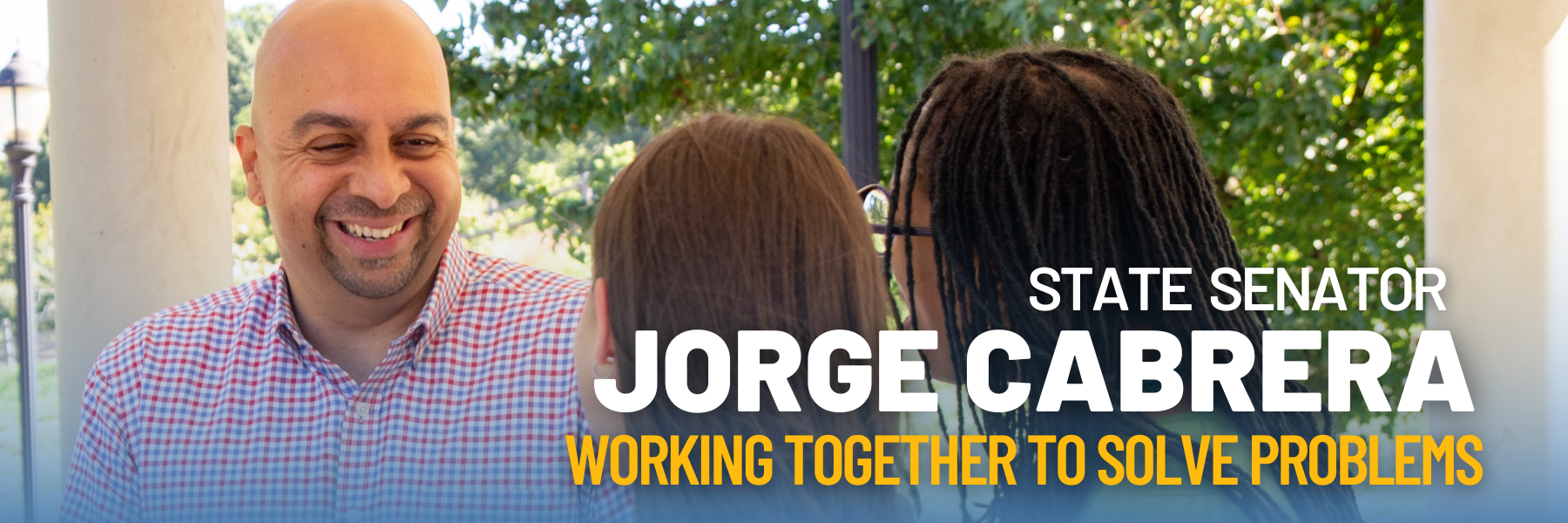
SEN. CABRERA, KATHERINE HINDS WELCOME BRIDGE BRIGADE FREEDOM OF SPEECH RESOLUTION WITH CONNECTICUT STATE POLICE
HAMDEN – State Senator Jorge Cabrera (D-Hamden) and his Connecticut Visibility Brigade protest leader and constituent Katherine Hinds today welcomed a new agreement between the Connecticut ACLU and the Connecticut State Police that prohibits state police from arresting citizens like Hinds who are exercising their free speech rights by protesting the Trump regime on highway overpasses.
It was the Connecticut State Police arrest of Hinds last summer on criminal trespass and breach of peace charges – charges that were later dismissed in court – that led to the new ACLU/state police agreement.
“Catherine is a friend, a constituent, and she is a role model for what it means to be a patriotic American in the very difficult times that we are all facing under Donald Trump and his awful, awful administration and all of the harm he’s causing our country,” Sen. Cabrera said. “If it weren’t for Katherine’s courage and fortitude, police may have felt free to trample the first amendment rights of other bridge protestors all across Connecticut — Lord knows we’ve seen people in power trample civil rights in other states. But thanks to Katherine, here in Connecticut, we have secured some basic protections for freedom of speech and assembly.”
“I’m thrilled, I’m relieved, and I’m so grateful to the ACLU and to all of the state legislators who assisted on this – and Jorge is right at the top of the list. They all stood up for the first amendment, and I couldn’t be more grateful,” Hinds said. “This agreement is a win-win. It applies to everyone in the state.”
Hinds founded the Connecticut Visibility Brigade just over a year ago, on Valentine’s Day 2025. It was the first of about 12 such ‘bridge brigades” whose members protest the Trump regime with signs and banners on highway overpasses around the state. Hinds says her group, which operates mostly on Interstate 95 in the New Haven area, sees about 7,000 to 10,000 cars per hour during their protests. There are now about 400 such bridge protest groups in 48 states, Hinds says.
Hinds was arrested last July by Connecticut State Police and charged with criminal trespass and breach of peace for holding signs and banners while standing on the sidewalk of an I-95 overpass. According to published reports, the bridge signs included phrases such as “Deport Musk,” “Go Grads, Save Democracy” and “Resistance Is Not Futile.”
A month later, the same Connecticut State Trooper who arrested Hinds in July pounded on the door of her home at 6 a.m. and presented her with a warrant for her arrest on similar charges based on his review of her Facebook account. All the state police charges against Hinds were dismissed by a New Haven judge in late October.
But the Connecticut ACLU still needed plaintiffs to make a case that the civil rights of Connecticut residents are being violated. Two other members of the Connecticut Visibility Brigade complained that they feared protesting out of concern that they would be arrested; those fears led to last week’s agreement between the ACLU and state police.
The agreement, which must become state police policy by February 22, stipulates that:
- State Troopers shall not use Conn. Gen. Stat. §§ 53a-107 (First-Degree Criminal Trespass), 53a108 (Second-Degree Criminal Trespass), 53a-109 (Third-Degree Criminal Trespass), 53a-181 (Second-Degree Breach of the Peace), 53a-182a (Obstructing Free Passage), 53a-182 (Disorderly Conduct), 13a-123 (Restriction of Outdoor Advertising Signs), or 13a-124 (Unauthorized Signs) to detain, identify, threaten, fine, disperse, or arrest individuals for peacefully assembling or for holding up signs conveying non-commercial, political messages when those individuals are on a sidewalk of an overpass that is not a limited-access highway.
- In addition, State Troopers shall not detain, identify, threaten, fine, disperse, or arrest individuals for peacefully assembling or for holding up signs conveying non-commercial, political messages when those individuals are on a sidewalk of an overpass that is not a limited-access highway based on the pace, conduct, or reaction of traffic on the highway below.
- The directive does not prevent State Troopers from arresting, fining, or dispersing any individual who incites imminent unlawful action, engages in fighting words, affixes a sign to an overpass fence, drops an item from an overpass onto a highway below, or who stands in a roadway.