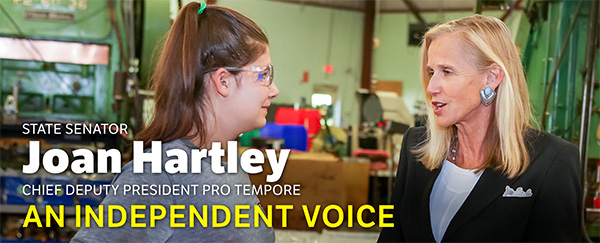
| Today, state Senator Joan Hartley (D-Waterbury), member of the UK-CT Friendship Caucus, hosted members of the United Kingdom Parliament for a UK-CT Friendship Caucus roundtable.
This visit arrives at a pivotal moment. The United States and United Kingdom have negotiated a bilateral Economic Prosperity Deal (EPD) in response to sweeping 2025 tariff actions by the Trump administration.
“It was a tremendous honor to host our colleagues from the United Kingdom Parliament here in Connecticut,” said Sen. Hartley. “At a time when the U.S.-UK relationship is being redefined through the bilateral Economic Prosperity Deal, direct dialogue between our legislators has never been more important. Connecticut has long valued its deep ties with the United Kingdom, and this roundtable is a reflection of our shared commitment to strengthening that partnership.”
Members of the United Kingdom Parliament in attendance included Luke Akehurst, Oliver Ryan, Amanda Martin, Dame Caroline Dinenage, and David Clay.
The trade environment has been significantly disrupted since early 2025. Key actions affecting the UK-CT relationship:
- March 2025: 25% tariff on all steel and aluminum imports (raised to 50% in June 2025).
- April 2025: 10% baseline ‘reciprocal tariff’ imposed on UK goods entering the US.
- April–May 2025: 25% tariff on passenger vehicles and parts.
- May 2025: US-UK Economic Prosperity Deal (EPD) — first 100,000 UK auto imports tariffed at 10% (not 25%); US tariffs on UK steel and aluminum zeroed out; UK tariffs on US ethanol eliminated.
- September 2025: US-UK Tech Prosperity Deal — cooperation on AI, quantum computing, and nuclear (partially suspended December 2025; civil nuclear cooperation restarted February 2026).
- February 20, 2026: US Supreme Court ruled IEEPA does not authorize presidential tariff imposition — creating major legal uncertainty for the existing tariff framework.
- March 5, 2026: Connecticut joined 23 other states filing suit to block Section 122 tariffs, reflecting acute state-level concern about trade disruption.
Connecticut, as one of America’s most trade-exposed advanced manufacturing states, has a direct stake in how that framework evolves. The UK remains a major source of foreign direct investment in Connecticut, with UK-based firms employing thousands of state workers in sectors from aerospace to financial services.
The United States and the United Kingdom share the world’s most enduring bilateral alliance, built on common language, democratic ideals, rule of law, and centuries of shared history. The relationship was forged through wartime alliance: World War I, World War II, Korea, the Gulf War, Iraq, and Afghanistan. It was institutionalized through NATO, in which the UK was a founding member. The US and UK are the world’s first and fifth largest economies. Together they trade over $260 billion in goods and services annually and represent each other’s number one source of foreign direct investment, with two-way investment exceeding $1 trillion. More than 1.2 million Americans work for UK companies in the US; more than 1.5 million Britons are employed by US firms.
Connecticut’s economic relationship with the United Kingdom is already strong. The United Kingdom is a major export market for Connecticut’s goods and services, which support thousands of U.S. jobs, and U.K.-based firms are among the leading foreign investors in Connecticut.
The UK is one of the three largest sources of foreign investment in Connecticut, alongside the Netherlands and Germany, with UK-controlled companies accounting for a significant share of the 113,200 Connecticut workers employed by foreign firms as of 2022 (7.7% of total private industry employment). |