Sen. Marx Celebrates $800,000 State Grant for Sheffield Pharmaceuticals Expansion in New London

Sen. Marx Celebrates $800,000 State Grant for Sheffield Pharmaceuticals Expansion in New London

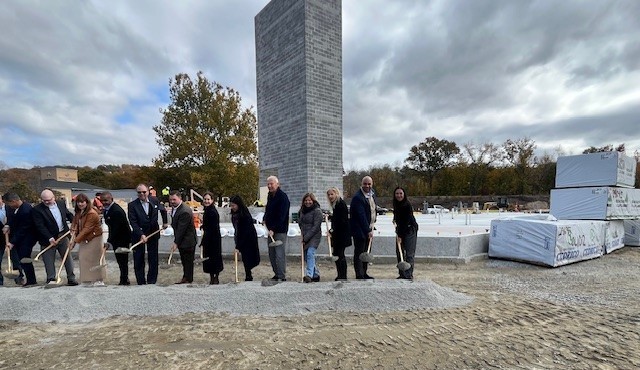
Senator Martha Marx (D-New London) today applauded an $800,000 state grant awarded to Sheffield Pharmaceuticals to support a major expansion at its New London facility.

The grant, awarded through the Department of Economic and Community Development’s Strategic Supply Chain Initiative, will help Sheffield Pharmaceuticals invest $3 million in state-of-the-art packaging equipment and mixing systems to increase capacity and expand into new product lines.

“Sheffield Pharmaceuticals has been a cornerstone of New London’s economy since the 1800s, and this investment ensures they’ll continue to grow and thrive here,” Senator Marx said. “An $800,000 state grant leveraging $3 million in private investment means expanded production capacity and a stronger local economy. That’s exactly the kind of growth we need to see.”

Sheffield Pharmaceuticals, located in New London, manufactures prescription and over-the-counter pharmaceutical products, including creams, ointments, liquids, and oral care products.

“The marketplace response to this program continues to be very strong. I am especially encouraged by the fact that so many businesses see growth opportunities in our state and are making new investments to meet the rising demand for their products,” said DECD Commissioner Daniel O’Keefe.

The Strategic Supply Chain Initiative is a $25 million program supporting companies that are increasing production capacity, expanding existing facilities, or establishing new operations in Connecticut.

Sen. Lesser Applauds Court Order to Release November SNAP Benefits

Sen. Lesser Applauds Court Order to Release November SNAP Benefits

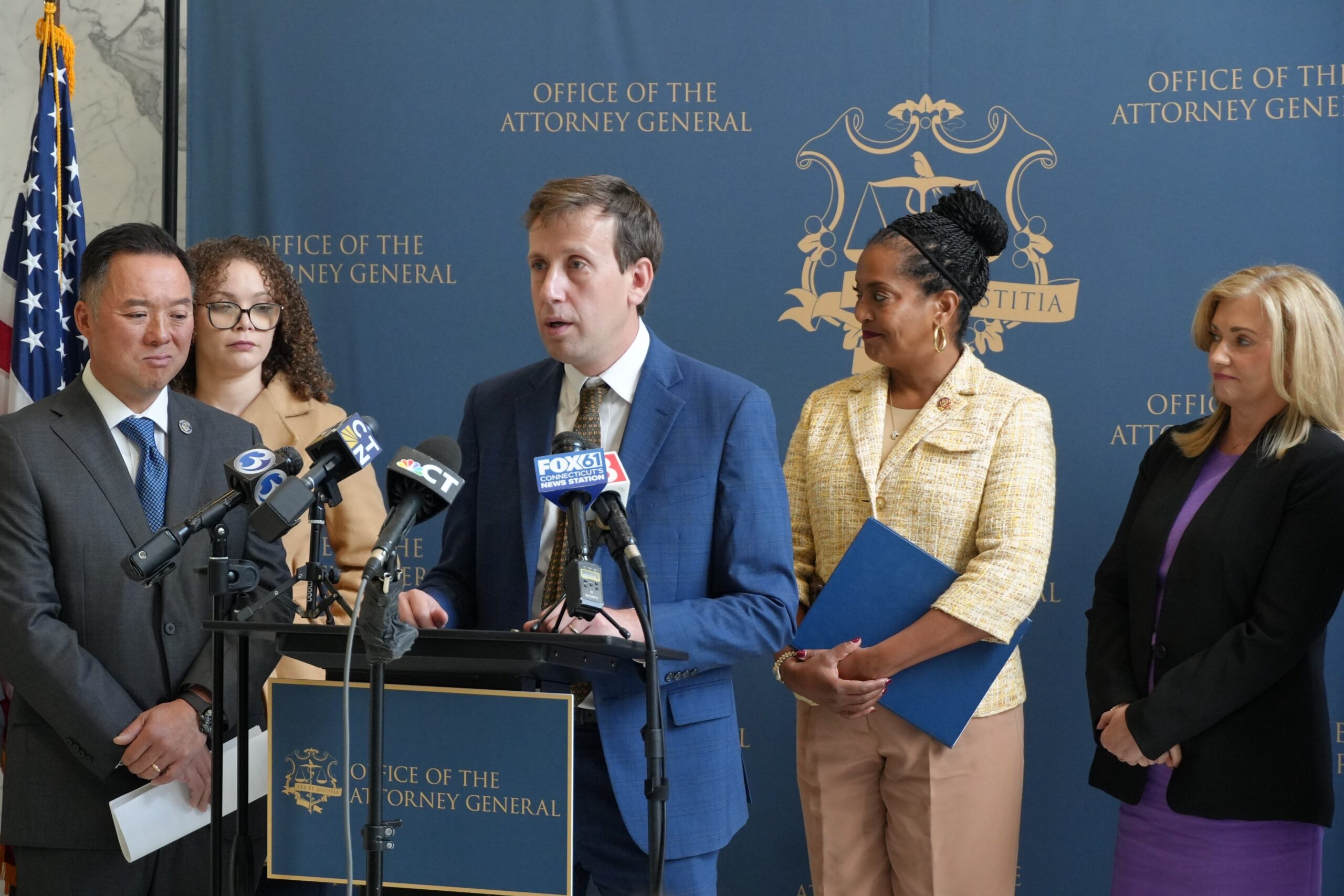
Senator Lesser speaks at a press conference with Attorney General William Tong, Congresswoman Jahana Hayes and State Representative Eleni Kavros DeGraw announcing the lawsuit on Tuesday.


Today, State Senator Matt Lesser, Chair of the Human Services Committee, welcomed two separate rulings from federal judges that order the Trump administration to continue Supplemental Nutrition Assistance Program (SNAP) payments, despite the administration’s efforts to cut off food assistance to over 40 million Americans.

This week, many Democratic governors and attorneys general, including Connecticut Attorney General William Tong, sued the administration in order to keep payments flowing. Today, two federal judges have ruled that withholding the funds is unlawful.

It is unclear whether the Trump administration will comply with the order and when or if funding will ultimately be reinstated.

“I am incredibly grateful to Attorney General Tong for immediately taking up this fight and delivering a win for Connecticut residents and those across the country. The verdict is clear – when we fight, we win,” said Sen. Lesser. “That said, we don’t yet know whether the President will comply with this court order, but our state needs to step up to do more to protect our residents from starvation. I have heard from Type 1 diabetics, home-bound individuals and parents of developmentally disabled adults who are fearful of what the next few days will bring. Connecticut needs adequate contingency plans to prepare for the emergency. People in my district are scared right now and looking to the state and Governor Lamont for leadership.”

Duff, Norwalk Delegation Celebrate Successful Advocacy for Norwalk

Duff, Norwalk Delegation Celebrate Successful Advocacy for Norwalk

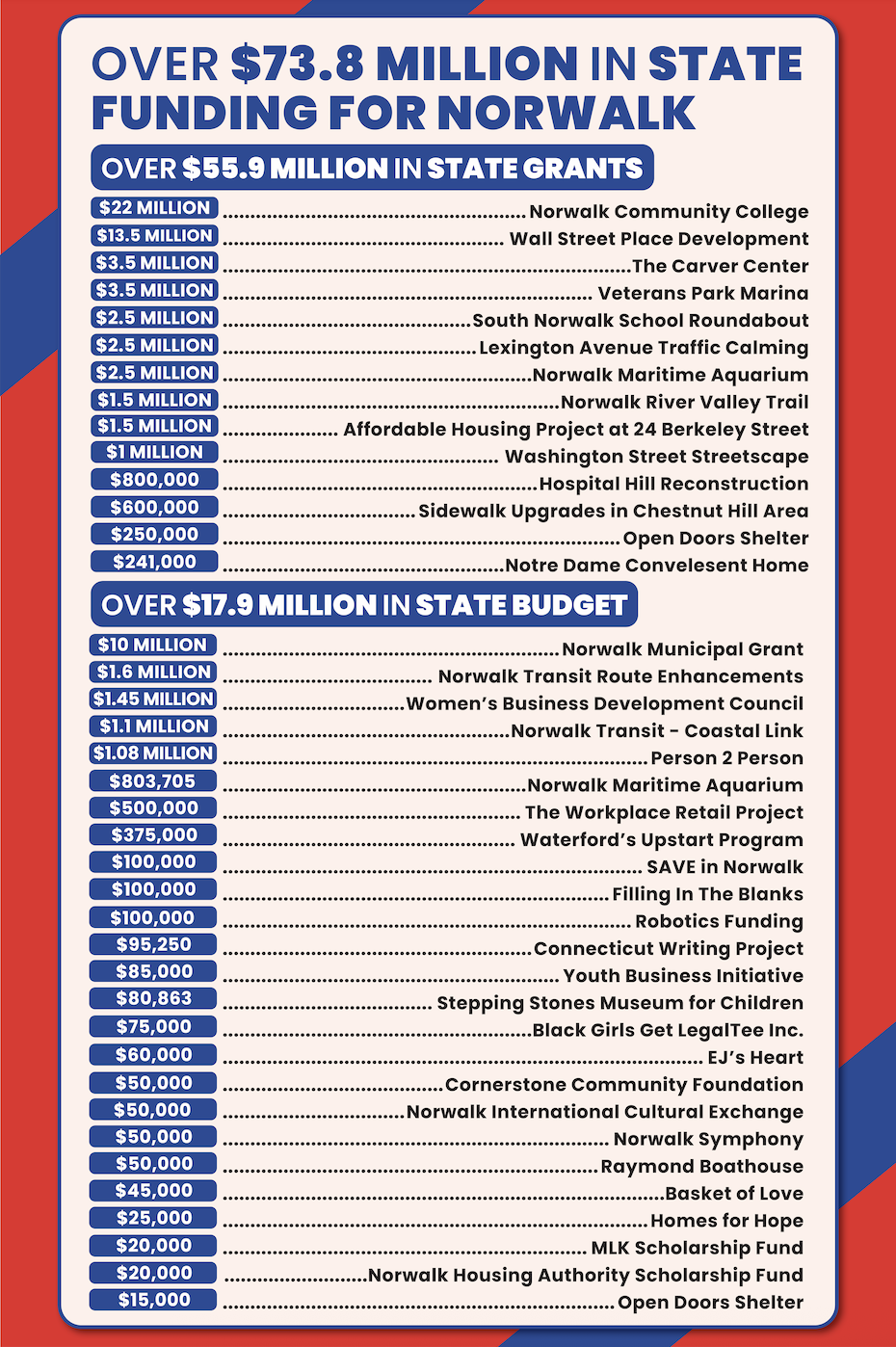
NORWALK – Senate Majority Leader Bob Duff and State Representatives Lucy Dathan, Dominique Johnson, Kadeem Roberts, and Travis Simms today celebrated the nearly $74 million in total state aid that he and Norwalk’s Democratic legislative delegation were able to bring to Norwalk and the region in 2025, funding everything from MLK student scholarships and the Norwalk Symphony to a college, an aquarium, a marina, and the City of Norwalk itself.

“Norwalk is one of the fastest-growing cities in Connecticut, and as such the city and its people need the state support that keeps them moving forward while keeping local property taxes in check and maintaining a high quality of life. That has been my goal this year in securing tens of millions of dollars in state funding or Norwalk and the region,” said Sen. Duff. “The life of a city is built on a myriad of things, all of them important to someone and all of them contributing in some way. All of it together makes for a very attractive and dynamic place to live. My family goes back five generations in Norwalk, and I graduated from Norwalk High School. I’m invested in this community, and I’m determined to see it flourish.”

As the respected state Senate Majority Leader, Sen. Duff plays a key role in the development of the Connecticut state budget and public policy. As the newly elected vice president of the National Conference of State Legislatures, Sen. Duff  collaborates in a bipartisan manner with legislators from all 50 states to tackle the issues and solve the problems facing America. “Public service is both an enormous responsibility and enormously satisfying, and when holding public office in service to your community, the sky is the limit if you have the will and the ability. I’m fortunate enough to have both and I’m committed to delivering for the people of Norwalk,” said Sen. Duff.

“I want to thank the Norwalk Delegation for delivering over $73 million to the City of Norwalk, especially Senator Duff who is always advocating for Norwalk residents.” said Mayor Rilling. “The community organizations receiving this funding from the State are the heartbeat of Norwalk and these investments will go a long way in helping to enhance equity and the quality of life for all Norwalkers.”

“I am proud of the results we have collaboratively delivered to our districts this year,” said Rep. Dathan. “By combining our diverse strengths and shared commitment to public service, we have effectively addressed the needs of our communities. It is an honor to serve our constituents, and through cooperation and with our thoughtful delegation, we continue to ensure their voices are heard and their priorities advanced.”

“I am overjoyed that the Norwalk delegation was able to secure over $73 million in state aid for the city. Like America, Norwalk is a giant melting pot – full of individuals that have different cultures and economic backgrounds. This aid is an investment in the whole city. Every resident of Norwalk will be able to reap the benefits,” said Rep. Roberts.

“2025 has been a successful year for Norwalk! Our delegation has worked tirelessly to secure funding for several diverse projects all over the City. These investments not only support and benefit current residents of Norwalk, but will also build on our foundation for a bright future. I am grateful that the Norwalk delegation is united in the fight to make our community as great as possible,” said Rep. Johnson.

“This historic investment is a testament to what we can achieve when we work together to prioritize the needs of our community. These funds will strengthen Norwalk’s educational institutions, support our small businesses and nonprofits, expand opportunities for our youth, and improve the overall quality of life for our residents. I’m especially proud to see resources going toward programs that uplift working families, empower entrepreneurs, and create pathways for our young people to succeed. As a lifelong Norwalker and representative of the 140th District, I remain committed to ensuring that every dollar we bring home builds a stronger, safer, and more equitable future for all,” said Rep. Travis Simms.

Sen. Marx Welcomes $333,000 in Waste Reduction Grants for Montville, Old Saybrook

Sen. Marx Welcomes $333,000 in Waste Reduction Grants for Montville, Old Saybrook

Senator Martha Marx (D-New London) today welcomed a total of more than $333,000 in state grants to support waste reduction in the towns of Montville and Old Saybrook.

The grants, awarded through the Department of Energy and Environmental Protection’s Sustainable Materials Management program, include $161,032 for Montville and $172,018 for Old Saybrook to support the development of a transfer station-based and unit-based pricing system and food scraps recycling program.

“We can’t keep trucking our trash to other states and expect costs to stay manageable,” Senator Marx said. “These grants will help Montville and Old Saybrook cut waste, invest in local solutions, and give residents more control over what they’re paying. That’s smart policy that makes sense for our communities.”

“With these grants, we’re continuing to support municipalities in their efforts to identify solutions to rising waste disposal costs that work for their communities,” Governor Ned Lamont said in announcing the grants today. “The smart and sustainable programs these grants will support give residents and municipalities more control over their disposal costs.”

Connecticut is facing a growing waste crisis. With the closure of the Materials Innovation and Recycling Authority (MIRA) in Hartford, municipalities have fewer disposal options located within Connecticut’s borders, causing communities to rely increasingly on trucking waste to landfills in other states.

Restoring Connecticut’s self-sufficiency in waste management is critical for a reliable waste system and long-term stability in tipping fees. Many municipalities and regional organizations are taking positive steps to increase diversion and invest in waste management infrastructure, and DEEP has been supporting those efforts through multiple grant opportunities, including the first round of the SMM program and the Materials Management Infrastructure grant program.

The SMM grant program helps municipalities and regional entities respond to this crisis by providing funds to develop and implement a wide variety of waste diversion and reduction programs and initiatives.

These programs and initiatives include unit-based pricing systems operated at municipal transfer stations; decentralized food scrap collection units; technical assistance for the startup of an aerated static pile composting facility; curbside food scraps collection; regional composting enhancements paired with an in-vessel composter installation; technical support for the expansion of a regional waste authority’s operations; and a major urban initiative to launch curbside co-collection of municipal solid waste and food scraps within a unit-based pricing system.

The first round of the SMM grant program resulted in more than 1,000 tons of waste diverted across participating municipalities.

Sen. Needleman Celebrates Nearly $200K in Waste Reduction Funding for Haddam, Old Saybrook

Sen. Needleman Celebrates Nearly $200K in Waste Reduction Funding for Haddam, Old Saybrook

Senator Norm Needleman (D-Essex) today welcomed a total of nearly $200,000 in state grants to support waste reduction in the towns of Haddam and Old Saybrook.

The grants, awarded through the Department of Energy and Environmental Protection’s Sustainable Materials Management program, include $21,940 for Haddam to support the deployment of satellite food scrap collection units and $172,018 for Old Saybrook to support the development of a transfer station-based and unit-based pricing system and food scraps recycling program.

“As both a state senator and a local official, I know firsthand how challenging waste management has become for Connecticut towns,” Senator Needleman said. “These grants give Haddam and Old Saybrook tools to tackle rising disposal costs while keeping waste decisions local. Food scrap recycling and unit-based pricing work because they reduce what goes to the landfill and give residents more control over their costs.”

“With these grants, we’re continuing to support municipalities in their efforts to identify solutions to rising waste disposal costs that work for their communities,” Governor Ned Lamont said in announcing the grants today. “The smart and sustainable programs these grants will support give residents and municipalities more control over their disposal costs.”

Connecticut is facing a growing waste crisis. With the closure of the Materials Innovation and Recycling Authority (MIRA) in Hartford, municipalities have fewer disposal options located within Connecticut’s borders, causing communities to rely increasingly on trucking waste to landfills in other states.

Restoring Connecticut’s self-sufficiency in waste management is critical for a reliable waste system and long-term stability in tipping fees. Many municipalities and regional organizations are taking positive steps to increase diversion and invest in waste management infrastructure, and DEEP has been supporting those efforts through multiple grant opportunities, including the first round of the SMM program and the Materials Management Infrastructure grant program.

The SMM grant program helps municipalities and regional entities respond to this crisis by providing funds to develop and implement a wide variety of waste diversion and reduction programs and initiatives.

These programs and initiatives include unit-based pricing systems operated at municipal transfer stations; decentralized food scrap collection units; technical assistance for the startup of an aerated static pile composting facility; curbside food scraps collection; regional composting enhancements paired with an in-vessel composter installation; technical support for the expansion of a regional waste authority’s operations; and a major urban initiative to launch curbside co-collection of municipal solid waste and food scraps within a unit-based pricing system.

The first round of the SMM grant program resulted in more than 1,000 tons of waste diverted across participating municipalities.

SENATOR OSTEN WELCOMES STATE FUNDING FOR WASTE REDUCTION IN MARLBOROUGH AND MONTVILLE

SENATOR OSTEN WELCOMES STATE FUNDING FOR WASTE REDUCTION IN MARLBOROUGH AND MONTVILLE

State Senator Cathy Osten (D-Sprague) today welcomed over a quarter-million dollars in state grants to support waste reduction in those two towns.

Both grants – $108,621 for Marlborough and $161,032 for Montville – will be used to support the development of a transfer station-based unit-based pricing system and food scraps recycling program.

“Local towns are facing rising trash disposal costs right now because of a combination of factors, including a lack of local disposal options in Connecticut and the collapse of the recyclables market world-wide. They have to put on their thinking caps and find new ways to handle waste disposal, and that’s what these grants will help them do,” Sen. Osten said.

“With these grants, we’re continuing to support municipalities in their efforts to identify solutions to rising waste disposal costs that work for their communities,” Governor Ned Lamont said in announcing the grants today. “The smart and sustainable programs these grants will support give residents and municipalities more control over their disposal costs.”

Connecticut is facing a growing waste crisis. With the closure of the Materials Innovation and Recycling Authority (MIRA) in Hartford, municipalities have fewer disposal options located within Connecticut’s borders, causing communities to rely increasingly on trucking waste to landfills in other states.

Restoring Connecticut’s self-sufficiency in waste management is critical for a reliable waste system and long-term stability in tipping fees. Many municipalities and regional organizations are taking positive steps to increase diversion and invest in waste management infrastructure, and DEEP has been supporting those efforts through multiple grant opportunities, including the first round of the SMM program and the Materials Management Infrastructure grant program.

The SMM grant program helps municipalities and regional entities respond to this crisis by providing funds to develop and implement a wide variety of waste diversion and reduction programs and initiatives. These programs and initiatives include unit-based pricing systems operated at municipal transfer stations; decentralized food scrap collection units; technical assistance for the startup of an aerated static pile composting facility; curbside food scraps collection; regional composting enhancements paired with an in-vessel composter installation; technical support for the expansion of a regional waste authority’s operations; and a major urban initiative to launch curbside co-collection of municipal solid waste and food scraps within a unit-based pricing system.

The first round of the SMM grant program resulted in more than 1,000 tons of waste diverted across participating municipalities

Senators Looney & Duff Call on CT Republicans to Join Them in Urging Trump to Release Over $5 Billion in SNAP Funding

Senators Looney & Duff Call on CT Republicans to Join Them in Urging Trump to Release Over $5 Billion in SNAP Funding

HARTFORD – Senate President Pro Tempore Martin Looney (D–New Haven) and Senate Majority Leader Bob Duff (D–Norwalk) today called on Connecticut Republicans to join Democrats in demanding that the Trump administration immediately release over $5 billion in federal reserve Supplemental Nutrition Assistance Program (SNAP) funding to sustain the program during the ongoing Republican federal shutdown.

The Republican-led U.S. Department of Agriculture announced that it would not tap into the SNAP contingency reserve to support the program during the shutdown. This action is jeopardizing food assistance for more than 360,000 Connecticut residents and over 42 million Americans nationwide.

“Putting food on the table is a moral issue, not a cynical political calculation,” said Senator Looney. “The existence of this fund underscores that we are dealing with a manufactured crisis and that the federal government is willing to see people suffer despite having the resources to mitigate that, even during a shutdown. Connecticut families rely on SNAP to get through tough times. If the Trump administration refuses to act, Republicans here in Connecticut should have the courage to speak up and put people ahead of politics.”

“This is the first time in our country’s history that the President of the United States is willfully starving his own people,” said Senator Duff. “Trump is holding hungry families hostage to his chaos. There is over $5 billion sitting in reserve that could be released today but instead is being used to pressure Democrats to agree to Trump’s health insurance rate hikes. We call on our Republican colleagues to join us in demanding that the President release these funds immediately.”

Looney and Duff noted that Governor Ned Lamont has already announced $3 million in emergency state aid to Connecticut Foodshare to help fill the gap but said that “state funds can only go so far.”

“The federal government has the ability and the responsibility to prevent a hunger crisis,” the Senate leaders said in a joint statement. “This is a moment for Connecticut Republicans to show leadership and to demand action from their party’s standard-bearer in Washington.”

In a memo to state agencies, the USDA claimed that it cannot use the SNAP contingency reserve because those funds are only available to supplement benefits “when amounts have been appropriated for, but are insufficient to cover, benefits.” USDA argues that because Congress has not enacted a fiscal year 2026 appropriation, there are no existing benefits to supplement, and therefore, the contingency fund cannot be accessed.

However, that interpretation contradicts USDA’s own previously published shutdown contingency plan, which explicitly stated that the multi-year reserve funds “are also available to fund participant benefits in the event that a lapse occurs in the middle of the fiscal year.” The plan further noted that “Congressional intent is evident that SNAP’s operations should continue” during a government shutdown. Legal and policy experts say the agency retains complete discretion to use the reserve to maintain operations and prevent a lapse in benefits, particularly given that the funds were established precisely to ensure continuity of essential nutrition programs in emergencies. Prior administrations—Republican and Democratic alike—have consistently used available funding sources, including the reserve, to prevent any lapse in benefits during shutdowns including the 2018–2019 Trump-era shutdown.

The issue of SNAP funding is a bipartisan one. According to CT Data Haven, Connecticut’s 11 Republican state senators will see 11,364 families in their districts lose $2.6 million a month in federal SNAP funding – nearly $86,000 a day.

Senator              Families Affected  

Martin                 1,785

Sampson             1,600

Somers                1,232

Perillo                 1,121

Gordon                1,088

Cicarella              1,029

Harding                  998

Kissel                     877

Berthel                   711

Fazio                      517

Hwang                    406

Senators Looney & Duff Call on CT Republicans to Join Them in Urging Trump to Release Over $5 Billion in SNAP Funding

Senators Looney & Duff Call on CT Republicans to Join Them in Urging Trump to Release Over $5 Billion in SNAP Funding

HARTFORD – Senate President Pro Tempore Martin Looney (D–New Haven) and Senate Majority Leader Bob Duff (D–Norwalk) today called on Connecticut Republicans to join Democrats in demanding that the Trump administration immediately release over $5 billion in federal reserve Supplemental Nutrition Assistance Program (SNAP) funding to sustain the program during the ongoing Republican federal shutdown.

The Republican-led U.S. Department of Agriculture announced that it would not tap into the SNAP contingency reserve to support the program during the shutdown. This action is jeopardizing food assistance for more than 360,000 Connecticut residents and over 42 million Americans nationwide.

“Putting food on the table is a moral issue, not a cynical political calculation,” said Senator Looney. “The existence of this fund underscores that we are dealing with a manufactured crisis and that the federal government is willing to see people suffer despite having the resources to mitigate that, even during a shutdown. Connecticut families rely on SNAP to get through tough times. If the Trump administration refuses to act, Republicans here in Connecticut should have the courage to speak up and put people ahead of politics.”

“This is the first time in our country’s history that the President of the United States is willfully starving his own people,” said Senator Duff. “Trump is holding hungry families hostage to his chaos. There is over $5 billion sitting in reserve that could be released today but instead is being used to pressure Democrats to agree to Trump’s health insurance rate hikes. We call on our Republican colleagues to join us in demanding that the President release these funds immediately.”

Looney and Duff noted that Governor Ned Lamont has already announced $3 million in emergency state aid to Connecticut Foodshare to help fill the gap but said that “state funds can only go so far.”

“The federal government has the ability and the responsibility to prevent a hunger crisis,” the Senate leaders said in a joint statement. “This is a moment for Connecticut Republicans to show leadership and to demand action from their party’s standard-bearer in Washington.”

In a memo to state agencies, the USDA claimed that it cannot use the SNAP contingency reserve because those funds are only available to supplement benefits “when amounts have been appropriated for, but are insufficient to cover, benefits.” USDA argues that because Congress has not enacted a fiscal year 2026 appropriation, there are no existing benefits to supplement, and therefore, the contingency fund cannot be accessed.

However, that interpretation contradicts USDA’s own previously published shutdown contingency plan, which explicitly stated that the multi-year reserve funds “are also available to fund participant benefits in the event that a lapse occurs in the middle of the fiscal year.” The plan further noted that “Congressional intent is evident that SNAP’s operations should continue” during a government shutdown. Legal and policy experts say the agency retains complete discretion to use the reserve to maintain operations and prevent a lapse in benefits, particularly given that the funds were established precisely to ensure continuity of essential nutrition programs in emergencies. Prior administrations—Republican and Democratic alike—have consistently used available funding sources, including the reserve, to prevent any lapse in benefits during shutdowns including the 2018–2019 Trump-era shutdown.

The issue of SNAP funding is a bipartisan one. According to CT Data Haven, Connecticut’s 11 Republican state senators will see 11,364 families in their districts lose $2.6 million a month in federal SNAP funding – nearly $86,000 a day.

Senator              Families Affected  

Martin                 1,785

Sampson             1,600

Somers                1,232

Perillo                 1,121

Gordon                1,088

Cicarella              1,029

Harding                  998

Kissel                     877

Berthel                   711

Fazio                      517

Hwang                    406

SEN. CABREREA HELPS BREAK GROUND ON 180 NEW APARTMENTS IN NAUGATUCK

SEN. CABREREA HELPS BREAK GROUND ON 180 NEW APARTMENTS IN NAUGATUCK

Senator Cabrera (second from right) breaking ground on the Pennrose/Cloud Company development in Naugatuck on October 28, 2025

NAUGATUCK – State Senator Jorge Cabrera (D-Hamden) today helped break ground on the construction of 180 new mixed-income apartments at the corner of Maple Street and Old Firehouse Road that are being built in part with state funding and which will give both local residents and businesses an economic boost.

The vacant, 7-acre parcel will see the first 60 apartments open next Fall with one- and two-bedroom apartments available at 30%, 50% and 80% of the area median income along with market-rate units. The apartments will also feature 3,000 square feet of ground floor commercial space for local businesses.

At the same time, the Connecticut Department of Transportation is building a new state-of-the-art train station nearby to be completed in 2027.

“I remember a year ago riding around with Mayor Hess, and he showed me this spot and he talked about the city’s plans for it. At the time, I thought it would be great if only it could be accomplished, and here we are breaking ground and surrounded by progress,” Sen. Cabrera said. “I think it’s important to stay positive and work together, and that’s how we make progress for everybody.”

SENATORS MAHER & KUSHNER WELCOME STATE FUNDING FOR WASTE REDUCTION IN BETHEL, NEWTON, RIDGEFIELD AND KENT

SENATORS MAHER & KUSHNER WELCOME STATE FUNDING FOR WASTE REDUCTION IN BETHEL, NEWTON, RIDGEFIELD AND KENT

State Senators Ceci Maher (D-Wilton) and Julie Kushner (D-Danbury) today welcomed $1.5 million in state grants to support waste reduction in these four towns.

The state awarded $1,542,527 to the Housatonic Resources Recovery Authority to support the deployment of additional satellite food scraps collection units, a new aerated static pile composting system in Bethel, the expansion of the aerated static pile composting system in Newtown, and waste diversion enhancements and improvements in Ridgefield and Kent.

The HRRA is a regional, governmental, waste management and recycling authority serving 14 municipalities in western Connecticut and a population of over 266,000 people.  HRRA municipalities include Bethel, Bridgewater, Brookfield, Danbury, Kent, New Fairfield, New Milford, Newtown, Redding, Ridgefield, Roxbury, Sherman, Weston, Wilton.

“Composting through food scrap recycling is the way of the future – it reduces waste, creates a highly usable end product, and cuts down on costs,” said Sen. Maher. “I’m excited to see the support and growth of this effort in our area as a model for the state.”

“Waste disposal has nearly reached the level of unaffordability, so we have to be creative in our approaches to reducing and re-using the household trash that keeps being generated,” Sen. Kushner said. “I was proud to support these grants and I’m glad to see some of them  coming back to the region to help taxpayers and the environment.”

“With these grants, we’re continuing to support municipalities in their efforts to identify solutions to rising waste disposal costs that work for their communities,” Governor Ned Lamont said in announcing the grants today. “The smart and sustainable programs these grants will support give residents and municipalities more control over their disposal costs.”

“Separating organic materials from the trash should be thought of as a resource, not a waste. More food reaches landfills and incinerators than any other single material in our everyday trash.  Compost added to gardens, construction sites, and poor soils makes great things happen,” the HRRA says on its website. “The HRRA is working to provide organics recycling programs throughout the region as a public service.  Our goals include reduction of waste and greenhouse gas emissions, sequestering carbon, and improving ecosystem health.”

Connecticut is facing a growing waste crisis. With the closure of the Materials Innovation and Recycling Authority in Hartford, municipalities have fewer disposal options located within Connecticut’s borders, causing communities to rely increasingly on trucking waste to landfills in other states.

Restoring Connecticut’s self-sufficiency in waste management is critical for a reliable waste system and long-term stability in tipping fees. Many municipalities and regional organizations are taking positive steps to increase diversion and invest in waste management infrastructure, and the state Department of Energy and Environmental Protection has been supporting those efforts through multiple grant opportunities, including the first round of the Sustainable Materials Management (SMM) grant program and the Materials Management Infrastructure grant program.

The SMM grant program helps municipalities and regional entities respond to this crisis by providing funds to develop and implement a wide variety of waste diversion and reduction programs and initiatives. These programs and initiatives include unit-based pricing systems operated at municipal transfer stations; decentralized food scrap collection units; technical assistance for the startup of an aerated static pile composting facility; curbside food scraps collection; regional composting enhancements paired with an in-vessel composter installation; technical support for the expansion of a regional waste authority’s operations; and a major urban initiative to launch curbside co-collection of municipal solid waste and food scraps within a unit-based pricing system.

The first round of the SMM grant program resulted in more than 1,000 tons of waste diverted across participating municipalities