
|
|||
|
Author: Devin James

SEN CABRERA: LOCAL POLICE DEPARTMENTS REPORT VIOLENT CRIME IN CONNECTICUT DROPPED 11% IN 2022; CT IS THE 3rd-SAFEST STATE IN AMERICA
FOR IMMEDIATE RELEASE
Wednesday, October 18, 2023
SEN CABRERA: LOCAL POLICE DEPARTMENTS REPORT VIOLENT CRIME IN CONNECTICUT DROPPED 11% IN 2022; CT IS THE 3rd-SAFEST STATE IN AMERICA
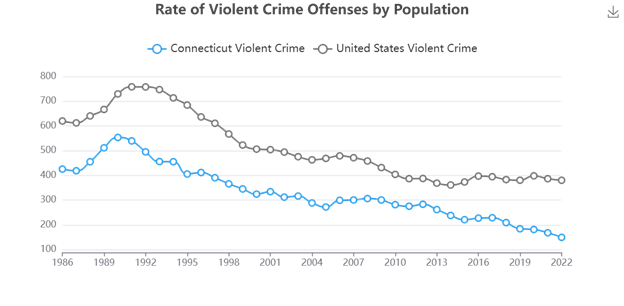
State Senator Jorge Cabrera (D-Hamden) announced today that violent crime in Connecticut reached its lowest level in at least a third of a century in 2022, according to local police departments, and that Connecticut’s violent crime rate continues to remain 60% below the national average, placing Connecticut once again among the safest states in America to live, work and raise a family.
Sen. Cabrera said violent crime also dropped in 2022 in the 17th Senate District towns of Ansonia, Bethany, Derby, Hamden, Naugatuck and Woodbridge (detailed crime data was not available for Beacon Falls).
“I know families have a lot to think about nowadays, but thankfully violent crime is not a major issue here in Connecticut when compared to the rest of the nation,” Sen. Cabrera said. “When it comes to the most heinous crimes, Connecticut the safest it’s ever been since at least the mid-1980’s. However, I continue to be concerned about some of the lower levels of crime in our state such as motor vehicle break-ins that are part of a larger, national trend and which affect the quality of our lives on a daily basis. But overall this FBI report is very good news.”
The new 2022 Federal Bureau of Investigation Crime Data Explorer crime data released Monday from 107 Connecticut police departments covering 98% of the population found that violent
crime in Connecticut – defined as homicide, rape, robbery and aggravated assault – dropped 11% from 168.6 incidents per 100,000 residents in 2021 to 150 incidents per 100,000 residents in 2022.
The national violent crime average in 2022 was 380.7 incidents per 100,000 residents, meaning Connecticut’s violent crime rate is less than half the national average.
Violent crime in Hamden dropped by 8.8% from 2021 to 2022, declined 8% in Ansonia, 5% in Derby, 25% in Naugatuck (from 34 incidents in 2021 to 25 incidents in 2022) and by 66% in Woodbridge (from three incidents in 2021 to one incident in 2022).
Connecticut ranked as the third-safest state in America in 2022 for violent crime, coming in behind Maine (103.3 incidents per 100,000 residents) and New Hampshire (125.6 incidents per 100,000 residents). Other states far surpassed Connecticut’s violent crime rate in 2022, including South Carolina (491.3), Texas (431.9), Arizona (431.5) and Florida (258.9).
The full FBI report is available at: https://cde.ucr.cjis.gov/LATEST/webapp/#/pages/home
Local Connecticut police departments also reported that:
1. Burglaries dropped 11% in 2022 to their lowest level in at least 37 years, and were 51% below the national average.
2. Motor vehicle thefts dropped 7.2% in 2022, and were 30% below the national average.
3. Property crimes dropped 1.6% in 2022 to their second-lowest level in at least 37 years, and were 23.5% below the national average.
4. Larceny rates remained essentially flat in 2022, but were still 16.6% below the national average.
###
TODAY: Duff, Rilling & Legislators to Highlight State Funding to Address Flooding in Norwalk

|
WHAT: Press conference to highlight over $5 million in state funding for a new wastewater infrastructure project to address flooding in the Heather Lane and Lockwood Lane neighborhood. The project will separate the combined sanitary and storm system into a separate storm draining infrastructure to help address continuous and erratic flooding in the area. The funding was recently approved by the State Bond Commission as a part of the Community Investment Fund initiative which was developed to target historically underserved Connecticut communities. WHEN: TODAY, Wednesday, October 18, at 11 AM WHERE: 13 Heather Lane, Norwalk, CT WHO:
|
 |
SEN. KUSHNER WELCOMES NEARLY $1 MILLION IN STATE AID FOR NEW FAIRFIELD TOWN GREEN, RIDGEFIELD ROAD CULVERT

FOR IMMEDIATE RELASE
Monday, October 2, 2023
SEN. KUSHNER WELCOMES NEARLY $1 MILLION IN STATE AID FOR NEW FAIRFIELD TOWN GREEN, RIDGEFIELD ROAD CULVERT
State Senator Julie Kushner (D-Danbury) today welcomed the news that New Fairfield and Ridgefield will receive a combined $975,272 in state Small Town Economic Assistance Program (STEAP) grants for improvements to the New Fairfield Town Green and Mountain Road in Ridgefield.
“STEAP grants are particularly useful for many western Connecticut towns because they’re smaller towns and they aren’t eligible for urban grants,” Sen. Kushner said. “STEAP grants are specifically tailored to preserve the historical integrity and beauty of our small towns, while at the same time improving the local economy and quality of life, and that’s exactly what these two grants will do.”
New Fairfield received $475,272 in state funding for upgrades to its town green that will be matched by $413,117 in town funds. It was just two years ago in November 2021 that New Fairfield voters approved to purchase two parcels off Route 37 to create New Fairfield’s first town green, which is a typical feature of the many small New England towns and which often serves as a focal point for various community events.
Ridgefield received $500,000 in state funding for the replacement of the Mountain Road culvert, which abuts the 41-acre, man-made Rainbow Lake; this will be matched by $266,100 in town funds.
The New Fairfield and Ridgefield STEAP grants were part of $24.5 million in state grants for 60 small towns announced Friday by the Lamont administration.
The STEAP grants will be used to complete a wide variety of infrastructure improvements all across Connecticut, such as road safety reconstruction projects, sewer and drainage upgrades, sidewalk and pedestrian safety enhancements, recreational facility upgrades, and other kinds of capital improvement projects.
The STEAP program is managed by the Office of Policy and Management (OPM) and delivers grants to small towns for economic development, community conservation, and quality-of-life capital projects. Towns seeking funding under this round of STEAP grants were required to submit applications to OPM by August 18, 2023.
###
SEN. KUSHNER WELCOMES NEARLY $1 MILLION IN STATE AID FOR NEW FAIRFIELD TOWN GREEN, RIDGEFIELD ROAD CULVERT
FOR IMMEDIATE RELASE
Monday, October 2, 2023
SEN. KUSHNER WELCOMES NEARLY $1 MILLION IN STATE AID FOR NEW FAIRFIELD TOWN GREEN, RIDGEFIELD ROAD CULVERT
State Senator Julie Kushner (D-Danbury) today welcomed the news that New Fairfield and Ridgefield will receive a combined $975,272 in state Small Town Economic Assistance Program (STEAP) grants for improvements to the New Fairfield Town Green and Mountain Road in Ridgefield.
“STEAP grants are particularly useful for many western Connecticut towns because they’re smaller towns and they aren’t eligible for urban grants,” Sen. Kushner said. “STEAP grants are specifically tailored to preserve the historical integrity and beauty of our small towns, while at the same time improving the local economy and quality of life, and that’s exactly what these two grants will do.”
New Fairfield received $475,272 in state funding for upgrades to its town green that will be matched by $413,117 in town funds. It was just two years ago in November 2021 that New Fairfield voters approved to purchase two parcels off Route 37 to create New Fairfield’s first town green, which is a typical feature of the many small New England towns and which often serves as a focal point for various community events.
Ridgefield received $500,000 in state funding for the replacement of the Mountain Road culvert, which abuts the 41-acre, man-made Rainbow Lake; this will be matched by $266,100 in town funds.
The New Fairfield and Ridgefield STEAP grants were part of $24.5 million in state grants for 60 small towns announced Friday by the Lamont administration.
The STEAP grants will be used to complete a wide variety of infrastructure improvements all across Connecticut, such as road safety reconstruction projects, sewer and drainage upgrades, sidewalk and pedestrian safety enhancements, recreational facility upgrades, and other kinds of capital improvement projects.
The STEAP program is managed by the Office of Policy and Management (OPM) and delivers grants to small towns for economic development, community conservation, and quality-of-life capital projects. Towns seeking funding under this round of STEAP grants were required to submit applications to OPM by August 18, 2023.
###
SEN. FLEXER WELCOMES $581,000 STATE INVESTMENT IN SCOTLAND TOWN HALL

FOR IMMEDIATE RELEASE
Friday, September 29, 2023
SEN. FLEXER WELCOMES $581,000 STATE INVESTMENT IN SCOTLAND TOWN HALL
SCOTLAND – State Senator Mae Flexer today welcomed a planned $581,000 state investment the renovation of Scotland Town Hall – renovations that Sen. Flexer began advocating for nearly a year ago.
The funding was approved by the state Community Investment Fund (CIF) on Tuesday and must now be approved by the State Bond Commission at its next meeting scheduled for Friday, October 6.
It was December 20, 2022 when Sen. Flexer wrote the Community Investment Fund board members and made a strong case for Scotland’s funding.
“The Scotland Town Hall was built in 1896 and currently houses antiquated heating, ventilation, and cooling systems within a crumbling structure. A complete renovation of this structure will address multiple building and fire code deficiencies, increase public accessibility, and preserve the beauty of this historical building for decades to come,” Sen. Flexer wrote.
“When I visit the Scotland Town Hall, I am dismayed by the condition of the building and its inability to accommodate many people with disabilities. The current foundation needs to be repaired and stabilized and hazardous materials need to be identified and remediated. The infrastructure must comply with building, safety, and accessibility codes in order to adhere to workplace safety standards. With the renovation, the town hall will provide municipal employees and the public with a comfortable and safe environment that is accessible and open to all,” she said.
“It is important for all communities to have an open community space for residents to communicate with leaders, to access crucial resources, and participate in community events. An inaccessible, run-down building will only continue to deter taxpayers from participating in their local government. The town of Scotland has one of the most challenging fiscal situations of any town in our state. Simply put, they do not have the resources on their own to complete this project. Please allow all the residents of Scotland to finally have access to their town government by making this grant towards this project. This will allow the diverse needs of this community to finally be met,” Sen. Flexer concluded.
The CIF is a statewide program authorized in state law whose projects are designed to promote economic or community development in the municipality where the project is located, and to consistently and systematically advance fair, just, and impartial treatment of all individuals, including individuals who belong to underserved and marginalized communities.
The Department of Economic and Community Development administers the program by overseeing the application process, vetting applications, sending application summaries to the CIF Board, and managing awards and reporting. The CIF Board and Office of the Governor
review applications and the summaries prepared by DECD and make recommendations to the State Bond Commission, which then approves projects for grants.
###
SENATOR SLAP VOTES FOR A NEW SUPREME COURT JUSTICE, AN EARLIER PRESIDENTIAL PRIMARY DATE, AND OVERSIGHT OF BRIDGEPORT ELECTIONS

|
||||||||||||||||||
|
||||||||||||||||||
|


STATEMENT OF SEN. KUSHNER ON NEW STATE LAW EFFECTIVE OCTOBER 1 MAKING IT EASIER FOR FIREFIGHTERS WHO DEVELOP CANCER TO RECEIVE WORKERS’ COMP BENEFITS
FOR IMMEDIATE RELEASE
Wednesday, August 30, 2023
STATEMENT OF SEN. KUSHNER ON NEW STATE LAW EFFECTIVE OCTOBER 1 MAKING IT EASIER FOR FIREFIGHTERS WHO DEVELOP CANCER TO RECEIVE WORKERS’ COMP BENEFITS
“Firefighters who contract certain cancers will now have the presumption that it’s a work-related illness, and they will qualify for coverage for themselves and surviving members of their families. After many years, we’re finally taking responsibility as a community and as a state. We expect firefighters to protect our homes and our families, yet we’ve never been willing to protect them and care for them when they got sick. That’s why I’m really proud of the work that the legislature did to finally address this issue, to step-up and make sure that we’re taking responsibility to provide for the men and women who risk their lives every day to take care of us,” said state Senator Julie Kushner (D-Danbury), who is Senate Chair of the Labor and Public Employees Committee.
To qualify for the compensation and benefits, a firefighter must have been diagnosed with any condition of cancer affecting the brain or the skeletal, digestive, endocrine, respiratory, lymphatic, reproductive, urinary, or hematological systems. They must have had a physical examination after entering the service that failed to reveal any evidence of or a propensity for the cancer, and they must not have used cigarettes during the 15 years before the diagnosis. Additionally, they must have been on the job for at least five years and submitted to annual medical health screenings as recommended by their medical provider.
The legislation enacting this law was approved in the Senate by a vote of 35 to 1 and in the House of Representatives by a vote of 139 to 12.
##
Connecticut is Investing in The Valley
Connecticut is Investing in The Valley
A few weeks ago, I was in Naugatuck with Mayor Pete Hess to promote a new $5.7 million state grant to revitalize Rubber Avenue when someone asked me why the street is named Rubber Avenue.
If you’re not from the Valley, you probably don’t know about Uniroyal Tire, which began as the United States Rubber Company in Naugatuck back in 1892 and which was one of the 12 original American companies that made up the New York Stock Exchange. Uniroyal’s 35 factory buildings were once located on 86 acres just off Rubber Avenue, along the Naugatuck River.
Uniroyal is one of those industrial-era companies that went through a lot of changes in ownership until it closed in 1979, leaving behind a lonelier Main Street, a polluted property, and a local historical society wondering that to do with lots of old photos and pamphlets. It’s a story that’s been repeated hundreds of times all across America as technology advances and the Cheney silk mills of Manchester (“Silk City”), the brass factories of Waterbury (“Brass City”), and the steamed beaver and rabbit pelt hats of Danbury (“Hat City”) all fade into obscurity.
But then what? What do we do with these old buildings, and their polluted properties, and the jobs and the lonely Main Streets they left behind? Who pays to make things better, to make up for the lost tax revenue, to set the table so new jobs and industry can move in and succeed?
Well, I’m happy to tell you that, at least around here, Connecticut is investing in The Valley.
The Rubber Avenue project I mentioned above is funded through a new state program called the Community Investment Fund. Passed in 2021 with 97 percent of state legislators voting “yes,” the fund sets aside $875 million over five years so cities and towns can make small business loans, improve water and sewer connections (like on Rubber Avenue), prevent power outages after storms, or build affordable housing, senior centers and libraries.
Rubber Avenue is getting drainage improvements, new sidewalks (esp. helpful to the high school students down the road), landscaping, and a roundabout at the intersection of Meadow and Cherry Streets. There’s another state DOT grant for a pedestrian bridge downtown, and another federal grant for the Naugatuck Senior Center (where I also was a few weeks ago!)
Last year, Naugatuck received $3 million from the state to help clean up the old Uniroyal site, where the Naugatuck River would sometimes turn the color of whatever Keds sneakers they were dying that day (25 years ago, the Connecticut Department of Environmental Protection spent $4 million to help clean up the Naugatuck River so people could actually catch and eat the sea trout that swim there.) Over the past few years, the city has also received a $1 million upgrade to the YMCA, $870,000 for the Brass City Charter School, $1 million for elderly housing and $2 million to rehabilitate the Derby-Shelton Bridge over the Naugatuck River.
Ansonia recently received $6.5 million in CIF funds to help clean up the 50-acreAnsonia Copper and Brass Site in Liberty Street. In just the past three years, the State Bond Commission has approved $9.2 million in economic development projects for Ansonia. As my friend Ansonia
Mayor David Cassetti said not too long ago, “Downtown Ansonia looks very different than it once did: from new businesses and apartments going up, to acres of old, blighted buildings being torn down.”
Over the past few years Derby has received $1.3 million grant to replace emergency generators at Griffin Hospital, $200,000 to renovate the Century Center, $5 million to rebuild downtown infrastructure, $3 million for athletic fields at Derby High School, $100,000 for the Derby Library, and $150,000 for school playgrounds, windows and floors.
My hometown of Hamden has benefitted too, with $1.35 million to renovate the Keefe Center, $4.3 million for a new firehouse, $4 million for elderly housing, $4.3 million for an emergency operations center, and $4 million to purchase homes in the Newhall section built on a landfill.
What does all this mean? I think it means that, even as local industries come and go and leave a legacy of good and bad behind them, life moves on and we need to invest in ourselves. The Valley will probably never be a tech hub like Palo Alto or Boston, but we can invest in the people and places who still call The Valley home, and who want to build their lives here. And that’s what Connecticut is doing: investing in The Valley.
###
SENATOR KUSHNER WELCOMES $135,000 FOR STUDENT SUMMER MENTAL HEALTH SERVICES THROUGH 2025
FOR IMMEDIATE RELEASE
Wednesday, August 16, 2023
SENATOR KUSHNER WELCOMES $135,000 FOR STUDENT SUMMER MENTAL HEALTH SERVICES THROUGH 2025
DANBURY – State Senator Julie Kushner (D-Danbury) today welcomed the news that $135,000 in state grants will be awarded to the Danbury public school system to support mental health services for students over the summer through mid-2025.
Awarded through the state Department of Education’s Summer Mental Health Supports Grant program, these grants will support mental health services for students during summer months over a three-year period. The grants are the result of legislation passed by the General Assembly and spearheaded by Senate Democrats during the 2022 legislative session.
“Last year I was proud to vote for Senate Bill 1 – our caucus’s top legislative priority – which addressed childhood mental and physical health services in schools. Part of that was providing grants for school districts to hire and retain more school social workers, school psychologists, school counselors and nurses,” Sen. Kushner said. “Mental health is 365 days a year. It doesn’t take summers off. Our children deserve our caring and support, and this grant will help accomplish that in Danbury.”
“The need for mental health support services among youths does not stop at the end of the school year, and these grants will enable these critical services to continue during the summer months,” said Governor Ned Lamont.
The competitive state grant program uses federal American Rescue Plan Act (ARPA). This is the third of three rounds of grants the department is releasing with ARPA funding that are aimed at increasing access to mental health support services for youths in schools. Eligible costs incurred beginning in summer 2023 through summer 2025 are reimbursable under this grant program.
###