Sen. Haskell’s Legislation to Eliminate Wasteful Spending Approved by Senate

Sen. Haskell’s Legislation to Eliminate Wasteful Spending Approved by Senate

Cohen

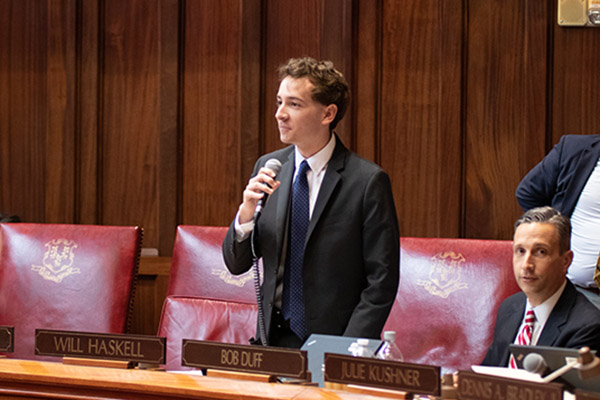
State Senator Will Haskell speaks on the Senate floor Friday regarding legislation he introduced to eliminate wasteful government spending.

HARTFORD, CT – Today, the Senate approved legislation introduced by State Senator Will Haskell (D-Westport) and Representative Jane Garibay (D-Windsor) that would help eliminate wasteful spending within state government. This bill is intended to improve efficiency of government departments, encouraging state employees to find ways to reduce spending and cut costs.

Senate Bill No. 682, “An Act Concerning State Employee Reporting of Wasteful Practices,” would provide state employees who report wasted funds in their employment agency to receive a financial reward of 5 percent of the estimated savings, which could represent an amount up to $10,000, after the wasteful practice is remedied and the Auditors of Public Accounts confirm the savings. Agency and department heads, as well as a “suggestion coordinator” in each agency, would be ineligible for that financial reward. The bill is modeled on similar programs that have helped municipalities cut costs.

“We’ve got to move beyond “us vs. them” rhetoric when it comes to state employees and streamlining Connecticut’s bureaucracy,” said Sen. Haskell. “With this bill, state employees will be our partner in removing inefficiency and saving taxpayer dollars. After all, those who work inside the government know the ins and outs of our agencies better than anyone else. I want to thank Representative Garibay and Senator Mae Flexer (D-Windham) for their hard work on this legislation and their tireless advocacy for the Connecticut taxpayer. I’m hopeful that the bill will be called in the House soon.”

Governor Signs Cohen-Supported Legislation to Create a Hemp Industry in Connecticut

Governor Signs Cohen-Supported Legislation to Create a Hemp Industry in Connecticut

HARTFORD, CT – State Senator Christine Cohen (D-Guilford) applauded Governor Ned Lamont’s signing into law a piece of legislation which will create an industrial hemp industry in Connecticut. Sen. Cohen, who co-chairs the Environment Committee, has championed this legislation and said she is excited for the possibilities a hemp industry will bring the state’s farmers and economy.

“I am thrilled Governor Ned Lamont signed this important bill into law,” said Sen. Cohen. “Connecticut will soon join other states that are reaping the benefits of industrial hemp. This new industry will strengthen our economy, while providing lucrative opportunities for the agriculture and manufacturing industry. This is great for our state and I look forward to all the ways Connecticut’s economy will grow thanks to this cash crop.”

State Senator Cathy Osten (D-Sprague) agreed with Sen. Cohen’s sentiments. Sen. Osten has been an early supporter of creating a hemp industry in Connecticut. She said she has spoken to many area farmers about their desire to grow industrial hemp in Connecticut. Sen. Osten’s district encompasses many of the 436,000 acres of arable land in Connecticut.

“I’m very happy to see our hemp bill signed into law by the governor; it will allow farmers to plant and grow a crop beginning this summer, and that’s a game-changer for the Connecticut agricultural community,” said Sen. Osten, an early proponent of legalizing hemp production in Connecticut. “Hemp is a billion-dollar industry in America that only has room to grow. I anticipate our new hemp law will help the large agricultural community in eastern Connecticut and maybe even replace some of the tobacco crops that have fallen out of production in recent years.”

State Representative Mike Demicco (D-Farmington) also co-chairs the Environment Committee and applauded the efforts of all those involved in getting this important piece of legislation signed into law. He said the possibilities a hemp industry will bring to Connecticut are endless.
“This bill is particularly important and serves as the gateway for farmers to grow, produce and sell hemp, which has many practical commercial applications,” said Rep. Demicco.

Senate Bill 893 will require the Department of Agriculture (DoAg) Commissioner, Bryan P. Hurlburt, to adopt regulations establishing an industrial hemp pilot program in accordance with federal law. The pilot program will study the growth, cultivation and marketing of industrial hemp in Connecticut and ensure hemp growth and cultivation only takes place at sites certified by, and registered with, DoAg.

In 2014, Public Act 15-202 legalized an industrial hemp pilot program authorized under the 2014 farm bill. This legislation establishing a pilot program in Connecticut will jumpstart the process and positions our state to reap the benefits of industrial hemp as soon as possible. Commissioner Hurlburt said an industrial hemp industry will be a lifeline for the state’s agricultural economy.

“We thank Governor Lamont and the General Assembly for moving this important piece of legislation – in a bipartisan manner – to open up and create new opportunities for farmers,” said Commissioner Hurlburt. “Today is an exciting day for our state and our farming community. Hemp has the potential to stabilize the agricultural economy and attract new farmers to the industry while providing consumers with a locally grown product that is in high demand. The Department of Agriculture looks forward to working with our potential growers.”

Commissioner Hurlburt added that individuals with questions on moving forward with hemp growing and processing can email DoAg at agr.hemp@ct.gov or call (860) 713 -2502.

A hemp industry will be incredibly advantageous to Connecticut’s economy. It is estimated that an acre of hemp could generate 500 to 1,500 pounds of dried flowers per acre, generating gross revenues of $37,500 to $150,000 per acre. The Hemp Industries Association notes that U.S. retail sales of hemp products totaled nearly $700 million in 2016. Gov. Lamont said this cash crop will benefit the state immensely.

“This legislation will strengthen our efforts to grow our agricultural economy and create jobs, and do so in a responsible manner by opening a competitive market to thousands of Connecticut’s farmers,” Gov. Lamont said. “With this program, farmers will have the opportunity to bolster their profits with hemp, and veteran and first-time farmers alike will be attracted to a new and growing market that will offer crop diversification, increased revenue, and expertise in an expanding field. I applaud both chambers of the General Assembly for their unanimous, bipartisan support of this legislation. If we truly want to give an economic boost to our state’s farms, this is something we should all support.”

Hemp has been grown for centuries for use in clothes, paper, and rope. According to the Congressional Research Service, there are over 25,000 different uses for industrial hemp, including fibers, textiles, paper, construction and insulation materials, cosmetic products, animal feed, food and beverages and a local hemp industry would fulfill a demand for locally produced CBD oil. CBD is currently being used to alleviate some epileptic conditions and the FDA recently approved a new medicine, Epidiolex. The Connecticut Hemp Association estimates more than 100 Connecticut farmers are interested in planting hemp.

Prior to getting Gov. Lamont’s signature, SB 893 passed the state House of Representatives, state Senate and Environment Committee by unanimous and bipartisan votes.
Senator Flexer Praises Senate Passage of Bill That Protects Victims of Family Violence or Sexual Assault

Senator Flexer Praises Senate Passage of Bill That Protects Victims of Family Violence or Sexual Assault

HARTFORD, CT – Today, the Senate unanimously passed a bill that adds housing protections for victims of family violence or sexual assault by a 36-0 vote. The bill would allow a landlord to change the locks to a housing unit of a person who has a valid order of protection. Senator Mae Flexer (D-Danielson) is a member of the Judiciary Committee which introduced the bill.

“A protective or restraining order is often the only thing that stands between a victim of domestic violence or sexual assault and their perpetrator, yet it isn’t always enough to ensure their safety,” said Senator Flexer. “This bill clarifies the law so that individuals protected by an order can change their housing locks to protect against intrusion. No one should have to live in fear and this simple step will help to make victims of violence feel safer and more secure in their own homes at what is one of the most dangerous moments of their lives.”

Senate Bill 693, “An Act Concerning Additional Housing Protections for a Victim of Family Violence or Sexual Assault,” would allow that upon the request of a tenant, a landlord would change the locks to a tenant’s housing unit when that tenant is named as a protected person in an issued protective or restraining order. The landlord would be required to do so no later than two business days after the initial request. If the landlord fails to change the locks, the tenant may change the locks without the landlord’s permission.

The bill now awaits a vote by the House of Representatives.


Abrams Legislation To Strengthen Middletown Area Transit Passes State Senate

Abrams Legislation To Strengthen Middletown Area Transit Passes State Senate

HARTFORD, CT – Today, the Senate approved legislation strengthening the abilities of Middletown Area Transit by expanding its Board of Directors. This legislation is intended to strengthen the board’s abilities by adding representation from Middletown, additionally providing the ability of the board to remove members. State Senators Matt Lesser (D-Middletown) and Mary Daugherty Abrams (D-Meriden, Middlefield, Rockfall, Middletown, Cheshire) sponsored the bill.

Senate Bill No. 521, “An Act Concerning Middletown Area Transit, (MAT)” would amend the Middletown Area Transit charter to allow the removal of directors prior to their terms expiring. In the past, the board has experienced governance lapses.

“I am happy to see this legislation that will benefit not only Middletown Area Transit, but the entire region’s transit abilities, advance,” said Sen. Abrams. “By changing the MAT’s charter to account for issues that previously threatened its solvency, we protect transportation in our region while strengthening the board’s ability to govern.”

“Middletown Area Transit plays a vital role in keeping our community’s transportation systems moving, and I’m thrilled to see this legislation move forward,” said Sen. Lesser. “By proactively improving the MAT’s charter, we take an important step toward protecting its long-term success.”

Sen. Lesser previously testified that this bill would rectify previous situations where the board’s small size, combined with its inability to remove members, nearly caused the MAT to become paralyzed and insolvent, adding that the current state discourages regional collaboration, which is essential for the board to ensure the district’s transit abilities remain viable.

This bill was previously approved by the Planning and Development Committee in a unanimous vote.


Looney Statement on Gov. Lamont’s Letter to General Assembly on Transportation

Looney Statement on Gov. Lamont’s Letter to General Assembly on Transportation

HARTFORD, CT (May 9, 2019) – Today, Senate President Pro Tempore Martin M. Looney (D-New Haven) released the following statement in reaction to Governor Ned Lamont’s letter to the Connecticut General Assembly on transportation:

“The transportation crisis in Connecticut is too large a problem to get bogged down in partisan politics. We must all rise above narrow partisanship and find a bipartisan solution to rebuilding and strengthening our state’s transportation infrastructure. All of Connecticut–Democrats, Republicans, and Independents–looks to the entire General Assembly to work together on developing a sustainable answer for our transportation challenges.”

-Senate President Pro Tempore Martin M. Looney


Senator Moore Leads Senate Passage of Two-Generational Family Success Cabinet Bill

Senator Moore Leads Senate Passage of Two-Generational Family Success Cabinet Bill

HARTFORD, CT – Today, Senator Marilyn Moore (D-Bridgeport) led the passage of Senate
Bill 1080, “An Act Concerning a Two-Generational Initiative.” The bill passed by a 29-5 vote and would establish an executive cabinet focused on promoting economic success across generations.

“This is a great day for Connecticut families,” said Senator
Moore. “In order to properly address intergenerational
poverty and the social and economic barriers that affect children and families in our communities, we need to look at parents and children as a unit. The 2GEN initiative is a creative way to bring together a variety of stakeholders in order to proactively
address the economic insecurity that affects too many of our families.”

The “two-generational approach,” or 2GEN, is an approach that seeks to disrupt cycles of intergenerational poverty while transforming how government works. 2GEN requires moving away from bureaucratic, isolated thinking and towards innovation – towards collaborating
across agencies and sectors, sharing data, leveraging existing resources to drive down costs, and advancing economic self-sufficiency for the whole family. The approach recognizes the role that racial and socioeconomic inequity plays in exacerbating cycles
of poverty and authentically engages parents and families as partners in the work.

Senate Bill 1080 would establish a first in the nation 2GEN cabinet in the executive branch and a mechanism to encourage legal data sharing within and between agencies. The 2GEN cabinet, named the Two-Generational Family Economic Success Cabinet, would create a space
for agency Commissioners to move quickly and collaboratively to develop whole family approaches to economic self-sufficiency, achieve measurable outcomes for families, and promote systems change in government. The Cabinet would be comprised of the thirteen
major state agencies that intersect with Connecticut families.

2GEN seeks to weave together support services and offer them at one, centralized location. Often when parents need access to support services, they need to go through multiple channels to receive the help they need. For example, if a parent is searching for child
care, transportation, or a job, they may interact with the Office of Early Childhood, the Department of Education, the Department of Labor, the Department of Social Services and the Department of Transportation, all at the same time. Through a 2GEN approach,
the parent has a single point of contact to access all of those services at once. Five municipalities in Connecticut currently offer services through a 2GEN approach.

In 2015, Senator Moore sponsored legislation, “An Act Concerning a Two-Generational School Readiness and Workforce Development Pilot Program,” that, when enacted, made Connecticut the first state in the nation to have a comprehensive, statewide 2GEN initiative
in law. Connecticut has since served as a national model for how the 2GEN approach can disrupt cycles of intergenerational poverty and promote innovation in government. In June 2017, Senator Moore, along with the Connecticut Commission on Women, Children and
Seniors, hosted representatives from Maryland Governor Larry Hogan’s office who visited to learn more about Connecticut’s 2GEN program. Governor Hogan signed an executive order in March 2017 establishing a 2GEN Commission and pilot program in Maryland.

“The 2GEN initiative has already had great success in Connecticut,” said Senator
Moore. “Establishing this cabinet will help
to bolster the program and ensure that more parents and children are able to become self-sufficient and rise up the economic ladder. When parents and children lead healthy and productive lives, our communities thrive, and I’m thrilled that we passed this bill
and I’m looking forward to seeing it pass in the House.”

The bill now awaits a vote by the House of Representatives.

Maroney Applauds Committee Advancement of Student Loan Debt Relief Legislation

Maroney Applauds Committee
Advancement of Student Loan Debt Relief Legislation

HARTFORD, CT – Today, state Senator James Maroney (D-Milford) applauded the Finance Committee for advancing Senate Bill No. 72, a bill that would make Connecticut a more affordable state for recent college graduates and the companies who hire them. The bill earned bipartisan support and will help address the growing student debt crisis.

State Senator Alex Bergstein (D-Greenwich), Senate Chair of the Banking Committee, originally introduced this bill, which was then referred to the Finance Committee and approved today. The amended bill is the product of collaboration between Sen. Bergstein and state Senators Will Haskell (D-Westport) and Maroney. Sen. Maroney introduced a similar bill, Senate Bill 435, earlier this legislative session. The legislation creates an opportunity for Connecticut to retain and attract talented, young college graduates.

Senate Bill No. 72, “An Act Establishing a Tax Credit for Employers That Make Payments on Loans Issued to Certain Employees By The Connecticut Higher Education Supplemental Loan Authority,” creates a tax credit for employers who make payments on the student loans of qualified employees. Sen. Maroney said this legislation will help lessen the burden of college loan debt on Connecticut residents.

“One of my goals this session, and something I campaigned on, was to provide our state’s college graduates with some college loan relief,” said Sen. Maroney. “I applaud state Senators Will Haskell and Alex Bergstein for their hard work on this legislation and the Finance Committee for advancing this legislation. Right now, the only debt that outweighs college loan debt is having a mortgage. We cannot continue to allow our state’s residents to be burdened in this way.”

In public testimony, Sen. Maroney said student loan debt in Connecticut more than doubled from 2008 to 2017, and the Connecticut Realtors supported the legislation, noting first-time home buyers are delayed, on average, by seven years due to student loan debt.

“CTR believes that Connecticut has the opportunity this session to establish our state as a leader in addressing the student debt crisis,” Connecticut Realtors testified.

Individuals can receive relief if they are state residents, are employed full-time, received education loans or refinanced loans through CHESLA and graduated in the last five years. Employers who make payments directly on the behalf of their employees can receive a 50 percent tax credit on those payments. Employers cannot claim credits for more than five taxable years per employee or for loan payments greater than what an employee owes in a year.

“By offering Connecticut college graduates a compelling reason to live and work in the state for five years post-graduation, we will build a talented workforce that generates more revenue for our state and builds a sustainable and thriving economy,” said Sen. Bergstein.

“I want to thank Sen. Bergstein and Maroney for all of their hard work on this, as well as my colleagues on both sides of the aisle who supported it today. As legislators, we hear constantly from business leaders that they have trouble recruiting a skilled workforce in Connecticut. We do such a good job of educating students, it’s time this state does a better job of keeping these graduates in Connecticut so they can become taxpayers and homeowners,” said Sen. Haskell. “This is a win-win method of addressing student loan debt. It lends a hand to college graduates and incentivizes them to stay in Connecticut after graduation. It gives our employers a reason to hire locally and creates a more friendly tax environment. Every dollar of tax credit given by the state will translate to debt relief for student graduates, benefitting the Connecticut economy.”

Sen. Lesser Recognizes Newington Student Contest Winners

Sen. Lesser Recognizes Newington Student Contest Winners

Lesser

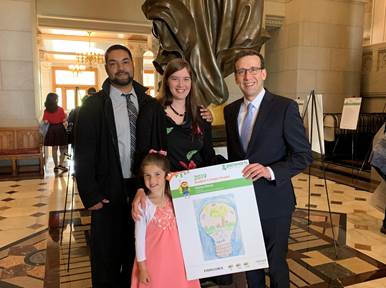
HARTFORD, CT – Today, state Senator Matt Lesser (D-Middletown) recognized Newington students who won the 14th annual eesmarts Student Contest. Sen. Lesser commended the students for their hard work.

“It’s wonderful to recognize these Newington kids on their work and artwork centered on protecting the environment,” said Sen. Lesser.
The eesmarts Student Contest is open to Connecticut students in grades K-12 and encourages them to demonstrate their knowledge of energy efficiency, renewable energy and sustainability by completing grade-specific assignments.

Students use poems, essays, news articles, book reviews, posters, images, speeches, public service announcements, community based projects and plays to showcase their knowledge of energy. The contest was broken into four different categories, which included kindergarten through second grade, third grade through eighth grade, ninth grade through eleventh grade and twelfth grade. At each grade level the prize was a gift card from Amazon, ranging from $50 for third place finishers, $100 for second place, and $200 for first place.

The winners from Newington are as followed:

  • Karina Marsh — First place in the Kindergarten category, Elizabeth Green School
  • Rishan Annadurai — Third place in the ninth to eleventh grade category, CREC Academy of Aerospace & Engineering

Lesser Legislation to Strengthen Middletown Area Transit Passes State Senate

Lesser Legislation to Strengthen Middletown Area Transit Passes State Senate

HARTFORD, CT – Today, the Senate approved legislation strengthening the abilities of Middletown Area Transit by expanding its Board of Directors. This legislation is intended to strengthen the board’s abilities by adding representation from Middletown, additionally providing the ability of the board to remove members. State Senators Matt Lesser (D-Middletown) and Mary Daugherty Abrams (D-Meriden, Middlefield, Rockfall, Middletown, Cheshire) sponsored the bill.

Senate Bill No. 521, “An Act Concerning Middletown Area Transit, (MAT)” would amend the Middletown Area Transit charter to allow the removal of directors prior to their terms expiring. In the past, the board has experienced governance lapses.

“Middletown Area Transit plays a vital role in keeping our community’s transportation systems moving, and I’m thrilled to see this legislation move forward,” said Sen. Lesser. “By proactively improving the MAT’s charter, we take an important step toward protecting its long-term success.”

“I am happy to see this legislation that will benefit not only Middletown Area Transit, but the entire region’s transit abilities, advance,” said Sen. Abrams. “By changing the MAT’s charter to account for issues that previously threatened its solvency, we protect transportation in our region while strengthening the board’s ability to govern.”

Sen. Lesser previously testified that this bill would rectify previous situations where the board’s small size, combined with its inability to remove members, nearly caused the MAT to become paralyzed and insolvent, adding that the current state discourages regional collaboration, which is essential for the board to ensure the district’s transit abilities remain viable.

This bill was previously approved by the Planning and Development Committee in a unanimous vote.

Sen. Bergstein: Update on the Biennial State Budget

Sen. Bergstein: Update on the Biennial State Budget

HARTFORD – State Senator Alex Bergstein (D-Greenwich) issued the following update today on the biennial state budget process and her thoughts on various aspects of it:

“The legislative session of 2019 will end on June 5, and our task is to pass a biennial state budget before then. We need a budget that restores fiscal discipline to our state government and which restores confidence in our state’s future.

In late February, Governor Lamont submitted his proposed budget. Late last week, the Appropriations Committee proposed its budget, and the Finance, Revenue & Bonding Committee submitted its package of revenue proposals as well.

In years past, Republicans have submitted their own proposed spending and revenue plans, but this year they did not. Why not? The deadline has now passed, and I’m disappointed they didn’t offer their own program of state budget solutions to be discussed and debated.
The time for making philosophical statements and floating new ideas has passed. Over the next four weeks, the executive and legislative branches of state government will work to reconcile the differences in their respective plans and hammer out a definitive two-year state budget. This budget MUST balance; it’s required by our state constitution.

I’ll be working with my fellow legislators and with the governor’s office to help craft a budget that meets the needs of Connecticut’s citizens, restores fiscal responsibility, and sets us on a path of economic growth. Here are some of the budget items now on the table that I support or oppose:

  • Estate and Gift Tax – The Finance Committee revenue plan eliminates the gift tax (which is great), and it also contains a strategy to eliminate the estate tax on an individual basis. I’ve been working hard to eliminate Connecticut’s estate tax and we’ve now made some significant advances. Senate Bill 1136 would potentially eliminate a person’s estate tax by providing a tax credit equal to 200% of a decedent’s investments in Connecticut social impact bonds or in a Connecticut Innovations-established venture capital fund. I know this isn’t a clean elimination, but it is a positive and creative compromise. What it says in a nutshell is that if you invest in Connecticut, you won’t pay an estate tax. We all need to “invest” in the success of Connecticut by caring about people and communities across the state.
  • Property Tax – Despite what you may have heard about higher property taxes, this did not occur. There is no “mansion tax” or “statewide property tax’ in the Democratic Finance Committee budget. The fear-mongerers have once again been proven wrong.
  • Capital Gains Tax – There is, however, a proposed 2% capital gains tax on joint filers with incomes above $1 million. This is estimated to raise $262 million in new revenue. I oppose this tax and will work to find ways to fill that hole in the budget.
  • Business Services Taxes – Again, the Democratic Finance Committee also rejected most of the governor’s proposed new business-to-business taxes, such as taxing accounting, legal, and real estate services. For that I am thankful.
  • Plastic Bag Fees – I believe we can all use less plastic and do our part to minimize pollution. Reminding ourselves to bring reusable bags when shopping is a fairly simple behavior change. As a society we use far too much plastic, and much of it is unnecessary. That’s why I support a ban on single-use plastic bags and I support a fee on the use of paper bags (but not a fee on both, as proposed by the Finance Committee.) I applaud stores like BJs and Costco that are already doing the right thing, even without legislation, and avoiding plastic bags. We can change our behavior and use less plastic!
  • Cannabis Revenue – I remain opposed to the legalization of a substance which science tells us harms the brains and development of young people. There is no amount of new revenue that can substitute for the health and wel-lbeing of our children.

Many of you ask me how the legislature is reducing state spending. That’s a priority for me as well, and here is one concrete example of how we’re making Connecticut government smarter and more efficient: The Democratic Appropriations Committee proposed significant reductions in spending. They’ve cut 500 state jobs in the Department of Social Services, or 17% overall. But don’t worry – this reduction in jobs will not impact the quality of services being delivered. Services have been outsourced to local non-profits who provide those services at lower cost and with the same or higher quality. This is a win-win!

“What else can we do? Lots. We all have to work together – citizens and legislators – to create a bright future for our state. That starts with a positive attitude! Spreading fear or false information is unhelpful and, in fact, destructive. If we want Connecticut to succeed, we need to be positive, productive and non-partisan. We all play a critical role in our democratic government. Thank you for believing we can do this together and working to make positive change.”