|
|
|
Author: Devin James
From Spielberg to Hitchcock: Discover the Films Shot in Connecticut

From Spielberg to Hitchcock: Discover the Films Shot in Connecticut
By Joe O’Leary
December 6 @ 9:00 am

Credit: SergeKa / Canva
In November, Connecticut’s Office of Tourism announced the Connecticut Christmas Movie Trail, which recognized 22 different holiday movies shot across the state. It celebrates the beauty of Connecticut’s varied towns and cities, many of which have played host to film productions featuring beloved stars.
Movie buffs, however, know that the Christmas Movie Trail is just the tip of the iceberg when it comes to Connecticut’s movie history. From classics dating back decades to modern hits and independent features, there’s another Connecticut Movie Trail that film buffs can traverse year-round.
The Office of Tourism website features a second collection of famous films shot here in Connecticut, with none other than Harrison Ford’s action hero Indiana Jones himself front-and-center. Indy’s fourth film, “Kingdom of the Crystal Skull” from 2008, shot a number of scenes at Yale University – who can forget Ford and Shia LeBoeuf riding a bike through the quad? – and the Essex Steam Train.
Speaking of A-listers, Julia Roberts’ “Mystic Pizza” was primarily filmed here in 1988. Production mostly took place where the title implies, in… Stonington, actually.
Before he sent stars racing through New Haven, Steven Spielberg filmed “Amistad” in Groton and Mystic, as well as a scene from “War of the Worlds” along the Farmington River. “A Mighty Wind,” another beloved film, shot scenes at Mohegan Sun.
Fairfield County’s rich landscapes are often a target for movies of all kinds. “Revolutionary Road,” with Leonardo DiCaprio and Kate Winslet, filmed all throughout Fairfield County, hitting a dozen towns from Beacon Falls to Southport. Although it’s a fictional town, Stepford, Connecticut is famously in Fairfield County, too – it filmed in Norwalk for both the 1975 and 2004 versions of “The Stepford Wives.”
The list goes much farther than just 11 films, though – Wikipedia lists more than 100 films shot in the state, with offerings ranging across every genre. Horror buffs may want to seek out some of the locations where Wes Craven’s second-to-last film “My Soul To Take” was shot in Stamford, where “Friday the 13th: Part 2” filmed in Kent and New Preston, or visit where indie horror icon Ti West worked on “The House of the Devil” in Lakeville.
Drama and history fans may want to look into the Hartford locations that became Chicago in 2022’s “Call Jane,” while comedy fans might want to head to New Milford to retrace Adam Sandler’s steps in “Mr. Deeds,” which became the fictional town of Mandrake Falls, New Hampshire.
Perhaps most interesting for film buffs may be retracing the steps of early film icons. There’s Alfred Hitchcock’s work on “Strangers on a Train” that included a trip to the Danbury Train Station; Bette Davis in “All About Eve,” performing in “Footsteps on the Ceiling” at the Shubert Theater; and 1947 Best Picture-winner “Gentleman’s Agreement” with Gregory Peck, which filmed in Darien.
The only thing bigger than the list of films shot in Connecticut is the list of films set in Connecticut; unfortunately, favorites like “Beetlejuice,” “The Conjuring” and “Glass Onion: A Knives Out Story” are only from the Nutmeg State in spirit.
SENATOR ANWAR ISSUED UPDATED STATEMENT AFTER ANTHEM ANNOUNCES ANESTHESIA CAPS WILL NOT APPLY IN CONNECTICUT
|
|
SENATOR OSTEN, REP. WILSON WELCOME STATE GRANT FOR MASON HOUSE, CHARTER SCHOOL EXPANSION IN NORWICH

FOR IMMEDIATE RELEASE
Wednesday, December 4, 2024
SENATOR OSTEN, REP. WILSON WELCOME STATE GRANT FOR MASON HOUSE, CHARTER SCHOOL EXPANSION IN NORWICH
NORWICH – State Senator Cathy Osten (D-Sprague) and state Representative Derell Wilson (D-Norwich) today welcomed a state Department of Economic and Community Development Brownfield Remediation and Development Program grant to remediate and stabilize the historic Mason House located at 68 Thermos Avenue.
The $1,857,370 state grant will allow the Integrated Day Charter School to use the remediated space to expand, allowing them to provide community mental health services and host community events.
“Connecticut’s brownfield remediation program continues to be an unqualified success, getting eyesores out of public sight and bringing blighted properties back into usefulness and onto the local tax rolls,” Sen. Osten said. “I’m especially pleased to see the property being put to good use by the Integrated Day Charter School.”
“I would like to thank Connecticut’s Brownfield Remediation and Development Program. This is a game-changer for IDCS and the Laurel Hill community of Norwich,” Rep. Wilson said. “This is an asset that will be historically preserved to tell a story, while addressing needs, school needs, and, more importantly, foster partnerships within the community.”
The Integrated Day Charter School was founded in Norwich in February 1997 and soon began searching for a location. After researching many options, the founding board decided to renovate the former Thermos Factory, taking advantage of large open spaces and bright classrooms. Renovation of portions of the building have been ongoing since its doors opened and throughout the school’s existence.
The Norwich grant is part of $20 million in state grants announced today by Governor Ned Lamont to support the remediation and redevelopment of 21 blighted properties consisting of 150 acres of contaminated land in 18 municipalities across Connecticut. These state investments are expected to leverage approximately $530 million in private investments and facilitate the creation of 1,392 units of new housing, as well as the growth of new businesses.
Sen. Hartley Welcomes Over $2M in State Funding for Waterbury and Naugatuck
|
|
|
SENATOR ANWAR ISSUES ‘OUTRAGED’ STATEMENT ON ANTHEM REPORTEDLY CAPPING ANESTHESIA COSTS

FOR IMMEDIATE RELEASE
Contact: Joe O’Leary | Joe.OLeary@cga.ct.gov | 508-479-4969
December 5, 2024
SENATOR ANWAR ISSUES ‘OUTRAGED’ STATEMENT ON ANTHEM REPORTEDLY CAPPING ANESTHESIA COSTS
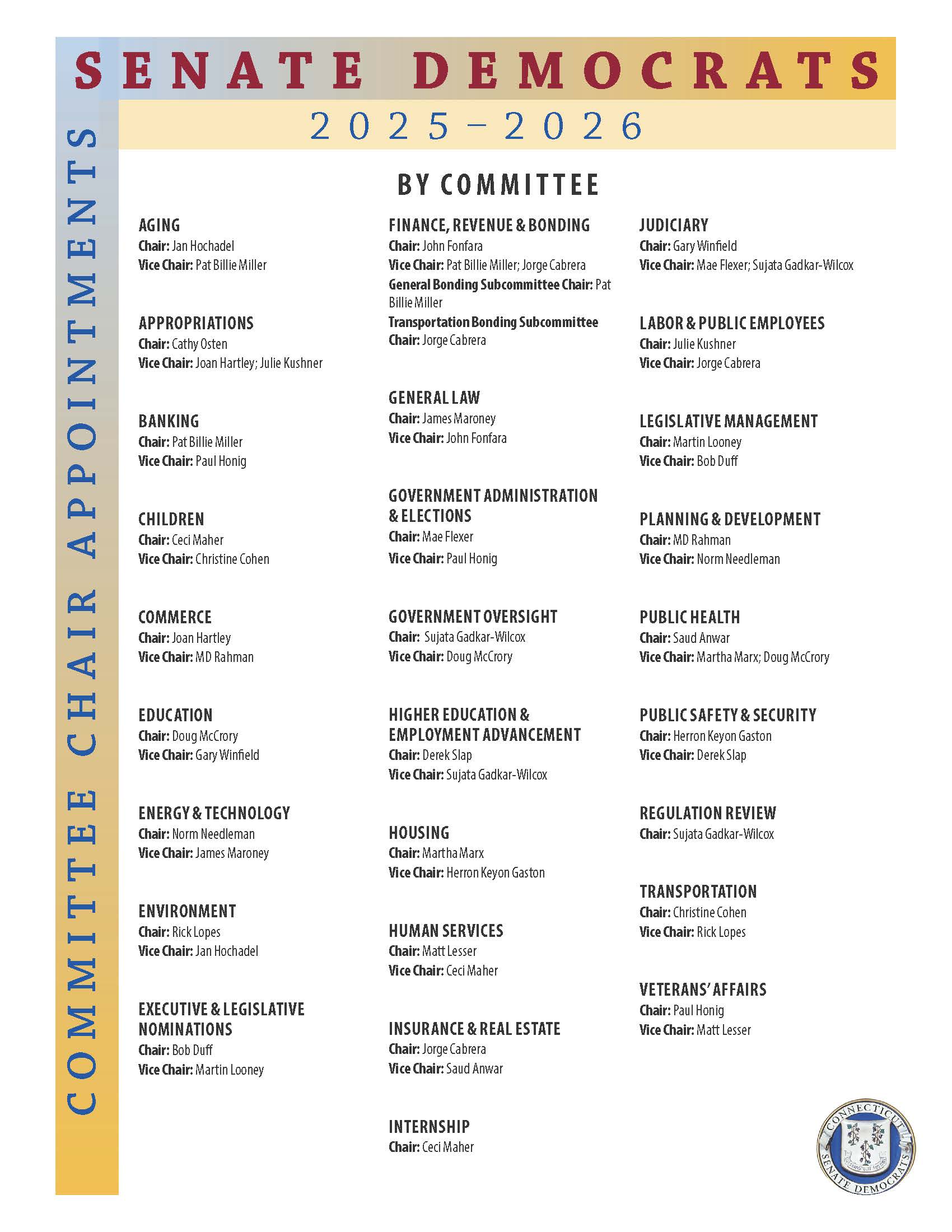
Today, State Senator Saud Anwar (D-South Windsor), Senate Chair of the Public Health Committee, issued a statement in response to reports that Anthem health insurance plans will no longer cover anesthesia for patients receiving surgeries or procedures beyond certain time limits:
“I am outraged that the companies we trust to support our health care systems, time and time again, instead seek to squeeze as much profit out of them as possible. A policy like this is directly dangerous to patients’ well-being, regarding the quality of the procedures they receive and the financial strain they could face after the fact. Anthem should reverse this cruel, ineffective, heavy-handedly abusive policy before it impacts patient care, throws people into medical debt or places timers hovering over the heads of surgeons in operating rooms. In the meantime, I will consult my colleagues on policy solutions to prevent greed like this from impacting public health in Connecticut.”
Workers Compensation Rates Continue to Decline, Saving Connecticut Businesses Money
Workers Compensation Rates Continue to Decline, Saving Connecticut Businesses Money
By Garnet McLaughlin
December 5 @ 10:45 am

Credit: AndreyPopov / Canva
Connecticut businesses will see another decrease in their workers compensation rates for 2025. This reduction, announced by Gov. Ned Lamont’s administration in November, follows an 11-year trend of declining rates.
The state Insurance Department approved a worker’s compensation rate filing for next year that includes a decrease of 6.1% to the voluntary market loss costs and a reduction of 6.2% in assigned risk plan rates. Connecticut has seen a continued decrease in claims surrounding workplace injuries, which lends to steadily decreasing rates, the agency said.
Sen. Jorge Cabrera, a Hamden Democrat who co-chairs the legislature’s Insurance and Real Estate Committee, lauded the reduction in workers compensation rate as great news for Connecticut’s business community.
“Employers can continue to ensure their workplaces are safe and their employees are healthy at reasonable rates that protect their bottom line,” Cabrera said. “With the 2025 Legislative Session ahead, I am eager to continue to build upon our work to support business here in Connecticut.”
The new rates will result in cost savings for Connecticut employers, continuing to make Connecticut a more business-friendly environment across all sectors, industries, and business sizes.
In a press release, state Insurance Commissioner Andrew N. Mais said the ongoing decline of workers compensation rates coupled with a drop in workplace injuries had saved Connecticut employers more than $400 million in reduced premiums.
“Workers’ compensation insurance is critical so workers can know they are protected as they work to support their families, and for business owners to help care for the health, well-being, and safety of their employees,” Mais said.
This news comes on top of a November announcement that Connecticut employers will not see an unemployment tax increase in 2025, thanks to the state’s decision to repay all 2024 borrowing under the Unemployment Trust Fund. Stabilizing the fund has saved employers millions of dollars in taxes and special assessments in the last few years.
Sen. Hartley Celebrates National Day of Romania in Connecticut State Capitol
|

|
Student Loan Reimbursement to Begin Next Month
Student Loan Reimbursement to Begin Next Month
By Michelle Rappaport
December 4 @ 9:00 am

Residents who graduated from a Connecticut college or university may be eligible for tuition loan reimbursement under a $6 million program aimed at providing financial relief to those burdened with student loan debt.
Beginning Jan. 1, the Office of Higher Education will begin accepting applications for the Student Loan Reimbursement Program, a new initiative providing up to $20,000 over four years in loan reimbursement.
According to the Connecticut Mirror, Dwayne Smith, interim president of Southern Connecticut State University, said borrowers collectively owed $1.6 trillion as of September 2023.
“As a proud first-generation college graduate, I deeply understand the resilience it takes to pursue higher education while managing significant financial challenges,” Smith said, according to the Mirror. “These scholars carry not only their own dreams, but also the hopes of their families and their communities.”
To be eligible for the program, applicants must be current Connecticut residents with outstanding loan balances, who have lived in the state for at least five years. Applicants must have paid toward a federal direct loan, a federal direct PLUS loan, federal Perkins loan, CHESLA loan or other state-sponsored student loan during 2024.
A person applying must have a Connecticut adjusted gross income in 2023 of not more than $125,000 for single applicants, or $175,000 for married applicants.
In order to qualify for the program, applicants must have completed at least 50 hours of volunteer work for a nonprofit organization this year and be able to provide notarized documentation of their volunteer efforts.
More information on how to apply for the program can be found on the Office of Higher Education’s website.
STATE SENATOR MARTHA MARX TO HOLD DECEMBER LISTENING TOUR
December 3, 2024
STATE SENATOR MARTHA MARX TO HOLD DECEMBER LISTENING TOUR
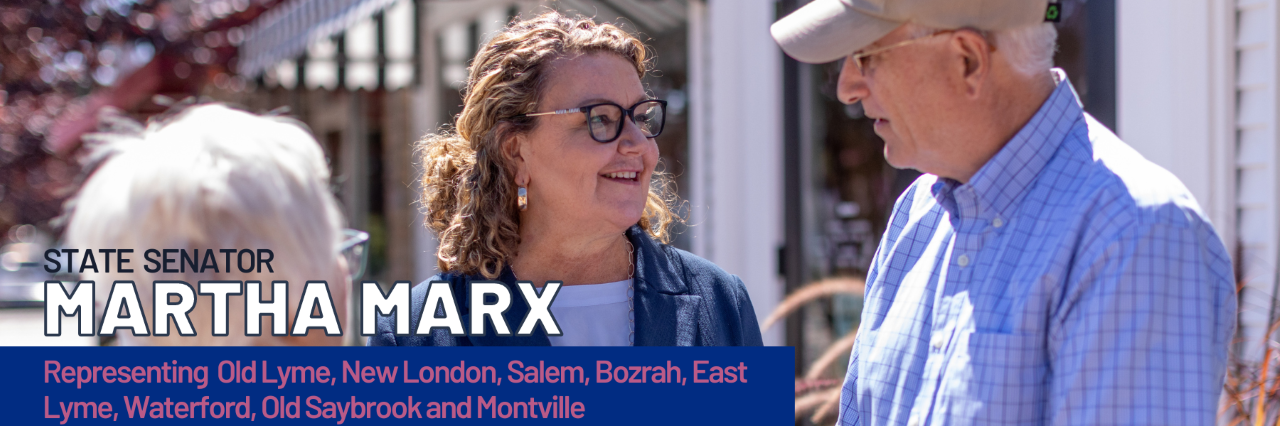
As she gears up for her second term, State Senator Martha Marx (D-New London) announced today she will hold a listening tour in early-mid December, hosting events in Montville, New London, Waterford, East Lyme and Old Lyme, as well as two listening sessions by telephone, where constituents can voice their opinions and concerns on a variety of issues impacting them. These events are open to the public and all questions, comments and concerns are welcome, as well as suggestions for the upcoming 2025 legislative session that convenes in January.
“For the last three months, my constituents have been listening to me on the campaign trail through mailers, text messages and phone calls. Now it’s my turn to listen to them,” said Sen. Marx. “These listening sessions are a perfect way to hear directly from the public and use what I learn from them to better inform my votes once the legislative session starts.”
Sen. Marx’s December listening tour schedule is as follows:
- Monday, December 9, noon – Montville Public Safety Meeting Room, 911 Norwich-New London Turnpike, Uncasville
- Monday, December 9, 4:30 p.m. – New London Library, 63 Huntington Street, New London
- Tuesday, December 10, noon – Waterford Library, 49 Rope Ferry Road, Waterford
- Tuesday, December 10, 6 p.m. – East Lyme Senior Center, 37 Society Road, Niantic
- Thursday, December 12, 6 p.m. – Old Lyme Town Hall, 52 Lyme Street, Old Lyme
Telephone Listening Events will also occur on Monday, December 16 at 10 a.m. and 7 p.m. Members of the community will receive district-wide phone calls inviting them to participate. Those who cannot attend in-person events are encouraged to join the listening sessions so they can ask Sen. Marx questions directly.