
|
|||||
|
Author: Devin James

SENS. KUSHNER AND MAHER, REP. BERGER-GIRVALO ANNOUNCE MAJOR CLEAN AIR INVESTMENT IN RIDGEFIELD PUBLIC SCHOOLS

FOR IMMEDIATE RELEASE
Monday, May 20, 2024
SENS. KUSHNER AND MAHER, REP. BERGER-GIRVALO ANNOUNCE MAJOR CLEAN AIR INVESTMENT IN RIDGEFIELD PUBLIC SCHOOLS
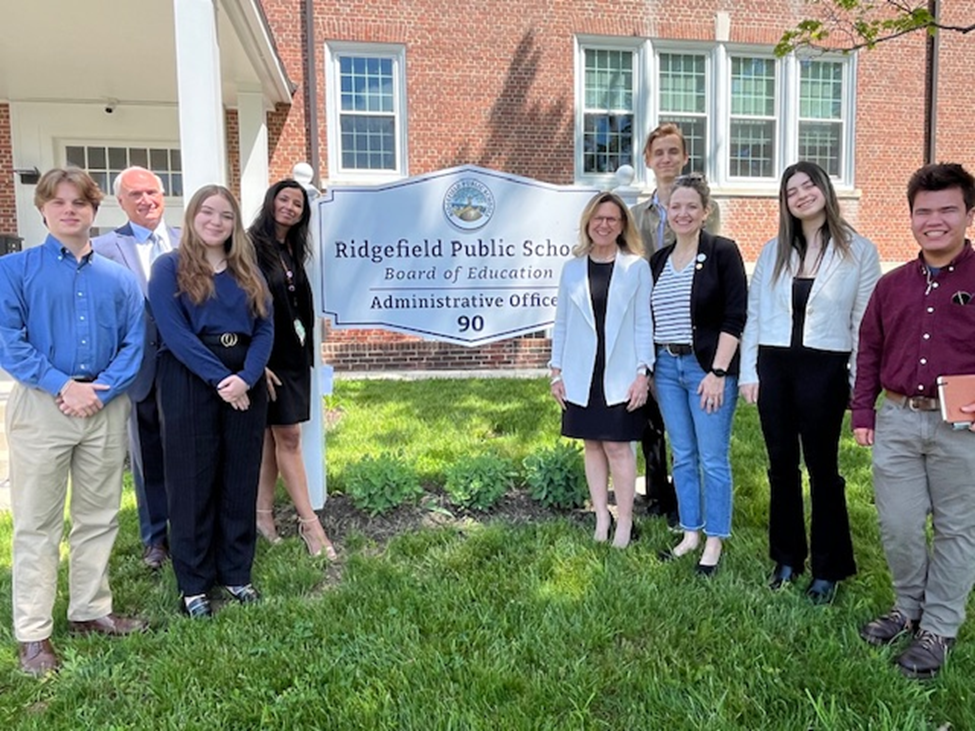
Sen. Kushner, Rep. Girvalo, First Selectperson Marconi, Supt. Da Silva and students outside of the Ridgefield Public School offices
RIDGEFIELD – State Senators Julie Kushner (D-Danbury) and Ceci Maher (D-Wilton) and state Representative Aimee Berger-Girvalo (D-Ridgefield) today joined Ridgefield Superintendent of Schools Dr. Susie Da Silva and Ridgefield First Selectperson Rudy Marconi to announce that the state Department of Administrative Services (DAS) has unveiled its 2024 list of Indoor Air Quality grants for public schools in Connecticut, and that eight Ridgefield schools will receive a total of $191,454 to help pay for a variety of projects, including the installation of
ventilators, mini-split air conditioners, roof exhaust fans, upgraded heating and cooling, air exchange and heat recovery, heat pumps, and other air quality-related work.
The state grants cover 23.57% of the projects’ total cost; the projects total $812,278, and after the grant reimbursement of $191,454, Ridgefield will pay $620,824.
“Back in 2022 I founded the School Indoor Air Quality Working Group and was appointed co-chair. Since then, we’ve worked very hard to meet, listen to the experts, and make
recommendations about improving school air quality, which can really affect the ways that students learn and teachers teach,” Sen. Kushner said. “I’m very thankful that the General Assembly and Governor Lamont have partnered to fund this program and that schools all across Connecticut, including right here in Ridgefield, are taking advantage of the opportunity
to address classroom temperatures that are too hot or too cold, mold, pest infestations, hazardous odors, or even the spread of infectious diseases. It’s going to be a game-changer for our students and teachers.”
“During COVID we came to understand the importance of ensuring circulating clean air in our classrooms. The continued investment in improving school air quality statewide will also benefit Ridgefield’s school community and support educational growth across eight local schools, improving the air for everyone from first graders to high schoolers,” said Sen. Maher. “It’s wonderful for our state to have such strong support and I’m grateful to Governor Lamont for his foresight and dedication to our schools.”
“Ridgefield is consistently rated among the top school districts in the country, but academics are only part of that story,” said Rep. Berger-Girvalo. “The health and safety of our children are as important as their intellectual development, and the quality of the air they breathe is a critical factor. Unsurprisingly, Superintendent DaSilva and our Board of Education have advocated strongly for a healthy environment for our children, and I’m grateful for the work done by the Education Committee, the Indoor Air-Quality Working Group, and the governor for their commitment to this endeavor.”
“This grant will undoubtedly have an impact, not only in terms of immediate improvements to our existing HVAC systems, but also in fostering greater sustainability, energy efficiency, and comfort within the designated facilities,” Superintendent Da Silva said. “When these grant opportunities were announced, the Ridgefield Public Schools facilities team identified work that was already in the queue and which fit the description of the grant; in other words, we did not elect to make these HVAC improvements because of a possible grant award — these improvements had to occur to keep our systems running, and we sought grant support as a subsidy to minimize the end cost to the town.”
“As First Selectperson of Ridgefield, I can say that we are always appreciative of any funds from the State of Connecticut to help defray infrastructure costs to the taxpayers of Ridgefield,” said First Selectperson Marconi. “The quality of air that our children and teachers breathe daily is as important as the quality of education our children receive. Thank you to Senator Kushner, Senator Maher and Representative Berger-Girvalo for their efforts in securing these funds for Ridgefield.”
The DAS grants will help pay for the following upgrades:
Ridgefield High School
Replace 2 heat pump and cooling units
Replace 4 air exchange energy heat recovery assemblies
Replace a 5-Ton split cooling system
Alternative High School
Update and replace main HVAC system (Heat Pump)
Update and replace dual zone heat pump system
East Ridge Middle School
Replace Trane rooftop unit (RTU)
Install new ductless mini-split unit
Barlow Mountain Elementary School
Install vertical unit ventilator for classroom
Replace self-contained unit ventilator
Replace upper and lower roof exhaust fan units
Branchville Elementary School
Replace 11 roof-mounted exhaust fans
Installed ductless mini-split AC unit for ventilation
Farmingville Elementary School
Install Split AC/Heat Pump 2-ton unit
Replace 11 roof-mounted exhaust fans
Installed ductless mini-split AC unit for ventilation
Ridgebury Elementary School
Replace the failed Rooftop Unit (RTU)
Replace 2 Trane RTUs
Replace heat only unit with heat pump option for heating and cooling
Add heat pump condenser for cooling to main gym air handler unit (AHU)
Scotland Elementary School
Install 2 Split AC/Heat Pump 2-ton units
Replace 2 exhaust hoods
Replace 16 roof-mounted exhaust fans
Installed ductless mini-split AC unit for ventilation
###
Senator Hochadel Applauds $12 Million in State Funding for Air Quality Improvements for Schools in Cheshire, Meriden, Middletown and Middlefield

|
|||
|

Senator Miller Celebrates More than $6.7 Million in State Grants for Stamford School HVAC Upgrades

|
||||||||||||||||||
|


Senator Gaston Celebrates Nearly $1 Million in State Grants for Stratford School HVAC Upgrades

|
|||||
|

SEN. OSTEN ANNOUNCES MAJOR STATE INVESTMENT IN CLEAN AIR FOR MONTVILLE, COLUMBIA & LEDYARD SCHOOLS

FOR IMMEDIATE RELEASE
Monday, May 20, 2024
SEN. OSTEN ANNOUNCES MAJOR STATE INVESTMENT IN CLEAN AIR FOR MONTVILLE, COLUMBIA & LEDYARD SCHOOLS
EASTERN CONNECTICUT – State Senator Cathy Osten (D-Sprague) announced today that the state Department of Administrative Services (DAS) has unveiled its 2024 list of Indoor Air Quality grants for public schools in Connecticut, and that Montville, Columbia and Ledyard will receive a combined total of $20 million to help pay for a variety of school projects, including the replacement of HVAC systems, the installation of air conditioning and ventilation units, upgraded electrical service, new boilers and heat pumps, new rooftop units, and the installation of mini-split air conditioners.
The state grants cover between 52.14% and 72.5% of the projects’ total cost; the Montville, Columbia and Ledyard projects total approx. $29,727,059, and the state grants will pay approx. $20,076,070 of that cost.
“I’m happy to see that eastern Connecticut towns are taking advantage of a state program designed to make schools healthier and more productive for students and staff. These are budgeted funds that serve a need, and obviously there’s a need in Montville, Columbia and Ledyard,” Sen. Osten said. “These are the kinds of state investments I’d like to see more of in eastern Connecticut.”
The grants are being awarded through the HVAC Indoor Air Quality Grants Program for Public Schools, a state program that is administered by DAS. It was created as part of the budget adjustment bill signed into law in 2022 (Public Act 22-118). In fiscal year 2023, DAS committed $56 million to projects across the state to address indoor air quality in school buildings.
MONTVILLE
· Dr. Charles E. Murphy Elementary School, $1,784,156, Replacement roof top units and upgrade electrical service
· Leonard J. Tyl Middle School, $4,334,089, Replacement of rooftop units and boilers. Installation of new pumps and hot water system
· Mohegan Elementary School, $1,813,177, Replacement roof top units and upgrade electrical service
· Montville High School, $4,731,687, Replacement of rooftop units
· Oakdale Elementary School, $2,144,723, Replacement roof top units and upgrade electrical service
· Palmer Building (Palmer Memorial/Palmer Academy), $724,451, Installation of mini splits, and rooftop condensing units, and upgrade electrical service
COLUMBIA
· Horace W. Porter School, $3,169,181, Replacement of HVAC system
LEDYARD
· Juliet Long School, $1,374,605, Installation of air conditioning and ventilation
###
Senator Herron Keyon Gaston Statement on Success Village
|
|||||
|
SENATOR NEEDLEMAN ISSUES STATEMENT IN RESPONSE TO EVERSOURCE SUPPLY RATE FILING

|
||||||||||||||||||||
|

SENATOR MARONEY RELEASES STATEMENT AFTER NEW YORK TIMES REPORT ON ARTIFICIAL INTELLIGENCE TECHNOLOGY ‘STEALING’ ACTORS’ VOICES

|
||||||||||||||||||||
|

Sen. Cohen Releases Statement on Hartford CTfastrak Ranked No. 1 in Nation
|
||||||||||||||||||
|
