CT Senate Leaders Slam Trump’s Cuts to Student Mental Health

CT Senate Leaders Slam Trump’s Cuts to Student Mental Health

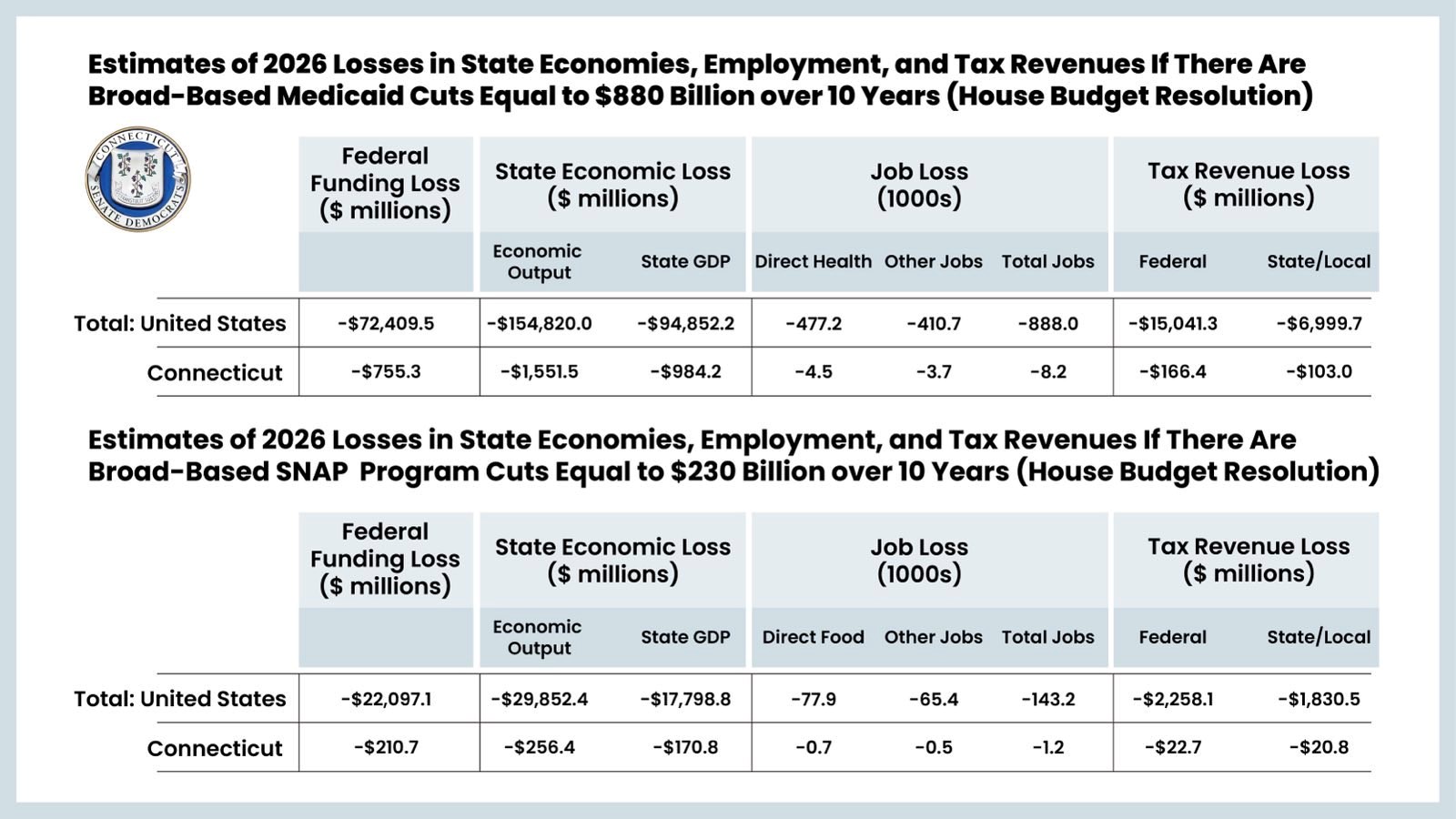
HARTFORD – Today, Senate President Pro Tempore Martin Looney (D-New Haven), Senate Majority Leader Bob Duff (D-Norwalk), Senator Saud Anwar (D-South Windsor), co-chair of the Public Health Committee, and Senator Ceci Maher (D-Wilton), co-chair of the Committee on Children, issued the following statements condemning Trump’s unlawful decision to cancel $1 billion in student mental health grants which was passed by Congress on a bipartisan basis after the tragic school shooting in Uvalde.

“Connecticut has led the nation in addressing gun violence and building a stronger, more compassionate mental health infrastructure for our youth,” said Senate President Martin Looney. “These unconscionable cuts from the Trump administration are a direct attack on our children’s safety and wellbeing. We urge Connecticut Republicans to stand up for children across our state instead of paying fealty to Donald Trump. This is a moment for courage, not politics.”

“This decision doesn’t just pull the rug out from under school counselors and mental health professionals, it will make our schools less safe,” said Senate Majority Leader Bob Duff. “The Trump administration is turning its back on the very children Congress vowed to protect after Uvalde.”

“Mental health support is proven to work best when it is culturally competent and reflects the community it serves,” said Senator Saud Anwar. “What this administration is doing is simply dangerous and illegal.”

“These programs help children navigate trauma, support parents, and save lives,” said Senator Ceci Maher. “To cancel them is not only reckless, it is morally bankrupt.”

Senate Passes Legislation to Expand Coverage for Sickle Cell Disease

Senate Passes Legislation to Expand Coverage for Sickle Cell Disease

Today, State Senator Saud Anwar (D-South Windsor) voted with the Senate to pass legislation that would require Medicaid coverage of FDA-approved gene therapies to treat sickle cell disease.

This legislation requires the Commissioner of the Department of Social Services to give Medicaid coverage for federal Food and Drug Administration approved gene therapies to treat sickle cell disease. It also requires the commissioner to apply for any federal initiative, including the Centers for Medicare and Medicaid Services’ cell and gene therapy access model, to increase cost-effective access to these therapies.

“The impacts of rare conditions like sickle cell disease can be crippling for individuals even before considering their financial cost,” said Sen. Anwar, “and the dollar total for life-changing and life-saving treatments can skyrocket. Patients should be able to access vital treatments and this bill makes them more attainable. This legislation has the potential to save lives and voting in support is an honor.”

Sickle cell disease is a group of inherited disorders that affect hemoglobin, the major protein that carries oxygen in red blood cells. It affects blood flow and causes anemia, chronic wounds that will not heal, frequent infections, episodes of extreme pain among other complications.

In recent years, technology has allowed for curative treatments, including cell and gene therapy, but cost remains a barrier for many. In December 2023, the FDA approved two gene therapies for the treatment of sickle cell disease, Casgevy which costs over $2 million per treatment, and Lyfgenia which costs over $3 million per treatment.

Sickle cell disease is a life-long disorder that causes a series of complications, and the Biden administration’s Centers for Medicare & Medicaid Services determined that complications from sickle cell disease cost the health system almost $3 billion annually. Sickle cell disease disproportionately impacts Black and Hispanic Americans. In the United States, more than 100,000 people live with sickle cell disease, and between 50-60% of those affected are enrolled in Medicaid.

FOR IMMEDIATE RELEASE
Contact: Joe O’Leary | Joe.OLeary@cga.ct.gov | 508-479-4969

Sen. Lesser Leads Passage of Legislation to Expand Coverage for Sickle Cell Disease

Sen. Lesser Leads Passage of Legislation to Expand Coverage for Sickle Cell Disease

Today, State Senator Matt Lesser, Senate Chair of the Human Services Committee, passed legislation that would require Medicaid coverage of FDA-approved gene therapies to treat sickle cell disease.

This legislation requires the Commissioner of the Department of Social Services to give Medicaid coverage for federal Food and Drug Administration approved gene therapies to treat sickle cell disease. It also requires the commissioner to apply for any federal initiative, including the Centers for Medicare and Medicaid Services’ cell and gene therapy access model, to increase cost-effective access to these therapies.

“Sickle cell disease is a debilitating disease that affects hundreds in our state, and for a very long time treatment options were limited,” said Sen. Lesser. “Today, cures are available and they provide real relief for patients. Unfortunately, the cost is unattainable for many and our most vulnerable are left without treatment options. This legislation is one step closer to providing comprehensive, quality healthcare to everyone, not just those who can afford the astronomical cost. This is an important step forward for health equity. I am grateful for the unanimous support of my Senate colleagues.”

Sickle cell disease is a group of inherited disorders that affect hemoglobin, the major protein that carries oxygen in red blood cells. It affects blood flow and causes anemia, chronic wounds that will not heal, frequent infections, episodes of extreme pain among other complications.

In recent years, technology has allowed for curative treatments, including cell and gene therapy, but cost remains a barrier for many. In December 2023, the FDA approved two gene therapies for the treatment of sickle cell disease, Casgevy which costs over $2 million per treatment, and Lyfgenia which costs over $3 million per treatment.

Sickle cell disease is a life-long disorder that causes a series of complications, and the Biden administration’s Centers for Medicare & Medicaid Services determined that complications from sickle cell disease cost the health system almost $3 billion annually. Sickle cell disease disproportionately impacts Black and Hispanic Americans. In the United States, more than 100,000 people live with sickle cell disease, and between 50-60% of those affected are enrolled in Medicaid.

Hartley Leads Passage of Bill Intended to Modernize Environmental Cleanup

Hartley Leads Passage of Bill Intended to Modernize Environmental Cleanup

State Senator Joan Hartley (D-Waterbury), Chair of the Commerce Committee, led Senate passage of a bill aimed to facilitate the state’s transition from the Transfer Act to a release-based cleanup program for contaminated properties. The release-based program would require that contamination be addressed when it occurs, resulting in a timelier cleanup.

Senate Bill 1404, ‘An Act Concerning Conforming Adjustments To Support The Transition To A Released-Based Cleanup Program,’ will create a transition period to allow for the development and implementation of new regulations that would establish cleanup standards based on the level of contamination remaining at a site, rather than the previous Transfer Act’s requirement for full remediation before property transfer.

Presently, 141 Connecticut communities have properties under the Transfer Act, many of which have remained blighted and shuttered for decades due to the onerous and costly Transfer Act requirements. The transition to a release-based cleanup model aims to break this logjam and accelerate the revitalization of these long-stalled sites.

“Today marks a significant step forward for Connecticut’s environmental and economic future,” said Senator Hartley. “This bill will empower our state to transition to a more efficient, release-based cleanup program, fostering responsible redevelopment of contaminated properties. This legislation not only enhances environmental protection but also stimulates economic growth by removing barriers to property reuse.”

“I want to thank Senator Hartley for her tireless leadership in guiding this complex and critically important legislation through the Senate,” said Senate President Martin Looney (D-New Haven). “Her deep understanding of both environmental policy and economic development has been instrumental in crafting a thoughtful transition to a release-based cleanup model. This new system will balance environmental protection with the need to revitalize our communities and attract new investment.”

The legislation reflects nearly five years of work by a dedicated working group made up of a broad coalition of stakeholders—including environmental advocates, members of the regulated community and environmental advocates, the Connecticut Environmental Bar, realtors, bankers, and environmental professionals—who came together to develop a more practical and effective cleanup framework.

Under this bill, the goal is to streamline the cleanup process, reduce regulatory burdens, and encourage the redevelopment of contaminated properties while ensuring environmental protection.

Under this new model, cleanups will be required based on actual environmental releases rather than being triggered by property transactions. This shift is expected to eliminate unnecessary regulatory hurdles and unlock opportunities for brownfield redevelopment, particularly in struggling urban areas.

Senate Bill 1404 now heads to the House for consideration.

Sen. Lesser Leads Passage of Bill Expanding Access to ABLE Act

Sen. Lesser Leads Passage of Bill Expanding Access to ABLE Act

On Wednesday, State Senator Matt Lesser, Senate Chair of the Human Services Committee, led passage of legislation that will expand access to the Achieving a Better Life Experience (ABLE) Act, a program that allows people with disabilities to maintain their independence, pay for qualifying expenses and preserve their eligibility for income-dependent public benefits.

The ABLE Act was an Obama-era law that allows states to create tax-advantaged savings programs for eligible people with disabilities or a designated beneficiary. Funds in these accounts can help account owners pay for qualifying disability expenses, and distributions are tax-free if used for qualifying expenses. Importantly, funds in these accounts do not count toward an individual’s income when determining eligibility for public services like Medicaid.

The law passed today makes conforming changes in compliance with federal law, allows people to disregard certain public assistance programs from income standards and provides protections from financial exploitation and abuse.

“This bill is an important step forward for families of children with disabilities,” said Sen. Lesser. “I am glad to work with the State Treasurer to strengthen the ABLE program, a vital tool that allows families to undertake financial planning to cover life and health care expenses. In addition we have added important protections to safeguard people with disabilities from financial exploitation and abuse.”

The bill passed unanimously and now heads to the House floor.

FOR IMMEDIATE RELEASE
Contact: Garnet McLaughlin | Garnet.McLaughlin@cga.ct.gov

Sen. Cohen Votes for Legislation Allowing Schools to Install Safety Systems for Better Emergency Response

Sen. Cohen Votes for Legislation Allowing Schools to Install Safety Systems for Better Emergency Response

Inspired by high school students, bill seeks to save lives during school emergencies

In an effort to ensure Connecticut never relives the horrors of the Sandy Hook Elementary school shooting, on Wednesday the Senate passed legislation allowing for emergency response communications systems and personal emergency communication devices in Connecticut schools.

This legislation was inspired by two Staples High School students from Westport, Elijah Falkenstein and Zander Bauer, who proposed the idea to the Committee on Children, of which State Senator Christine Cohen serves as vice-chair.

The students reached out after learning a similar personal emergency communications system in a Georgia school allowed for faster response by local police during a shooting. Local law enforcement said activation of the system at Apalachee High School in Winder, Georgia in September of 2024 likely saved lives, EducationWeek reported at the time.

Senate Bill 1216, “An Act Concerning School Emergency Response Systems,” would allow for the state’s school security infrastructure competitive grant program, signed into law in 2013 after the Sandy Hook Elementary School shooting, to be used for schools to purchase emergency response communications systems and personal emergency communication devices for school personnel.

“I often say that the very best legislation comes from our constituents, and this bill is a fantastic example of that,” said Sen. Cohen. “In the aftermath of one of the most tragic school shootings in our country’s history, Connecticut vowed to do better. Since then, we have enacted strong gun safety legislation and have equipped our schools to respond if the worst case scenario  should occur. With this legislation, Connecticut schools will have the ability to install highly responsive technology and keep our students, teachers and staff safe. Thank you to these students and to my Chair, Senator Maher for her leadership on this important proposal.”

Emergency response communications systems and personal emergency communication devices would likely resemble ones used in other schools across the country. Most prominently, the system at Apalachee High School saw teachers carry devices that served as panic buttons; when activated, those buttons would inform law enforcement that an emergency was happening on campus, Reuters said.

A shooting at that school that killed four was likely to have led to more violence if not for the activation of the system, police said at the time. Upon activation, police were on site within two minutes and the shooter was taken into custody within six minutes of initial alerts.

According to the Atlanta Journal-Constitution, such systems can activate general alerts and emergency alerts; the former stays within the school for medical emergencies or other incidents not requiring outside assistance, while the latter, for more serious events, would trigger flashing lights and a lockdown on a school campus. Most uses of the systems, more than 98%, remain within schools.

While these systems can be expensive, a fiscal note for the bill noted that there is currently an unallocated bond balance of $20 million for school security programs, which would be able to fund a number of installations.

This bill received strong support in public testimony, with the Connecticut Education Association, Connecticut Association of Independent Schools and Connecticut Catholic Public Affairs Conference among the organizations endorsing it.

The bill previously passed the Committee on Children with a unanimous 17-0 vote; it now heads to the House for further consideration and potential passage. If passed by the House, the bill proceeds to Governor Lamont’s desk to be signed into law

For Immediate Release
Contact: Garnet McLaughlin – Garnet.McLaughlin@cga.ct.gov – 860-304-2319

SEN. KUSHNER LEADS SENATE PASSAGE OF BILL TO EXPAND FIREFIGHTER CANCER RELIEF PROGRAM

FOR IMMEDIATE RELEASE

Wednesday, April 30, 2025

SEN. KUSHNER LEADS SENATE PASSAGE OF BILL TO EXPAND FIREFIGHTER CANCER RELIEF PROGRAM

HARTFORD – State Senator Julie Kushner (D-Danbury) today led Senate passage of a bill that adds skin cancer to the list of cancers covered under the state’s Firefighters Cancer Relief Program, as well as defining such afflictions as an “occupational disease” instead of a personal injury and expanding the program to state firefighters working at UCONN and Bradley International Airport.

Senate Bill 1426, “AN ACT MAKING CHANGES TO THE FIREFIGHTERS CANCER RELIEF PROGRAM. SUMMARY,” passed the Senate today on a unanimous and bipartisan vote and now leads to the House of Representatives for consideration.

Significantly, the bill expands the types of cancers covered by the program to include skin cancer (melanomas), which are one of the Top 10 cancers that firefighters develop, according to the Firefighter Cancer Support Network.  Other types of cancer already covered by the state program include those affecting the brain or the skeletal, digestive, endocrine, respiratory, lymphatic, reproductive, urinary, or hematological systems.

“We depend on firefighters to protect our lives and property. We have to be there for them and their families when, as the result of fighting these fires, they contract cancer,” said Sen. Kushner, who helped shepherd this bill through the Labor and Public Employees Committee. “I’m so proud that we as a legislature are taking steps to ensure all firefighters in Connecticut, municipal and state, will have the resources they need f they contract cancer on the job.”

“On behalf of the nearly 4,000 career firefighters in our state, I want to thank the Senate leadership and the entire Senate for taking swift action in passing Senate Bill 1426, which makes important technical changes to our Firefighter Cancer Relief program,” said Peter Brown, President of the Uniformed Professional Fire Fighters Association. “These changes will streamline the claims process so our firefighters battling cancer will be able to access critical benefits without delay. I also need to share my sincere appreciation to our champion, Senator Julie Kushner, who led the charge to get this bill passed and who fights tirelessly to improve firefighter health and safety every session. We look forward to working with our partners to get this measure over the finish line in the House.”

The Firefighters Cancer Relief Account is managed by the state Department of Administrative Services, and it receives funds through the state budget and investment income. In the past three years, the account received an average of $617,908 per year through annual appropriations and investment income. In the same period, the account expended an average of $242,989 per

year. The account’s current balance is $8,124,758.

SENATOR ANWAR VOTES TO ALLOW SCHOOLS TO INSTALL SAFETY SYSTEMS FOR BETTER EMERGENCY RESPONSE

SENATOR ANWAR VOTES TO ALLOW SCHOOLS TO INSTALL SAFETY SYSTEMS FOR BETTER EMERGENCY RESPONSE

In an effort to ensure Connecticut never relives the horrors of the Sandy Hook Elementary school shooting, the Senate today passed legislation allowing for emergency response communications systems and personal emergency communication devices in Connecticut schools.

Senate Bill 1216, “An Act Concerning School Emergency Response Systems,” would allow for the state’s school security infrastructure competitive grant program, signed into law in 2013 after the Sandy Hook Elementary School shooting, to be used for schools to purchase emergency response communications systems and personal emergency communication devices for school personnel.

“Thirteen years have passed since the horrors of Sandy Hook, and we can always do more to protect and prevent further violence in our schools,” said Sen. Anwar. “This bill expands security resources available to school communities, including the installation of these systems that allow for immediate emergency response in time-sensitive situations. It’s another step to keep our schools safer and protect our youth.”

Emergency response communications systems and personal emergency communication devices would likely resemble ones used in other schools across the country. Most prominently, the system at Apalachee High School in Georgia saw teachers carry devices that served as panic buttons; when activated, those buttons would inform law enforcement that an emergency was happening on campus, Reuters said.

A September 2024 shooting at that school that killed four was likely to have led to more violence if not for the activation of the system, police said at the time. Upon activation when shots were fired, police were on site at the school within two minutes and the shooter was taken into custody within six minutes of initial alerts.

According to the Atlanta Journal-Constitution, such systems can activate general alerts and emergency alerts; the former stays within the school for medical emergencies or other incidents not requiring outside assistance, while the latter, for more serious events, would trigger flashing lights and a lockdown on a school campus. Most uses of the systems, more than 98%, remain within schools.

While these systems can be expensive, a fiscal note for the bill noted that there is currently an unallocated bond balance of $20 million for school security programs, which would be able to fund a number of installations.

This bill received strong support in public testimony, with the Connecticut Education Association, Connecticut Association of Independent Schools and Connecticut Catholic Public Affairs Conference among the organizations endorsing it.

The bill previously passed the Committee on Children with a unanimous 17-0 vote; it now heads to the House for further consideration and potential passage. If passed by the House, the bill proceeds to Governor Lamont’s desk to be signed into law.

FOR IMMEDIATE RELEASE
Contact: Joe O’Leary | Joe.OLeary@cga.ct.gov | 508-479-4969

SENATE PASSES LEGISLATION ALLOWING SCHOOLS TO INSTALL SAFETY SYSTEMS FOR BETTER EMERGENCY RESPONSE

SENATE PASSES LEGISLATION ALLOWING SCHOOLS TO INSTALL SAFETY SYSTEMS FOR BETTER EMERGENCY RESPONSE

Inspired by high school students, bill seeks to save lives during school emergencies

In an effort to ensure Connecticut never relives the horrors of the Sandy Hook Elementary school shooting, the Senate today passed legislation allowing for emergency response communications systems and personal emergency communication devices in Connecticut schools.

This legislation was inspired by two Staples High School students from Westport, Elijah Falkenstein and Zander Bauer, who proposed the idea to State Senator Ceci Maher (D-Wilton), Senate Chair of the Committee on Children. As students, they have been extremely concerned about school gun violence and were the leads of the school group Make Our Schools Safe, or MOSS.

They reached out after learning a similar personal emergency communications system in a Georgia school allowed for faster response by local police during a shooting. Local law enforcement said activation of the system at Apalachee High School in Winder, Georgia in September of 2024 likely saved lives, EducationWeek reported at the time.

Senate Bill 1216, “An Act Concerning School Emergency Response Systems,” would allow for the state’s school security infrastructure competitive grant program, signed into law in 2013 after the Sandy Hook Elementary School shooting, to be used for schools to purchase emergency response communications systems and personal emergency communication devices for school personnel.

“This bill was inspired by the very students it seeks to keep safe, and I’m very glad it is one step closer to becoming law,” said Sen. Maher. “Connecticut continues to work to make our schools and children safer, and allowing for installation of these safety systems – which have already been proven to quicken emergency responses in worst-case scenarios –will serve as a strong additional resource for pinpoint accuracy and immediate notification if something goes awry during the school day.”

“This legislation is a testament to what’s possible when young people engage with their government to bring about meaningful change,” said Senate President Martin Looney (D-New Haven). “By allowing schools to implement advanced emergency response systems, we are giving educators and first responders the tools they need to act quickly and decisively in moments of crisis. This is a thoughtful, student-driven approach to improving school safety, and I commend Senator Maher and the students for their leadership.”

Emergency response communications systems and personal emergency communication devices would likely resemble ones used in other schools across the country. Most prominently, the system at Apalachee High School saw teachers carry devices that served as panic buttons; when activated, those buttons would inform law enforcement that an emergency was happening on campus, Reuters said.

A shooting at that school that killed four was likely to have led to more violence if not for the activation of the system, police said at the time. Upon activation, police were on site within two minutes and the shooter was taken into custody within six minutes of initial alerts.

According to the Atlanta Journal-Constitution, such systems can activate general alerts and emergency alerts; the former stays within the school for medical emergencies or other incidents not requiring outside assistance, while the latter, for more serious events, would trigger flashing lights and a lockdown on a school campus. Most uses of the systems, more than 98%, remain within schools.

While these systems can be expensive, a fiscal note for the bill noted that there is currently an unallocated bond balance of $20 million for school security programs, which would be able to fund a number of installations.

This bill received strong support in public testimony, with the Connecticut Education Association, Connecticut Association of Independent Schools and Connecticut Catholic Public Affairs Conference among the organizations endorsing it.

The bill previously passed the Committee on Children with a unanimous 17-0 vote; it now heads to the House for further consideration and potential passage. If passed by the House, the bill proceeds to Governor Lamont’s desk to be signed into law.

SENATOR ANWAR JOINS SENATE ADVANCEMENT OF EXPANSIONS TO CANCER RELIEF PROGRAM FOR FIREFIGHTERS

SENATOR ANWAR JOINS SENATE ADVANCEMENT OF EXPANSIONS TO CANCER RELIEF PROGRAM FOR FIREFIGHTERS

Today, State Senator Saud Anwar (D-South Windsor) joined Senate Democrats to advance legislation expanding conditions and circumstances covered by the state’s Firefighters Cancer Relief Program.

Senate Bill 1426, “An Act Making Changes To The Firefighters Cancer Relief Program,” seeks to include skin cancer as a type of cancer covered under program benefits, removes a requirement that firefighters must have had physicals failing to show a likelihood of cancer development before receiving support and makes a few other changes to the program as it stands.

The program allows firefighters to qualify for benefits if they’re diagnosed with certain types of cancer, had a physical examination after joining service and were employed as a firefighter in certain positions for at least five years.

“Our relief program for firefighters has delivered real support for people who sacrificed to serve our communities and are struggling with their health. It’s about time we expand its access to include more people,” said Sen. Anwar. “By including more forms of cancer in coverage and making it simpler for individuals to apply for support, we’re going to help more people reach the aid they need and deserve.”

In addition to expanding cancer coverage and removing a requirement for accessing care, the bill streamlines access to care by removing a step in the application process, allowing a primary municipal or state employer to administer claims or benefits instead of municipalities themselves.

The bill also allows for deaths or disabilities connected to work on the job to be treated as occupational disease instead of personal injury.

This legislation previously passed out of the Labor and Public Employees Committee by a 12-1 vote in March. It now heads to the House for further consideration.

FOR IMMEDIATE RELEASE
Contact: Joe O’Leary | Joe.OLeary@cga.ct.gov | 508-479-4969