|
|
|
|
FOR IMMEDIATE RELEASE
Wednesday, October 23, 2024
HARTFORD – Senate President Pro Tempore Martin Looney (D-New Haven) today issued the following statement following a week of news reports about the University of Connecticut’s review of and possible elimination of as many as 70 majors due to low student enrollment.
“UConn is proud of its ranking as a Research 1 university, which only three percent of American colleges and universities achieve. Therefore, it is incongruous that Connecticut’s flagship state university is adopting a Wal-Mart-like approach to some of its less-popular majors, to the extent that majors graduating only 100 or so students over five years could be put in some sort of academic ‘close-out’ bin. Many of these courses serve as class options for undergraduate students looking to fulfill their core requirements needed for graduation. Eliminating them would be short-sighted and ultimately have a negative impact on UConn’s reputation and appeal.
“My hope is that the Provost’s office will find – perhaps through administrative savings – a way to maintain these courses and programs, in much the same way the General Assembly has year after year found a way to maintain or increase UConn’s funding, even as we contend with state budget spending caps and the end of pandemic federal funding.
Today, Senate President Pro Tempore Martin Looney (D-New Haven) and Senate Majority Leader Bob Duff (D-Norwalk) released the following statement after today’s Hartford Courant report entitled “Senator claims CT elections not secure; 300 officials say otherwise” wherein Republican State Senator Rob Sampson attempted to undermine Connecticut’s democracy.
“Republican Senator Rob Sampson’s Trump-playbook, dishonest claim that voter fraud is occurring in various Connecticut cities and towns is a direct threat to our democracy. Falsely asserting there is widespread voter fraud in our state is nothing but a desperate attempt to sow doubt regarding the integrity of our elections. This Trumpian falsehood serves as a local version of national rumors and baseless accusations from the Republican party. It’s the same rhetoric that led to the events of January 6, 2021, and it’s the same rhetoric that’s been circulating nationally for months, well before any voter even cast a ballot, to lay seeds for another attempted overthrow of the American government.
“As the leaders of Connecticut’s State Senate, we have a duty to the General Assembly to defend our democratic representative government. We call on Senator Sampson to retract his statement and admit what every election official in the state knows as true: Connecticut’s 2024 election is free, fair, and secure.”
|
|
|
Today, Senate President Pro Tempore Martin Looney (D-New Haven) and Senate Majority Leader Bob Duff (D-Norwalk) released the following statement after today’s Hartford Courant report entitled “Senator claims CT elections not secure; 300 officials say otherwise” wherein Republican State Senator Rob Sampson attempted to undermine Connecticut’s democracy.
“Republican Senator Rob Sampson’s Trump-playbook, dishonest claim that voter fraud is occurring in various Connecticut cities and towns is a direct threat to our democracy. Falsely asserting there is widespread voter fraud in our state is nothing but a desperate attempt to sow doubt regarding the integrity of our elections. This Trumpian falsehood serves as a local version of national rumors and baseless accusations from the Republican party. It’s the same rhetoric that led to the events of January 6, 2021, and it’s the same rhetoric that’s been circulating nationally for months, well before any voter even cast a ballot, to lay seeds for another attempted overthrow of the American government.
“As the leaders of Connecticut’s State Senate, we have a duty to the General Assembly to defend our democratic representative government. We call on Senator Sampson to retract his statement and admit what every election official in the state knows as true: Connecticut’s 2024 election is free, fair, and secure.”
|
|
|

Senator MD Rahman, D-Manchester, received a perfect score of 100% from the Connecticut League of Conservation Voters (CTLCV) this week based on his support of pro-environment legislation during the 2024 legislative session.
The CTLCV’s annual scorecard, released Tuesday, assigned Connecticut legislators numerical grades based on their support or opposition to proposals to reduce pollution, promote climate resilience, or preserve natural resources. This year’s scorecard evaluated votes on more than a dozen environmental bills to generate the overall score.
“Recent severe weather events have taken a toll on our neighbors and local farmers, many of whom have faced significant crop losses due to flooding. I am grateful to the Connecticut League of Conservation Voters for recognizing my consistent support for policies that protect our environment and build resiliency in the face of these challenges,” Senator Rahman said. “By voting for these key environmental policies, we are safeguarding the agricultural community and helping to build a sustainable future for Connecticut’s next generation.”
Some new policies highlighted in this year’s scorecard included:
-SB 292, PFAS Ban: This law prohibits the use of toxic PFAS chemicals in a wide range of consumer products such as textiles, carpets, and children’s items.
-HB 5052, Supporting Solar Energy in Schools: This policy, adopted through state bonding, creates financing for solar energy and energy efficiency projects in public schools, reducing both energy costs and carbon emissions.
-HB 5219, Herbicides Along Railroads: This new law requires railroads to adhere to standards on the application of herbicides in railroad rights-of-way to protect water sources and wetlands.
-SB 301, Energy Efficiency Standards: This policy, adopted through state bonding, updates Connecticut’s energy efficiency standards for consumer products and provides grants for retrofitting projects to reduce energy use and costs.
Senator Rahman was one of 18 senators — all of them Democrats — to receive a perfect score in this year’s environmental report card. Democratic senators scored an average grade of 97% for their votes to protect Connecticut’s environment. Republican senators scored an average of 50%, according to the CTLCV.
Contact: Hugh McQuaid | Hugh.McQuaid@cga.ct.gov | 860-634-4651 |

 September was a banner month for the Connecticut economy, as the state’s unemployment rate plunged to levels not seen since nearly the beginning of the century, according to statistics from the Department of Labor.
The agency reported that the unemployment rate fell to just 3.2% in September, which Gov. Ned Lamont noted was the lowest level of unemployment seen in the Nutmeg State since September 2001. That data was collected prior to the September 11, 2001 terror attacks in New York City, Washington, D.C. and Pennsylvania that spurred short-term economic headwinds nationally.
The decline in unemployment was welcome news for Connecticut and came as the state saw a slight decrease in government sector employment. In September, private employment across the state remained level while state government employment fell slightly due to student workers not yet being on payroll when the survey was taken. Evening that out, while August saw a net loss in jobs, those numbers were revised to account for 300 more jobs filled than expected.
These figures match trends reported by the Department of Labor where, in recent years, Connecticut has seen strong hiring early in the year that slows down in the latter half of the year with overall growth.
While September did not spur significant growth, Connecticut’s economy has remained resilient amid murky national trends. From the end of 2023 to September 2024, the state added 14,500 total jobs, and compared to the national Labor Force Participation Rate of 62.7%, Connecticut’s stands just over 64%, with more than 75,000 jobs left to be filled for job-seekers.
In a press release, Labor Commissioner Danté Bartolomeo said the state was trending in the right direction.
“While we’ll see monthly ups and downs, the underlying economy remains solid; we must keep our focus on workforce development, housing, and other issues that attract and retain a talented workforce,” she said.
The Department of Labor’s Director of Research, Patrick Flaherty, said that Connecticut was experiencing challenges in improving hiring.
“Stronger economic growth is constrained by the size of the workforce and high retirements in key industries such as manufacturing,” Flaherty said.
In further good news for workers and consumers, on a year-over-year basis, hourly earnings rose 6.1% in the Nutmeg State while the Consumer Price Index went up 2.4%. Not only was the CPI pacing with national inflation year-over-year, hourly earnings were strongly outpacing them, while average weekly earnings surged 8% from a year prior with increases in numbers of hours worked.

Senator Jan Hochadel, D-Meriden, received a perfect score of 100% from the Connecticut League of Conservation Voters (CTLCV) this week based on her support of pro-environment legislation during the 2024 legislative session.
The CTLCV’s annual scorecard, released Tuesday, assigned Connecticut legislators numerical grades based on their support or opposition to proposals to reduce pollution, promote climate resilience, or preserve natural resources. This year’s scorecard evaluated votes on more than a dozen environmental bills to generate the overall score.
“The environmental decisions we’re making now will impact the future we leave for the next generation of Connecticut residents. That’s why I’m proud to receive this perfect score from the CTLCV,” Senator Hochadel said. “These votes reflect my belief that we can work together to protect Connecticut’s natural resources while forging more resilient communities and I’m committed to keeping our state on a healthy and sustainable path.”
Some new policies highlighted in this year’s scorecard included:
-SB 292, PFAS Ban: This law prohibits the use of toxic PFAS chemicals in a wide range of consumer products such as textiles, carpets, and children’s items.
-HB 5052, Supporting Solar Energy in Schools: This policy, adopted through state bonding, creates financing for solar energy and energy efficiency projects in public schools, reducing both energy costs and carbon emissions.
-HB 5219, Herbicides Along Railroads: This new law requires railroads to adhere to standards on the application of herbicides in railroad rights-of-way to protect water sources and wetlands.
-SB 301, Energy Efficiency Standards: This policy, adopted through state bonding, updates Connecticut’s energy efficiency standards for consumer products and provides grants for retrofitting projects to reduce energy use and costs.
Senator Hochadel was one of 18 senators — all of them Democrats — to receive a perfect score in this year’s environmental report card. Democratic senators scored an average grade of 97% for their votes to protect Connecticut’s environment. Republican senators scored an average of 50%, according to the CTLCV.
Contact: Hugh McQuaid | Hugh.McQuaid@cga.ct.gov | 860-634-4651 |
Tuesday, October 22, 2024
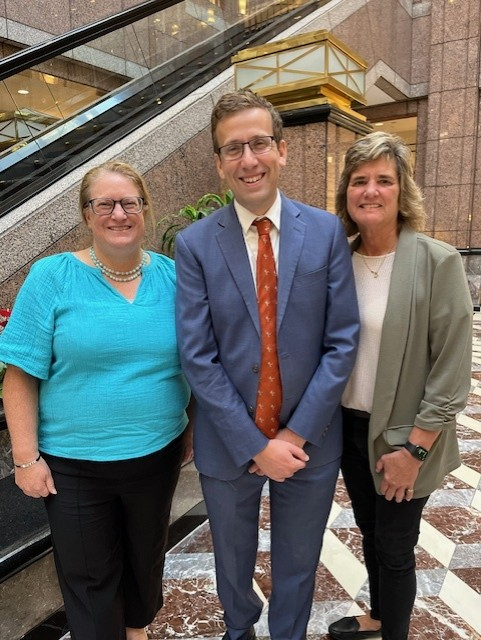
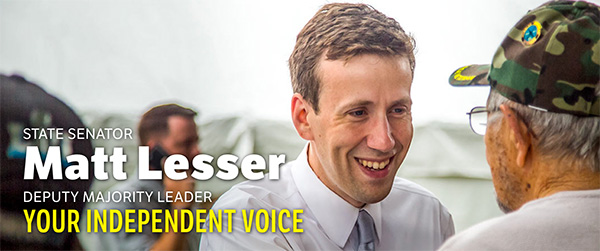
Senator Matt Lesser (center) with Executive Director Michele Rulnick and Volunteer Teresa Opalacz of the Middletown YMCA celebrating the State Bond Commission approval of $8 million to renovate the Y.
HARTFORD – State Senator Matt Lesser (D-Middletown) today welcomed State Bond Commission approval of more than $8 million for projects in Middletown, Rocky Hill and Wethersfield.
The bond commission today gave final approval to $8 million in Community Investment Funds to renovate and expand the Northern Middlesex YMCA facility in Middletown, including ADA access, multi-generational spaces and increased childcare/preschool care.
Rocky Hill received $175,000 in state aid for sewer extension and infrastructure improvements along Cedar Hollow Drive.
The Friends of Kycia Farm in Wethersfield also received $150,000 to help preserve the farm. The Friends is a non-profit organization of the Kycia Farm, which is owned by the Town of Wethersfield to promote farming, land preservation, and community engagement.
“The Y has been a fixture at the corner of Main and Union streets in Middletown for nearly a century. It needs some work to continue serving the residents here for another 100 years,” Sen. Lesser said. “I want to thank Governor Lamont and the State Bond Commission for helping the people of Middletown, Rocky Hill and Wethersfield improve their quality of life.”

FOR IMMEDIATE RELEASE
Tuesday, October 22, 2024
HARTFORD – The two Democratic co-chairs of Connecticut’s School Indoor Air Quality Working Group today welcomed an $11.5 million state investment to build classroom air
purifiers – part of their ongoing efforts to improve air quality in Connecticut’s school classrooms to benefit students, teachers, administrators, and visitors.
The State Bond Commission today approved an $11.5 million grant to purchase equipment and materials for the construction and installation of individual classroom air purifiers by the University of Connecticut as part of the Supplemental Air Filtration for Education program under the Clean Air Equity Response Program. The air purifiers are to be built along the lines of so-called do-it-yourself “Corsi-Rosenthal” boxes, which are typically made of a box fan, four common furnace filters, duct tape, and cardboard.
Connecticut’s School Indoor Air Quality Working Group was founded in 2022, and state Senator Julie Kushner (D-Danbury) and state Representative Jennifer Leeper (D-Fairfield) were appointed co-chairs. The group is charged with developing requirements to inspect and evaluate heating, ventilation, and air conditioning (HVAC) systems in Connecticut’s public schools.
“After a lot of hard work and advocacy, Connecticut is on track to improve the air quality in our public schools with these low-cost but highly effective classroom air purifiers,” Sen. Kushner said. “When you combine this low-tech approach with the millions of dollars we are investing in wholesale HVAC change-outs at schools – like in Ridgefield – we are making giant strides in improving the learning environment for our students and teachers.
“I’m thrilled to see the Bond Commission approve funds for University of Connecticut’s Indoor Air Quality Initiative to receive these funds to rapidly get their more affordable Corsi-Rosenthal air filters directly into classrooms and enhance air quality for students and staff,” Rep. Leeper said. “These filters are safer and more efficient, providing a win-win for the students, staff, and faculty of UConn. Serving as co-chair of the Indoor Air Quality Working Group has shown me the importance of providing the highest level of air quality to all schools, and Senator Kushner and I are committed to providing a safe and healthy learning environment for every student across the state. Thank you to Governor Lamont and the State Bond Commission for your support of our mission, and to Senator Kushner for being such an effective partner.”
Far from some kitschy kitchen-table invention, these boxes – named after engineers Richard Corsi and Jim Rosenthal who invented it during the COVID-19 pandemic – have been tested by the U.S, Environmental Protection Agency and shown to remove 97% of infectious aerosols in just 30 minutes, and 99.4% within 60 minutes – including the virus that causes COVID-19. A recent study in published in Environmental Science & Technology showed the boxes also significantly decrease the concentrations of several PFAS and phthalates in a room. PFAS, a type of synthetic chemical found in a range of products including cleaners, textiles and wire insulation, decreased by 40% to 60%; phthalates, commonly found in building materials and personal care products, were reduced by 30% to 60%.
Today’s state bonding for these classroom air purifiers comes just five months after Sen. Kushner announced a major state investment in clean air for Ridgefield’s classrooms. In May, Sen. Kushner announced that the state Department of Administrative Services had unveiled its 2024 list of Indoor Air Quality grants for public schools in Connecticut, and that eight Ridgefield schools were receiving a total of $191,454 to help pay for a variety of projects, including the installation of ventilators, mini-split air conditioners, roof exhaust fans, upgraded heating and cooling, air exchange and heat recovery, heat pumps, and other air quality-related work.
|
|