|
|
|
|
|
|

Connecticut’s Department of Transportation will receive $3 million in emergency funding from the Biden-Harris administration to help the state fund recovery and road repair work necessitated by historic flooding in August, state officials announced last week.
The federal assistance comes from the U.S. Department of Transportation’s Emergency Relief program and will support infrastructure repair efforts that have been underway since Aug. 18, when severe rainfall and flash flooding washed out roads and bridges in the western region of the state.
In a press release, Gov. Ned Lamont said the flooding event had a devastating impact on the area’s transportation infrastructure as well as homes and businesses. Lamont thanked members of the Biden-Harris administration for authorizing the quick release of the funding.
“Our administration will continue pursuing additional federal emergency relief funds to help our communities rebuild, including for homeowners and businesses who have been impacted and need support,” the governor said.
On Monday, the governor announced he had submitted a formal request for a major disaster declaration for communities in Fairfield, Litchfield, and New Haven Counties as a result of the storm damage.
If the administration grants the federal disaster declaration, the state could receive additional funding to reimburse homeowners, businesses and local governments, according to a press release.
In a letter to President Joe Biden, Lamont described the state’s preliminary assessment of the damage inflicted by the historic storm: three people died as a direct result of the storm, flooding destroyed 19 homes in the state, caused major damage to 170 homes, and minor damage to hundreds more.
Meanwhile, the storm caused major damage to 77 businesses and minor damage to another 51 businesses, according to the governor.
“People who live in the communities impacted by this historic storm are shaken as many of them have experienced significant damage to their homes and businesses and need support to rebuild and recover,” Lamont said.
In the meantime, state work crews and contractors have been working since the storm to reopen roads for safe travel. As of Thursday, the Connecticut Department of Transportation had reopened more than 25 roads that had been closed due to storm damage, Commissioner Garrett Eucalitto said.
“Their hard work and efforts have truly been remarkable,” he said. “I appreciate the support of the USDOT, FHWA [Federal Highway Administration], and our federal delegation who continue supporting the state during the ongoing recovery efforts.”
By Hugh McQuaid

Recent rankings by CNBC and Oxfam were the latest to position Connecticut in the top 10 nationally when it comes to working, a development that’s the result of several developments nationwide.
With the publication itself noting that blue states are gaining ground in many lifestyle and employment metrics as the result of “raging culture wars” in red states, CNBC placed Connecticut ninth overall in its ranking of the best states for quality of life.
The Nutmeg State’s strong health care access, availability and quality were primary reasons for such a strong ranking, with worker job protections, a high minimum wage, pay transparency and low crime rates (in the bottom 5 in the country, per FBI statistics) cited as strong benefits for the state’s residents.
The biggest factor holding the state back in CNBC’s metrics was air quality, which can get poor during summer months due to Connecticut’s many highways and primarily driving-fueled transportation.
CNBC weighed “life, health and inclusion” higher in this year’s metrics, reflecting upon issues ranging from health and child care access to discrimination and state abortion laws; states restricting the rights of their residents or experiencing higher rates of discrimination received lower markings this year.
Much of New England placed highly – Vermont and Maine took first and second spots while Massachusetts and New Hampshire tied Connecticut in ninth. New York and New Jersey also took slots in the top 10.
Comparatively, Texas placed worst for quality of life, with abortion restrictions, weak health care, poor voting rights and poor worker protections contributing to its placement. Nearly every state in the bottom 10 had Republican leadership, with Indiana, Alabama and Arkansas dinged for poor child care access, poor wage policies (a minimum wage of $7.25 per hour in Alabama) and high crime rates, respectively.
A second ranking by Oxfam America, an organization dedicated to fighting inequality, placed Connecticut on its top 10 states to work, with the state landing in ninth place. The state received strong marks regarding wage policies, worker protections and protecting workers’ rights to organize.
All ten states in Oxfam’s rankings, which include the District of Columbia and Puerto Rico, are led by Democrats, including California, Oregon, New York and Washington State. Red states placed low on the metric, with states lacking worker protections like North Carolina, Mississippi, Alabama and South Carolina sitting in the bottom tiers.
These new rankings suggest that Connecticut’s policies are increasingly drawing positive attention in the national conversation, with CNBC’s weighing of issues like discrimination and abortion indicative of changing needs and points of emphasis for people in the country. The lists follow recent metrics finding Connecticut’s schools ranking among the best in the country and its residents among the most educated.
By Joe O’Leary
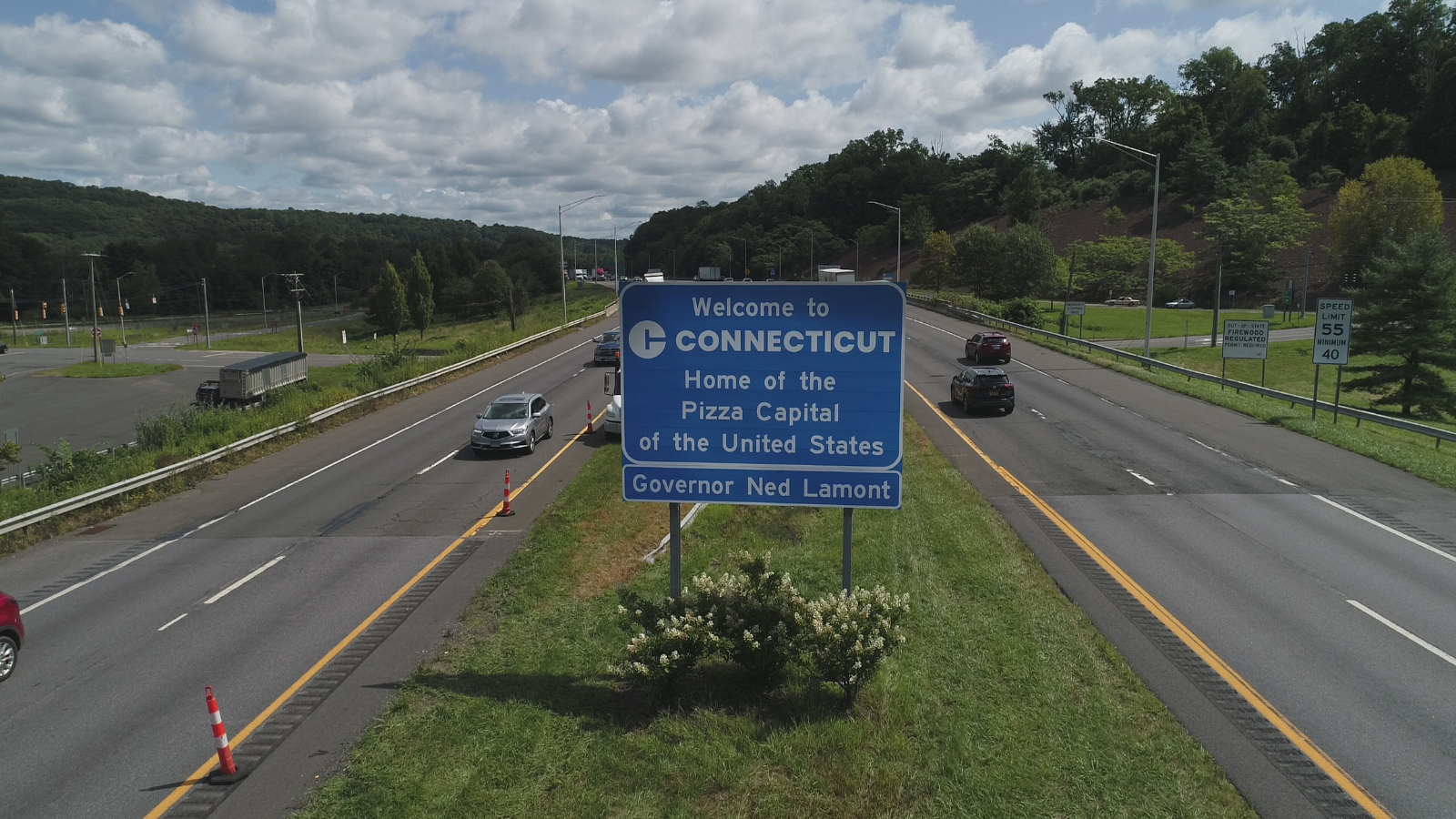
From basketball titles to acclaimed pizza, a new series of “Welcome to Connecticut” signs unveiled by Gov. Ned Lamont Wednesday seek to highlight winning aspects of Connecticut’s identity for motorists traversing state highways.
State transportation officials have placed the news signs in seven locations alongside highways where drivers cross into Connecticut from Massachusetts, New York and Rhode Island.
Each sign highlights a unique aspect of Connecticut. For instance, the signs tout Connecticut as “the Pizza Capital of the United States” and the “Foodie Capital of New England.” Other signs proclaim Connecticut as home to both the “Basketball Capital of the World” and the “Submarine Capital of the World.”
In a press release, Lamont said the new signs were meant to reflect the qualities that make Connecticut special.
“We want everyone entering our state to immediately feel proud of what we do well here, whether it’s making the nation’s best pizza, world class meals, national championships, or the most complex machines in the world,” Lamont said. “Each sign is an invitation to experience all that we have to offer as one of the best states to live, work, and play.”
Signs touting the state’s acclaimed pizza reflect a February proclamation by the governor, naming Connecticut the Pizza Capital of the U.S. and have been placed at locations on I-95 and I-84 entering Connecticut from New York.
Signs declaring Connecticut the “Home of the Basketball Capital of the World” highlight a long history of national titles by the University of Connecticut’s Men’s and Women’s Basketball teams, including the men’s recent back-to-back national titles in 2023 and 2024. The signs have been installed at three locations on I-91, I-84, and I-395 along the border with Massachusetts.
A third sign, highlighting Connecticut’s submarine industry, has been placed along I-95 entering Connecticut from Rhode Island. The sign reflects both the Groton headquarters of submarine manufacturer Electric Boat and the Naval Submarine Base in New London.
Finally, a sign declaring Connecticut the “Foodie Capital of New England,” has been posted along U.S. Route 6 entering Connecticut from Rhode Island. This year, the governor issued an official proclamation, naming Connecticut the foodie capital of the region in response to growing recognition of Connecticut chefs and restaurants including Chef David Standridge, who was awarded the James Beard Award for Best Chef: Northeast in 2024.
Posted by Michelle Rappaport

Continuing a trend that has now lasted more than half a decade, Connecticut’s first budget projections of fiscal year 2025 indicated the state would likely see another surplus.
Comptroller Sean Scanlon said Tuesday that his office had projected a General Fund surplus of $113.2 million and a Special Transportation Fund surplus of $126.4 million, which would put the state in position to continue making significant contributions toward its debts and further improve its finances.
Speaking of those debts, the state expected to contribute $940.5 million toward state employee and teacher retirement pension debts once the 2024 fiscal year was closed out, Scanlon added in the report. This would represent a total of $8.5 billion in such payments since 2020, progress that has reduced projected interest on that debt by hundreds of millions of dollars.
Scanlon noted those pension debt payments were possible because of the state’s Rainy Day Fund, a reserve fund that represents up to 15% of the state budget that can be accessed in times of financial crisis. The comptroller’s report projected the Rainy Day Fund would be at its statutory limit of more than $4 billion.
“Connecticut’s fiscal health continues to be in prime condition as we prepare to make another historic pension payment and embark on the next budgeting season,” Scanlon said in a press release. “While the stock market remains strong, our office is closely watching the Federal Reserve to see what impact an anticipated – and overdue – rate cut will have on our overall economic picture, and we remain optimistic, especially in light of our full Rainy Day Fund, which will ensure we can weather any downturn.”
An initial review of the state’s budget found the surplus lower than expected due to increased medical costs and similar pressures, Scanlon said. However, revenue projections were $148.6 million higher than budgeted, which works to offset the higher-than-expected spending expectations and preserve the state’s current standing.
In late 2023, Scanlon issued a report of the state’s actuarial valuation, which found progress made toward that debt. In 2023, the state contributed $1.05 billion to the State Employee Retirement System. Those payments helped reduce the state’s payment obligations by $87.5 million for the 2025 fiscal year.
Over the last five years, payments to pay down the state budget have freed up more than $500 million in annual spending, which increased to $738 million when combined with the Teachers’ Retirement System, the report found.
Of additional note, Scanlon said that from 2016 to 2023, Connecticut’s payments helped fund the state employee pension fund from 35% to 52%, the highest it’s been since 2008, which helped the state invest in tax cuts and education spending in the process.
By Joe O’Leary

Connecticut’s quarter-century old law prohibiting racial profiling by police departments – which has been updated a few times over the years – has become a national model for other states to combat racial profiling in their own cities and towns.
As Hearst CT News reporter Bill Cummings wrote on Aug. 31, Northeastern University in Boston recently concluded that the Connecticut Racial Profiling Prohibition Project has become “a national leader” in its efforts to monitor and reduce potential racial profiling by officers conducting traffic stops, and the project is spreading its expertise nationwide.
Connecticut’s law is named for former state Sen. Alvin Penn, a Black legislator from Bridgeport, who, according to the blog Only in Bridgeport, was stopped and interrogated by a white police officer in 1996 as he drove through the neighboring town of Trumbull. Penn pushed back when the officer questioned his location.
“I asked why I was being stopped and why I needed to be aware of which town I was in. I wanted to know what difference that made,” Penn told a reporter in describing the situation. “He told me he didn’t have to give a reason for stopping me and said if I made an issue of it, he would give me a ticket for speeding.”
Three years later, in 1999, on an overwhelmingly bipartisan basis, the General Assembly passed the Alvin W. Penn Racial Profiling Prohibition Act, which prohibited the stopping, detention, interdiction, or search of an individual by a police officer on the basis of their race, color, ethnicity, age, gender, or sexual orientation.
The problem was, police departments throughout Connecticut were not using a standardized traffic stop form, which made data collection and analysis nearly impossible.
So, in 2012, the Connecticut General Assembly – again on a nearly unanimous and bipartisan basis – established the Racial Profiling Prohibition Project Advisory Board for the purpose of advising the state’s non-partisan Office of Policy and Management on adopting standardized methods and guidelines to collect and report this information. The advisory board has been meeting since May 2012 on a monthly basis; all meetings are open to the public.
Since the law and its various amendments have taken effect, the frequency of Black and Hispanic drivers being stopped by police in Connecticut for no reason has decreased: “reductions in traffic stops involving minority drivers primarily result from fewer pretextual stops [85 %] for lighting violations and non-moving violations. We find relative declines of approximately 30% for stops resulting in a warning or an arrest,” Northeastern found.
That has elevated Connecticut’s program to a national model for police reform, Northeastern concluded. “The influence of the Connecticut Racial Profiling Prohibition Project has reached far beyond the state’s borders and has had a national impact on the conversation about police reform,” their study said.
Ken Barone, manager of the Connecticut Racial Profiling Prohibition Project and policy director for the Institute for Metropolitan and Regional Policy (a UConn research institute which staffs the Racial Profiling Prohibition Project), told Hearst CT Media that the group’s reach has grown, and that they are now working with California, Oregon, Colorado, Nevada, Rhode Island and Maine to develop and implement programs to reduce profiling by police in those states.
“We analyzed Rhode Island data between 2016 and 2019 and are in the process of analyzing 2020 to 2022,” Barone told Hearst CT Media. “We were also hired to evaluate the Metropolitan Police Department in Washington, D.C. More recently, we have been speaking with New Jersey, Maryland and Illinois about the evaluation of traffic stop records.”
Posted by Lawrence Cook
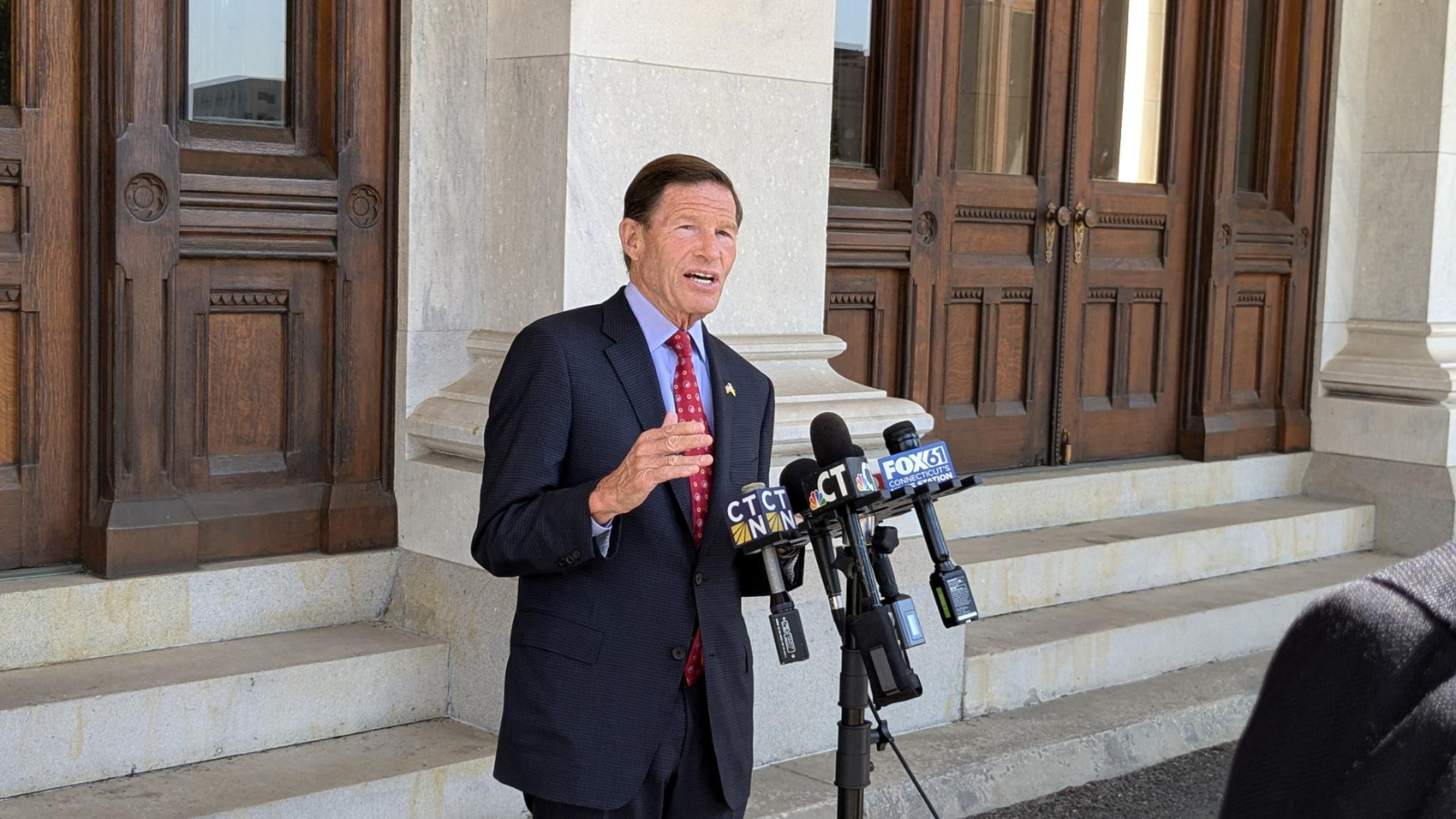
Voters should be wary of an influx of misleading campaign messages generated by artificial intelligence, U.S. Sen. Richard Blumenthal said Tuesday as he called for new rules and legislation to regulate the emerging technology.
Blumenthal, D-Conn, delivered the warning during a mid-day press conference outside the state Capitol building in Hartford.
“Voters can expect to be bombarded, beginning right now, with a blizzard of pre-recorded robocalls, ads, texts — more and more of it generated by AI technology,” he said. “Artificial intelligence technology has become the new norm.”
The prevalence of AI-generated campaign messaging was especially concerning given the ease with which users can now produce deepfakes and misrepresentations that are virtually indistinguishable from legitimate video and voice recordings, Blumenthal said. He urged voters to independently verify any election-related messages that seemed out of place.
“The AI technology is so sophisticated that there are almost no telltale signs, looking at the ad or listening to the robocall or seeing the text,” he said. “But anything that seems unexpected, like the change of a voting place or the cancellation of an election, should be checked with town hall before you take action.”
In an effort to combat misleading AI robocalls, Blumethal called on the Federal Communications Commission to adopt new rules to restrict the calls by requiring callers to disclose their intent to use AI-generated content.
Meanwhile, Blumenthal vowed to continue his efforts to pass the AI Transparency in Elections Act, legislation he co-sponsored to require disclaimers on political ads that significantly rely on AI-generated content. The bill would also require the FCC to quickly address violations of the act.
Although Blumenthal said bipartisan support could help put his bill over the congressional finish line, he noted that states like Connecticut have found success adopting their own rules to govern use of AI.
In 2023, state Sen. James Maroney, D-Milford, led passage of a law to examine and inventory use of artificial intelligence in government in order to ensure automated systems were not making discriminatory decisions.
This year, the Senate’s Democratic majority passed a separate bill that would have, among other provisions, taken steps to criminalize the distribution of deceptive AI-generated media within 90 days of an election. The House did not act on the bill prior to the conclusion of the 2024 session.
On Tuesday, Blumenthal praised states like Connecticut for taking action to regulate artificial intelligence in the absence of federal policies.
“Right now, in this election session, artificial technology is in the Wild West,” Blumenthal said. “Anything goes because we have no effective protection requiring disclosure of the use of artificial intelligence technology and penalties for distortive deepfakes or impersonations. So, I strongly support those state efforts.”
Posted by Hugh McQuaid
|
|
|
|

Connecticut has once again earned a leading spot in a state-by-state list of the best and worst community college systems, according to an August report by the website WalletHub, which ranked the state third in the nation.
The website placed Connecticut behind only Maryland and New Mexico, marking the third consecutive year the state has placed in the top three community college systems nationally.
WalletHub financial writer Adam McCann noted that five of Connecticut’s schools were among the top 55 community colleges in the country and highlighted the state’s efforts to provide free community college to many residents.
The website ranked Enfield’s CT State Community College Asnuntuck as the top community college in the state.
“It offers services to help graduates find jobs, receives a lot of funding from state taxes, and offers sizable grants and scholarships,” McCann wrote of Asnuntuck.
In a press release, CT State President John Maduko said the ranking reflected CT State’s commitment to delivering high quality and affordable education that prioritizes positioning students for successful careers.
“As families across the state grapple with rising costs, our community college offers a valuable alternative, enabling students to achieve their academic goals without sacrificing quality or future opportunities,” Maduko said. “We remain dedicated to supporting our students and their aspirations, helping them maximize their educational investment.”
The WalletHub report looked at 653 institutions and considered 18 metrics including career outcomes, education outcomes, and costs.
Posted by Hugh McQuaid

A new Connecticut law was helping to protect children on school buses as they returned to classrooms this back-to-school season by allowing cities and towns to fine drivers up to $250 for illegally passing stopped school buses.
This law was introduced by Sen. Herron Keyon Gaston, D-Bridgeport, during the 2024 legislative session and was signed into law by Gov. Ned Lamont. It followed a report from the city of Bridgeport that found 10,000 drivers passed a school bus illegally over a six-month period.
“I want to do all that I can to make sure our kids are safe,” said Gaston, Senate chair of the legislature’s Public Safety Committee. “We cannot afford to lose our precious young ones. We need to increase safety personnel in areas where there is high traffic flow, and in areas where school buses most frequent. We must continue to explore best practices around increasing public safety and make the necessary investments to protect young people throughout the state of Connecticut.”
The revenue collected by the fines will go back to the towns and cities to increase education measures and public safety.
For many children, the school bus is their primary mode of transportation. From getting onto the bus at the bus stop to getting off the bus after school. Following safety guidelines can help ensure that every ride is safe.
Last week, AAA warned drivers to be focused and patient as school buses return to the roads during the morning and afternoon commute. Back-to-school transportation affects not only school districts, students and parents, but also other drivers on the roads.
According to Connecticut law, drivers are required to stop their vehicles at least 10 feet away from a school bus that has its flashing red lights activated, unless otherwise directed by an officer. Drivers must remain stopped until the lights stop flashing and the stop-arm is retracted.
Posted by Michelle Rappaport