|
|
|
|
|
|
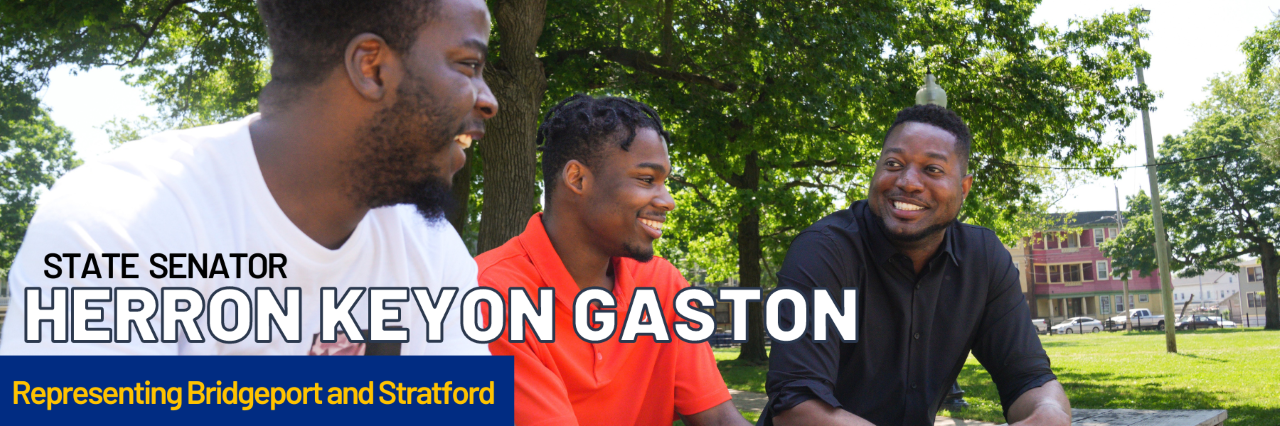
Today, state Senator Herron Keyon Gaston (D-Bridgeport) and the Stratford Delegation is celebrating funds being released to Stratford during the Community Investment Fund meet. African American Collections, Inc applied for Community Investment Funds (CIF) that will help rehabilitate 2225 Main Street in Stratford.
The CIF is awarding $2,000,000 to help with the Rehabilitation of the Sterling Homestead for relocation of the Ruby & Calvin Fletcher African American History Museum. The Museum has outgrown its temporary East Broadway location and was invited by Stratford to relocate to their newly acquired 10,000-sq.-ft. Sterling Homestead on Main Street. The building rehab project includes a new HVAC system, roof, plumbing, electrical, kitchen/warming center for events, fire/burglar alarm systems, restoring rotting and missing clapboard siding, and trim, repurposing exterior and interior walls and ceilings with painting, accessible bathrooms, exterior wall and attic insulation, ADA ramps, additional parking spaces, and an elevator.
“This museum is more then just a collection of artifacts, it provides a rich history and is a testament to the resilience, achievements, and contributions of African Americans,” said Sen. Gaston. “This museum serves as a space to offer reflection, education and pride. I am deeply proud this funding will work to support the continued rehabilitation of relocating the Ruby & Calvin Fletcher African American History Museum.”
“Working on this project with Jeffrey Fletcher over the past few years has been a pleasure,” Rep. Joseph Gresko said. “Moving the Fletcher African American Museum to the heart of Stratford’s historic district is a great success. Everyone who worked on this project should be proud.”
“It is incredibly important that this funding injection benefit the Ruby & Calvin Fletcher African American History Museum,” said Rep. Ben McGorty. “This space does an excellent job at illustrating a notable and troubling part of our nation’s history. This state grant will be integral in maintaining the Museum’s commitment to educating further generations.”
“Securing a sustainable future must begin with preserving and protecting our history,” Representative Laura Dancho (R-120) said. “I am grateful to see a significant investment in two Stratford landmarks that tell important stories about local culture. With this expected funding, both the Sterling Homestead and the Ruby & Calvin Fletcher African American History Museum can continue to educate and remind us about the role our community has played in Connecticut’s development.”
“It’s wonderful news,” said Senator Kevin Kelly (R-Stratford). “The Ruby and Calvin Fletcher African American History Museum is the first museum of its kind in New England. It is a chronological and educational journey that starts at the continent of Africa and takes small steps through various points in African American History. Stratford is very blessed to have this impactful and provocative museum right here in our town which shares both difficult and empowering pieces of our nation’s history. I thank the entire Stratford delegation for working as a team in advocating consistently for this worthy project, and I thank the governor for recognizing the long-term value of this significant state investment.”
The Ruby & Fletcher African American Museum, which is the first African American history museum in the state, was being moved into the childhood home of John William Sterling, the namesake of Yale’s Sterling Memorial Library. The Museum displays a wide collection of artifacts dating from the Atlantic slave trade to the Jim Crow South. The organization serves individuals, including students and teachers, affording them an opportunity to learn about African American culture by seeing historic artifacts up close and personal.
The Community Investment Fund 2030 (CIF) was created by a bipartisan vote of the General Assembly in 2021 and is funded through state bonding.
The CIF fosters economic development in historically underserved communities across the state. CIF will provide a total of up to $875 million to eligible municipalities as well as not-for-profit organizations and community development corporations that operate within them.
Grants are available for:
Capital improvement programs, such as brownfield remediation, affordable housing, infrastructure, clean energy development, and home or public facility rehabilitation
Small business capital programs, including revolving or micro loan programs, gap financing, and start-up funds to establish small businesses
Planning for capital projects including activities such as community engagement processes, feasibility studies, development of project plan and construction budget
|
|
|
|
|
|
|
|
|
|
|
|
|
|
|
|


A recent visit by James Tillman to the Connecticut Department of Emergency Services and Public Protection (DESPP) Forensic Laboratory in Meriden served as a stark reminder of just how far forensic science has come in recent decades, and how state-funded improvements to the lab have eradicated a backlog of cases and are helping to solve new crimes.
Tillman was falsely convicted on sexual assault and kidnapping charges in 1989 but was released from prison in 2006 with help from the Connecticut Innocence Project and after advanced DNA testing was conducted at the forensic lab.
“I lived a life unimaginable for some people,” Tillman told a gathering marking National Forensic Science Week at the state’s forensic lab in Meriden. “I always wanted to come here. This was on my bucket list to be here. This is where it all happened. I thank law enforcement for their job. I know things don’t go the way they are supposed to go all the time, but through science it makes it easier for them to get it right.”
State Department of Emergency Services and Public Protection Commissioner Ronnell A. Higgins said the lab’s advanced DNA testing proved Tillman could not have committed the crime for which he was wrongly convicted.
“I am renewed by our belief in the highest standards – and the best science – as we work every day to analyze evidence and provide the best investigative leads we can to our law enforcement officers,’ Higgins said.
The DESPP Forensic Science Laboratory is charged with:
· Examining physical evidence submitted by criminal case investigators
· Assisting state and local law enforcement agencies with criminal investigations and crime scene processing
· Providing forensic and technical training and education for law enforcement agencies and the community
· Conducting scientific and technical research
The laboratory is staffed with administrative and scientific personnel who handle various forensic disciplines like arson, biochemistry, chemistry, DNA, documents, firearms and toolmarks, fingerprints, image analysis, imprints, instrumentation, photography, reconstruction, and trace.
Perhaps most importantly, in the last 10 years, the forensic lab has cleared a backlog of 12,000 cases and reduced the case investigation time from two-and-a-half years to less than 60 days. The lab’s “Rapid DNA” program offers around-the-clock access for police investigations, utilizing forensic genealogy and DNA analysis to resolve long standing cold cases. Additionally, the lab recently achieved a perfect score on its accreditation.
In June 2023, the State Bond Commission approved another $1.5 million in renovations to the lab, and $1.2 million for a building load generator installation.
The DESPP Division of Scientific Services began its history as the Connecticut State Police Bureau of Identification, which operated from 1935 to 1975 in the Troop I Barracks in Bethany. The forensic services provided then by the troopers were limited to photography, fingerprints and firearms examination.
Posted by Lawrence Cook
|
|
|

The Department of Transportation’s Highway Safety Office has started a new public service announcement campaign, meant to remind drivers about the “Real Lives” at risk if they don’t comply with the state’s Move Over law.
Connecticut’s Move Over law is one of the strongest and most thorough in the United States, as it does not just require drivers to move over if there is an emergency vehicle stopped on the roadside, but for any vehicles on the side of the road. The law applies to all highways and side roads in Connecticut, including one-lane roads. If a driver cannot change lanes or is driving on a one-lane road, drivers must instead slow down and exercise caution in the process.
Sen. Norm Needleman, D-Essex, stressed the importance of the law during a Thursday event with Colchester emergency responders.
“There’s good reason why moving over for traffic was made law – it protects workers and prevents serious injury and death in the event of crashes,” Needleman said. “I’m proud to be here today with our state and local leaders to make sure those who need space will get it, and to help make sure we see fewer avoidable crashes on the side of the road.”
On an annual basis, Connecticut first responders rush to the scenes of more than 100,000 motor vehicle crashes just within state lines. On a national basis, since 2020, roughly 40 crash responders are killed in the line of duty per year, according to the Highway Safety Office.
Violators can face significant fines, especially if their actions lead to crashes, injury or death. A normal violation is an infraction, but a crash resulting in the injury of emergency personnel can see fines climb to $2,500, and a crash resulting in a fatality can lead to a fine of up to $10,000 and potential criminal charges.
While Connecticut first passed its Move Over law in 2009 and expanded it in 2017, unfortunately, the state continues to experience roadside crashes. From 2017 to 2021, 16 people lost their lives in roadside crashes in Connecticut, with 13 of those deaths happening after sunset on dark roadways. Those statistics prompted lawmakers to update the policy again in 2023, ensuring all roads were considered in its language.
The new campaign is designed to remind drivers that motorists can be parked on the side of roadways for any variety of reasons, including Department of Transportation crews and construction workers performing roadwork, tow operators hooking up damaged or malfunctioning vehicles and emergency responders who have pulled over other motorists or are assisting someone in need.
Drivers who see a vehicle stopped on or next to a roadway should immediately try to slow down within reason and move over to a lane that would give the vehicle extra space. If they cannot move over safely, they should slow down and proceed with caution – but the DOT reminded drivers not to stop, as that can compound and worsen traffic issues and lead to further damage.
Posted By Joe O’Leary

Kathleen Unger Holt, former associate director of the Center for Medicare Advocacy, has received Gov. Ned Lamont’s nomination to serve as state healthcare advocate, the governor’s office announced in a Wednesday press release.
As a leader of the Medicare policy nonprofit, Holt helped develop healthcare policy on a state and federal basis. The governor said that experience would serve Connecticut well as Holt steps into her new advocacy role.
“I am very excited that Kathy Holt has accepted our offer to serve as Connecticut’s next healthcare advocate because she has an incredible amount of experience, both here in our state and on a national level, in helping people access the coverage they need and advocating on their behalf, especially for people who are older, people who have disabilities, and people who frequently face barriers to obtaining health insurance,” Lamont said.
Holt, who was raised in Newtown and began her career working for Bloomfield-based insurance provider Cigna, said she was excited to begin working to ensure Connecticut residents had access to affordable healthcare.
“In addition to assisting individuals obtain access to healthcare services, the Office of the Healthcare Advocate represents the collective voice of all Connecticut patients,” she said. “I look forward to collaborating with healthcare providers, insurers, employers, other state agencies, and state and federal legislators to coordinate, deliver, oversee, and improve healthcare in Connecticut, making Connecticut a healthcare model for the country.”
Although Holt will serve on an interim basis beginning Sept. 30, her nomination will require approval from state lawmakers after the 2025 legislative session begins in January. Her nomination comes with a recommendation from the Healthcare Advocate Advisory Committee, a panel of legislative appointees tasked with evaluating candidates for the position.
Holt earned praise from Sen. Saud Anwar, a South Windsor Democrat who co-chairs the Public Health Committee. In a Wednesday statement, Anwar said he looked forward to working with Holt on issues impacting Connecticut patients.
“Her experience advocating for Medicare and quality healthcare for our older populations and people with disabilities will be valuable and I know she will be focused on fixing issues patients face in getting care,” Anwar said. “Her career has spanned a variety of professional and legal roles in the healthcare industry and I’m confident that her breadth of knowledge will benefit many in our state.”
Holt is poised to take over the advocate position from Sean King, the office’s general counsel, who has been serving as an interim basis since last year, following the departure of former advocate Ted Doolittle. Doolittle left the position to accept a nomination as a federal immigration judge.
Posted By Hugh McQuaid

FOR IMMEDIATE RELEASE
Thursday, September 19, 2024
NORWICH – State Senator Cathy Osten (D-Sprague) today welcomed a $64,250 state grant to update the environmental assessment work at the Capehart Mill Riverfront Park project.
The funding, through the Connecticut Department of Energy and Environmental Protection (DEEP), will help update the remedial plan necessary to redevelop the 6-acre Norwich property into a municipal riverfront park.
“This is going to be a transformative riverfront project, and any and every state dollar we can get to move this redevelopment along and keep the financial burden off of local taxpayers is very much welcome,” Sen. Osten said.
Just three months ago, Sen. Osten welcomed a $4 million state grant for Norwich to clean up the former Capehart Textile Mill located in the Greeneville National Historic District and turn it into a riverfront park along the Shetucket River. That state grant will be used to create a remedial action plan and an asbestos work plan, abatement, and demolition of buildings A & B, the skywalk, and 5th Street Bridge.
DEEP expects to make future grants available to municipalities and non-profits annually over the next three years. DEEP announced that starting today, it is accepting applications for Round 2 of this grant program. In this round, a total of $750,000 available, up to $250,000 per applicant for assessment or cleanup (no minimum request). The program is open to municipalities and non-profit organizations. Applications will be accepted until noon on Friday November 22, 2024. To apply for a grant, go to: https://portal.ct.gov/deep/business-and-financial-assistance/grants-financial-assistance/grants-and-financial-assistance