SENATOR NEEDLEMAN RELEASES STATEMENT FOLLOWING DECISION IN UTILITY RATE REQUESTS

State Senator Norm Needleman
FOR IMMEDIATE RELEASE
Contact: Joe O’Leary | Joe.OLeary@cga.ct.gov | 508-479-4969

SENATOR NEEDLEMAN RELEASES STATEMENT FOLLOWING DECISION IN UTILITY RATE REQUESTS

Today, State Senator Norm Needleman (D-Essex), Senate Chair of the Energy & Technology Company, released the following statement in response to the Public Utilities Regulatory Authority’s decision this week approving rate increase requests from state utility companies Eversource and United Illuminating, and related comments made this week by utility and political leaders:

“How does a company with an underlying profit of more than $1.5 billion plead unfair treatment the day after Connecticut’s regulators gave them everything they requested? Worse, they threatened the state of Connecticut, saying they will not fulfill their obligations to build out improvements to the electric grid necessary to support our policy goals. This week, Eversource received every penny it requested, but it’s still complaining. This behavior is threatening, vindictive and irresponsible, not to mention disrespectful to ratepayers facing another increase to their monthly bills. When you get what you want and you’re still whining, one has to wonder, is there something else going on under the hood?

If Eversource does not want to make green energy investments in our grid, for which it receives full reimbursement and an additional profit on top of out-of-pocket costs, maybe we should consider a review of their franchise agreement, which allows them to operate as a monopoly with no competition. The only thing protecting ratepayers from corporate greed is a regulatory authority that does its job appropriately and acts as a proxy for ratepayers and the free market. If they are unwilling to honor that agreement, then maybe the state needs to reconsider its commitment to allow them to operate as a monopoly.

The General Assembly will continue to enable our regulators to provide appropriate oversight in the best interest of Connecticut’s ratepayers and won’t be threatened or intimidated by a company whose primary interest is shareholder profit and compensation for senior executives.

More baffling is the Republicans’ apparent change of heart and their support of this behavior. In recent years, bills passed by broad bipartisan majorities with the intent of holding these utilities accountable. It appears Republicans are having buyer’s remorse after having done the right thing by supporting those bills.

Amid all this noise and fury, it appears the Republicans are parroting the utilities, creating an echo chamber that constantly supports the interests of the utilities and not the ratepayers. Democrats will continue to support the interests of the ratepayers while doing everything we can to advance our energy goals, looking to the future for generations to come.”

Share Share
Tweet Tweet
Forward Forward

SEN. OSTEN APPLAUDS SENATE PASSAGE OF BILL TO CURTAIL RENTAL PROPERTY ABUSES

FOR IMMEDIATE RELEASE

Thursday, April 18, 2024

SEN. OSTEN APPLAUDS SENATE PASSAGE OF BILL TO CURTAIL RENTAL PROPERTY ABUSES

NORWICH – A bill that would give municipalities greater control over how private homes are put up for rent in their communities – and the negative public consequences that may come from the use and abuse of Airbnb’s and other such property rental arrangements – passed the state Senate today and now heads to the House of Representatives for consideration.

Senate Bill 335, “An Act Concerning Short-Term Rental Properties,” passed the Senate on a xx-xx vote. The bill allows cities and towns to vote and adopt local ordinances regulating the operation and use of short-term rental properties like Airbnb’s and requires these properties to be licensed. Under the bill, short-term rental properties are defined as rentals of 30 days or less.

“The short-term rental industry has created some real public contentiousness in many, many Connecticut municipalities,” Sen. Osten said. “This bill is yet another tool in the toolbox for cities and towns to curtail any short-term rental abuses.”

Sen. Osten’s support for the bill stems from recent rental abuses in Norwich, which she represents. Over time, some small gatherings at short-term rental homes turned into larger and larger gatherings replete with loud music, cars blocking streets and private driveways – even being used as wedding sites.

###

SEN. OSTEN WELCOMES POTENTIAL EXPANSION OF PAID FAMILY AND MEDICAL LEAVE ACT TO 10,000 TRIBAL EMPLOYEES

FOR IMMEDIATE RELEASE

Thursday, April 18, 2024

SEN. OSTEN WELCOMES POTENTIAL EXPANSION OF PAID FAMILY AND MEDICAL LEAVE ACT TO 10,000 TRIBAL EMPLOYEES

NORWICH – A bill that would make Connecticut’s highly successful Paid Family and Medical Leave Act available to approximately 10,000 employees of the Mohegan and Mashantucket Pequot Tribal Nations passed the state Senate today and now heads to the House of Representatives for consideration.

Senate Bill 222, “AN ACT CONCERNING CHANGES TO THE PAID FAMILY AND MEDICAL LEAVE STATUTES,” makes several changes to Connecticut’s PFML law, which has been in effect since January 1, 2022, including:

· requires employers to register and submit reports to the PFML Authority

· broadens the authority’s powers regarding attempted fraud and recovering benefit overpayments

· allows rape victims to receive PFMLI benefits concurrently with benefits from the state’s Victim Compensation Program

· and allows the governor to enter into a memorandum of understanding (MOU) with the Connecticut’s federally recognized tribes to allow employees of those tribal businesses to participate in the PFML program.

“This is a very important change to our Paid Family and Medical Leave Program. Now, more than 10,000 new workers can have access for the first time to PFML who otherwise wouldn’t,” Sen. Osten said. “It’s a substantial benefit, as more than 100,000 Connecticut residents have already found out – about one out of every 15 people working in this state.”

The bill was supported by the two federally recognized tribal nations at its public hearing on February 27.

According to the Connecticut Paid Leave Authority, as of late February 2024, the new state program has provided income-replacement benefits to more than 100,000 Connecticut workers and paid out $638 million in benefits. Claims have come from all 169 Connecticut cities and towns and have been used to deal with a person’s own serious health condition, pregnancy/childbirth, or to care for a family member experiencing a serious health condition.

###

Sen. Lesser Leads Passage of Bill to Protect Those with Medical Debt

FOR IMMEDIATE RELEASE
Contact: Garnet McLaughlin | Garnet.McLaughlin@cga.ct.gov

Sen. Lesser Leads Passage of Bill to Protect Those with Medical Debt

Today State Senator Matt Lesser, Chair of the Human Services Committee led passage of legislation to protect residents with medical debt from further financial strain.

Senate Bill 395 prohibits Connecticut health care providers and hospitals from reporting medical debt to credit rating agencies for use in a credit report and voids any medical debt that is reported to credit rating agencies. The bill passed on a bipartisan basis and now heads to the House.

“Medical debt is not the result of poor financial decisions or consumer spending – it is the result of a health care system that prioritizes profits over people,” said State Sen. Matt Lesser. “Medical debt is typically a one time incurrence due to necessity, and no family faced with those circumstances should face further financial pressure while seeking to rent an apartment or buy a car. Massive healthcare reform is needed, but I am proud that we have taken a step to insulate Connecticut residents from financial ruin for circumstances outside of their control. I am encouraged by the bipartisan vote today, as well as the support from the Connecticut Hospital Association and a wide array of consumer advocates”

A number of consumer advocates, the Connecticut Hospital Association and the federal Consumer Financial Protection Bureau submitted testimony in favor of this legislation.

Share Share
Tweet Tweet
Forward Forward

Sen. Slap Leads Passage of Two Bills to Improve Access to Higher Education

Senator Derek Slap

Sen. Slap Leads Passage of Two Bills to Improve Access to Higher Education

Today, State Senator Derek Slap, Senate Chair of the Higher Education and Employment Advancement Committee led passage of two pieces of legislation to improve access to higher education. The legislation passed today changes the eligibility standards for the Connecticut Automatic Admission Program (CAAP) to increase equity and eligibility, and expands access to low-interest loans through the Connecticut Higher Education Supplemental Loan Authority (CHESLA).

“We know that removing barriers to access to higher education is one of the most effective steps toward educational equity,” said Sen. Slap. “Both of these programs – the loan authority and CAAP have been integral in helping students access opportunity and these changes will expand their reach. CAAP will continue to encourage more folks to matriculate, while now offering a level of transparency and increased fairness in their eligibility standards by considering unweighted GPAs instead of class rank. Expanding eligibility for CHESLA loans allows 17 year old high school seniors access to the same low interest student loans their 18 year old classmates have access to.”

Senate Bill 109 changes the eligibility requirements of the Connecticut Automatic Admission Program (CAAP) to increase equity and access for students. CAAP requires graduating Connecticut high school seniors who meet identified thresholds to be notified of their eligibility for automatic admission to participating colleges and universities. SB 109, passed today, changes the requirement for admission from a minimum class rank percentile to a minimum, unweighted grade point average (GPA).

This legislation seeks to make the pre-qualification threshold more transparent for students by relying on a GPA as opposed to class rank, which is not readily available to students. By using an unweighted GPA, the legislation seeks to make the program more equitable by reducing the importance of heavily weighted Advanced Placement (AP) courses. This is important because lower resourced school districts often have less AP courses available.

A student who qualifies is required to complete a simplified, free application for the participating colleges and universities that they wish to attend. The student will automatically receive a letter of acceptance and details about financial aid awarded.

According to Connecticut State Colleges & University (CSCU), this year, the total number of CAAP applicants has increased by 70%, and the total number of applicants to the CSCU schools has increased by 400%, or 3,259 students.

Senate Bill 304 allows students under 18 to apply for low-interest loans through the Connecticut Higher Education Supplemental Loan Authority (CHESLA) with a cosigner. Under current law, high school graduates under the age of 18 are unable to apply for loans through the quasi-public CHESLA. However, they are able to apply for private loans, often with much higher interest rates.

Both bills will now head to the House.

Contact: Garnet McLaughlin
860-304-2319
Share Share
Tweet Tweet
Forward Forward

Senate Passes Legislation to Improve Eligibility for Automatic College Admissions

April 18, 2024

Senate Passes Legislation to Improve Eligibility for Automatic College Admissions

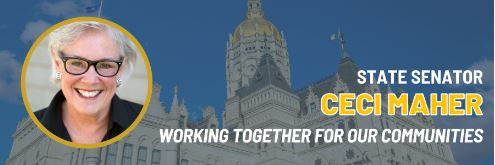
Today, State Senator Ceci Maher (D-Wilton) voted to change the eligibility requirements for the Connecticut Automatic Admission Program (CAAP) to increase equity and access for students. The bill passed unanimously and now heads to the House.

“The college admissions process can be challenging for many students. Today, we took a step to simplify and ease it for Connecticut high schoolers and their families,” said Sen. Maher. “Now, students will be able to know exactly where they stand when they apply for college, and will have an easier time receiving an excellent education from schools across our state.”

CAAP allows graduating Connecticut high school seniors who meet identified thresholds to be notified of their eligibility for automatic admission to participating colleges and universities. SB 109, passed today, changes the requirement for admission from a minimum class rank percentile to a minimum, unweighted grade point average (GPA).

This legislation seeks to make the pre-qualification threshold more transparent for students by relying on a GPA as opposed to class rank, which is not readily available to students. By using an unweighted GPA, the legislation seeks to make the program more equitable by reducing the importance of heavily weighted Advanced Placement (AP) courses. This is important because lower resourced school districts often have less AP courses available.

According to Connecticut State Colleges & University (CSCU), this year, the total number of CAAP applicants has increased by 70%, and the total number of applicants to the CSCU schools going up by 400%, or 3,259 students.

A student who qualifies is required to complete a simplified, free application for the participating colleges and universities that they wish to attend. The student will automatically receive a letter of acceptance and details about financial aid awarded. Participating universities include:

  • Central Connecticut State University
  • Eastern Connecticut State University
  • Southern Connecticut State University
  • Western Connecticut State University
  • Mitchell College
  • University of Bridgeport
  • University of New Haven
  • University of Saint Joseph
Contact: Joe O’Leary | 508-479-4969 | Joe.OLeary@cga.ct.gov

SENATOR ANWAR LEADS SENATE PASSAGE OF LEGISLATION WORKING TO EASE EMERGENCY ROOM CROWDING

FOR IMMEDIATE RELEASE
Contact: Joe O’Leary | Joe.OLeary@cga.ct.gov | 508-479-4969
April 17, 2024

SENATOR ANWAR LEADS SENATE PASSAGE OF LEGISLATION WORKING TO EASE EMERGENCY ROOM CROWDING

As emergency rooms across Connecticut continue to struggle under heavy loads of patients, with studies showing that patients can wait more than three hours on average to be seen after arrival, State Senator Saud Anwar (D-South Windsor), Senate Chair of the Public Health Committee, led the Senate’s unanimous passage of legislation seeking to collect information and rectify that issue.

“Our emergency rooms are overfull for a number of different reasons. We need to find those reasons and fix the problem in the name of providing better health care in our state,” said Sen. Anwar. “This bill will work to determine a baseline of care. That baseline can then be used to track the effectiveness of future laws and how they impact that figure in years to come. It provides us with an important barometer for our future efforts.”

Senate Bill 181, “An Act Concerning Emergency Department Crowding,” if made law will require private hospitals in Connecticut to collect data on the number of patients receiving emergency room care. That data would include the number of patients who were admitted, the average length of time from arrival in the emergency department to their admission, and the number of patients who were required to wait for an available bed in the emergency department.

That data will be used to inform hospitals of potential methods to improve the efficiency of their admissions, as well as to develop policies to reduce wait times for admission to hospitals after patients present to the emergency department.

Medical professionals testified in support of the legislation in force, citing its potential to show the “scope and severity” of the emergency room concern, according to Jonathan Bankoff, Chairman of Middlesex Health’s Department of Emergency Medicine.

“A first step to solving any problem is to measure it, and that is what this bill proposes to do,” said Melissa Chuongvan-Roy, an emergency medicine physician at Yale New Haven Hospital. “Transparent and accurate data collection, curation and dissemination is important” in trying to address specific problems, she added.

The bill previously passed the Public Health Committee by a unanimous 37-0 vote in March. It now heads to the House for further consideration.

Share Share
Tweet Tweet
Forward Forward

STATE SENATOR NORM NEEDLEMAN LEADS SENATE PASSAGE OF BILL SUPPORTING LOW-INCOME WATER CUSTOMERS

State Senator Norm Needleman
FOR IMMEDIATE RELEASE
Contact: Joe O’Leary | Joe.OLeary@cga.ct.gov | 508-479-4969
April 17, 2024

STATE SENATOR NORM NEEDLEMAN LEADS SENATE PASSAGE OF BILL SUPPORTING LOW-INCOME WATER CUSTOMERS

Today, State Senator Norm Needleman (D-Essex), Senate Chair of the Energy and Technology Committee, led the State Senate’s passage of legislation supporting low-income water customers by broadening the scope of a key state advisory board.

“When water rates are rising faster than inflation in the last two decades, we need to provide increased protections for state residents,” said Sen. Needleman. “This bill adds water services to the Low-Income Energy Advisory Board’s oversight, an important step forward to help connect people in need with the aid available to them.”

Senate Bill 384, “An Act Concerning The Low-Income Energy Advisory Board,” redesignates that board to include low-income water customers as well. The bill will require that board to make recommendations to the General Assembly on heating and water assistance programs benefitting low- and moderate-income households and requires that board to come together and work out recommendations to improve availability, administration and implementation of heating and water assistance programs.

The advisory board will also advise and assist the Office of Policy and Management, the Department of Social Services and Department of Energy and Environmental Protection in planning, development, implementation and coordination of water assistance programs and policies, including programs and policies alleviating the impact of utility rates.

By expanding this board to cover water in addition to heating, the legislation will better ensure that Connecticut ratepayers can affordably access water. According to Claire Coleman and Nora Duncan, Chair and Vice-Chair of the Low-Income Energy Advisory Board, in testimony supporting the bill, the national average residential water bill has increased nearly 50 percent in the last 14 years. While the Federal government created the Low-Income Household Water Assistance Plan in 2021 during the COVID-19 pandemic, it is slated to close in June 2024, leaving a gap that this change in policy can help fill by increasingly advocating for water affordability.

The bill passed the Energy and Technology Committee by a unanimous 20-0 vote in March and passed the Senate today unanimously. It now heads to the House for further consideration.

Caption: Senator Needleman speaks on the Senate floor Wednesday.

Share Share
Tweet Tweet
Forward Forward

CT SENATE PASSES BILL THAT STRENGTHENS ELECTORAL COLLEGE GUARDRAILS 

FOR IMMEDIATE RELEASE

Wednesday, April 17, 2024

CT SENATE PASSES BILL THAT STRENGTHENS ELECTORAL COLLEGE GUARDRAILS 

HARTFORD – The state Senate voted today to have the secretary of the state officially serve as the executive in charge of certifying Connecticut’s presidential electors, thereby taking advantage of a new federal law that updates America’s electoral college regulations for the first time in 135 years in an effort to prevent a recurrence of the January 6, 2021 attack on American democracy.

Today’s bill, Senate Bill 257, designates Connecticut’s secretary of the state as the state official responsible for certifying presidential electors under the federal Electoral Count Reform Act of 2022 (ERCA). As the designated official, the secretary of state must issue the elector certification and then immediately transmit the certificate to the Archivist of the United States.

“There is perhaps nothing more important than modernizing and validating our presidential elections processes, especially in light of the threats that our democracy faced in the 2020 election and its aftermath, ” said Senate President Pro Tem Martin Looney (D-New Haven). “By making this change today, we are taking part in the larger, national discussion of what it means to value and protect our elections and forestall ambiguity that could lead to bad-faith actions.”

“Every state should take advantage of the federal ECRA law and update its statutes now, not only for the sake of clarification, but also to prevent any possibly recurrence of the attempted overthrow of American democracy that we saw in late 2020 and early 2021,” said Senate Majority Leader Bob Duff (D-Norwalk). “If you remember, it was Georgia’s Republican Secretary of State Brad Raffensperger who refused to ‘find’ the 11,780 votes that Donald Trump demanded that he find in order to steal the 2020 election from the American people. Process is important. Integrity is important. People are important. We reaffirmed that today with this bill.”

The Senate bill passed today is a direct result of ECRA, which seeks to provide better guardrails on how presidential election results get from the states to the Electoral College process, and then to Congress, and how Congress handles those ballots once there.

While the new federal law mainly addresses what Congress does after electors are sent forward from the states, it also addresses the states’ side of the equation: the 2022 federal law specifies   that the executive of each state sends forward the state’s slate of electors, and that while “the executive” is usually a governor, states can appoint someone else, such as a secretary of state.

The ERCA made a host of other updates and clarifications to America’s electoral college laws, which former President Donald Trump and his Republican Congressional allies attempted to exploit in the weeks leading up to the January 6, 2021 assault on the U.S. Capitol by violent and treasonous Trump supporters who attempted to overturn the certification of Joe Biden as president of the United States of America.

SENATOR MAHER LEADS SENATE PASSAGE OF LEGISLATION MAKING YOUTH CAMPS SAFER

SENATOR MAHER LEADS SENATE PASSAGE OF LEGISLATION MAKING YOUTH CAMPS SAFER

Today, State Senator Ceci Maher (D-Wilton), Senate Chair of the Committee on Children, led the Senate’s passage of legislation making Connecticut youth camps safer. The bill takes several steps to improve regulation of youth camps including increased inspections and improved state oversight.

“By keeping a focus on the current and future demands and needs for state youth camps, our state takes strong action today to ensure children’s safety,” said Sen. Maher. “Summer camps and youth camps help foster children’s education, growth and joy; these steps will better ensure that outcome remains the case for years to come.”

Senate Bill 215, “An Act Concerning Youth Camps,” includes requiring a second inspection of a newly licensed youth camp no later than 72 hours after it commences operations, with priority to single-week camps, and reduced priority to camps with national accreditations or those with no complaints or violations filed in the last five years. It also establishes a Youth Camp Safety Advisory Council within the Office of Early Childhood, and allows the state to refuse to license a camp that had its license revoked in another state.

State laws require the Office of Early Childhood to inspect camps before licensing them; adding a second inspection after the camp starts operating will provide additional oversight to ensure proper operations. Inspections focusing on initial applicants and single-week camps will also be a more rapid and effective oversight.

The Youth Camp Safety Advisory Council also will increase both safety of youth camps in the state as it ensures industry representatives and state leaders’ inputs on the needs of these camps.

The bill passed the Committee on Children by a 15-3 vote on March 12 and passed unanimously through the Senate today. It now heads to the House for further action.

Caption: Sen. Maher speaks on the Senate floor Wednesday.

Contact: Joe O’Leary | 508-479-4969 | Joe.OLeary@cga.ct.gov