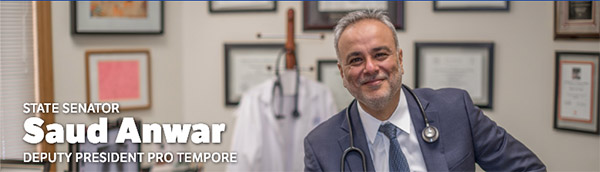
SENATOR ANWAR CALLS FOR CEASEFIRE IN GAZA

FOR IMMEDIATE RELEASE
Contact: Joe O’Leary | Joe.OLeary@cga.ct.gov | 508-479-4969
SENATOR ANWAR CALLS FOR CEASEFIRE IN GAZA
As the continuing conflict in Gaza nears its sixth month, with tens of thousands of deaths reported, State Senator Saud Anwar (D-South Windsor) today released the following statement decrying the continued bloodshed and calling for a ceasefire in the region:

“The events of October 7, the massacre that sparked this latest ongoing conflict between the Israeli Defense Forces and Hamas, were and are indefensible. This resulted in hundreds of innocent individuals losing their lives, not to mention hostages taken that have still not been returned home. The events in months following, where tens of thousands of innocent lives have been lost by indiscriminate bombings, are beyond heartbreaking.

“Those of us with voices and platforms have a responsibility to say something amid this fraught situation.

“I ask those in power to find a path towards a permanent ceasefire, one that allows for immediate humanitarian support in Gaza that will save lives and relieve the suffering of thousands of people there, and I ask for the release of hostages to their homes and families.

“We must collectively commit for a better future, one that can be shared between Jews and Muslims across our world. I wish for the devastation wrought upon Gaza to end and for the rebuilding to begin. I wish for governments to stop their violence and work towards a constructive model of peace. A two-state solution has been sought by many for decades but has yet to come to fruition. This current violence underscores the dire need to recommit to a two-state solution with a new urgency.

“This war has traumatized, shocked and horrified millions, not only in the regions impacted, but also those watching and listening to this continued disaster around the world. Our interconnected global communities have been experiencing anger, despair, and helplessness as we watch this ongoing human suffering. There must be an end to the violence and pain for our collective healing to begin.”

Share Share
Tweet Tweet
Forward Forward

ENERGY & TECHNOLOGY COMMITTEE ADVANCES BILLS EXPLORING NEW OPPORTUNITIES IN SOLAR, POWER GENERATION

State Senator Norm Needleman
FOR IMMEDIATE RELEASE
Contact: Joe O’Leary | Joe.OLeary@cga.ct.gov | 508-479-4969
March 22, 2024

ENERGY & TECHNOLOGY COMMITTEE ADVANCES BILLS EXPLORING NEW OPPORTUNITIES IN SOLAR, POWER GENERATION

As the 2024 legislative session in Connecticut continues, the Energy & Technology Committee, led by Senate Chair State Senator Norm Needleman (D-Essex), is focused on important concepts that can potentially advance adoption of new power generation strategies and explore further adoption of solar power among other renewable energies in the state. It recently passed several bills for further consideration on the House and Senate floors.

“This year, our committee is looking toward increasing the ease of access and potential use of technology like solar and geothermal energy,” said Sen. Needleman. “As our state continues to explore the expansion and adoption of these forms of energy, the more we can do to encourage its adoption, protect its users and study new uses for the future will be beneficial for our communities.”

Perhaps the most significant piece of legislation advanced by the Energy & Technology Committee this year is House Bill 5052, “An Act Supporting Solar Energy In Schools.” The bill, if passed, would lead to the creation of a program encouraging the installation of solar energy systems and energy storage systems at public schools in Connecticut. School districts would be eligible to apply for and accept grants for school building projects involving solar energy based on assessments of solar feasibility, especially in projects where towns or districts don’t utilize solar energy.

Making access and development of solar energy easier is a common thread in the committee’s work this year and is not focused solely on schools. Senate Bill 297, “An Act Concerning Consumer Protection For Customers Of Solar Power Companies,” seeks to put requirements in place for third-party solar salesmen, including that they are directly affiliated with companies they use and that they explain all rates, fees and charges as well as terms and conditions of the systems they sell when discussing a sale. The bill further seeks to establish a task force providing further recommendations in future years, including potential special protections for low-income or senior residents.

Finally, House Bill 5358, “An Act Concerning A Study Of Geothermal Energy,” would require the Department of Energy and Environmental Protection to study the feasibility of developing a community geothermal pilot program. These systems dig deep into the ground where temperature is nearly always consistent and utilize it to provide heat in winter and air conditioning in summer, most often using heat pumps. Community geothermal would see buildings interconnected with these heat pump systems, with increased energy efficiency through transferring air, possibly providing a new and eased way for HVAC and air regulation in communities.

All three bills passed the Energy & Technology Committee on March 21.

Share Share
Tweet Tweet
Forward Forward

Bill to Strengthen MDC Consumer Advocate Position Advances 

Senator Derek Slap
Bill to Strengthen MDC Consumer Advocate Position Advances 

The bill helps consumers and businesses save money and resolve issues with the Metropolitan District 

Today, State Senator Derek Slap, and State Representatives Tammy Exum and Kate Farrar celebrated the committee passage of Senate Bill 336 – An Act Concerning the Metropolitan District of Hartford County’s Independent Consumer Advocate.

The position of the Independent Consumer Advocate was established in 2017 by then Representative Derek Slap and Senator Beth Bye, however funding for the position has not been increased since. Funding levels are currently inadequate to support the position. The advocate is paid hourly and this proposal calls for raising the cap on billable hours so the advocate can better represent consumers.

Second, under current law the MDC must approve any request for additional hours for the advocate. The bill transfers that authority to the Office of Consumer Counsel to better establish independence of the position and improve accountability.

“Since its inception the advocate has helped families and businesses save hundreds of thousands of dollars and these changes will ensure their voice is well represented when dealing with the MDC,” said State Sen. Derek Slap. “This bill calls for a small but meaningful investment in the position and untethering control of its funding from the MDC, thus enhancing its independence. These are simple, common-sense reforms that will save consumers money and time.”

“From flooded basements to billing issues, MDC ratepayers have concerns that need to be addressed and the Independent Consumer Advocate must remain a reliable resource for all families,” said State Rep. Tammy Exum. “I am glad the Planning and Development Committee recognized the importance of SB 336, which will critically strengthen the Independent Consumer Advocate and ensure MDC ratepayers’ interests remain the top priority.”

“The MDC Independent Consumer Advocate is an essential and valuable voice for our local ratepayers,” said State Rep. Kate Farrar. “This bill is crucial to provide the financial support needed for the Consumer Advocate to not only support our MDC consumers but improve oversight and accountability.”

“The Independent Consumer Advocates have become an important intermediary between MDC and the customer. They are tasked with monitoring, informing and educating the public about MDC’s actions, and all local residents benefit from their tireless work. It is of the upmost importance that we attract a strong candidate to hold this position, but the cap on salary has unfortunately become a deterrent to prospective hires.  I am proud to cosponsor a bill that would help ensure that these advocates are fairly compensated for their impactful work,” said State Rep. Bobby Gibson.

This legislation will now move to the Senate floor.
 

Contact: Garnet McLaughlin
860-304-2319
Share Share
Tweet Tweet
Forward Forward

PUBLIC HEALTH COMMITTEE PASSES KEY BILLS SUPPORTING NURSING HOME RESIDENTS

FOR IMMEDIATE RELEASE
Contact: Joe O’Leary | Joe.OLeary@cga.ct.gov | 508-479-4969
March 22, 2024

PUBLIC HEALTH COMMITTEE PASSES KEY BILLS SUPPORTING NURSING HOME RESIDENTS
Legislation would increase staffing and patient support and prevent discrimination based on mental health

As work during the 2024 legislative session continues, members of the Public Health Committee recently passed legislation supporting nursing home residents. The two bills, if passed, would respectively provide stronger guidelines and ensure direct care for residents and prevent discrimination against them based on their mental health history. Both bills passed on March 20.

“The health and well-being of our state’s vulnerable must remain on the forefront of legislators’ minds when considering public health,” said State Senator Saud Anwar (D-South Windsor), Senate Chair of the Public Health Committee. “These bills will play a direct role in supporting seniors needing daily aid, ensuring they get the care they need and are not discriminated against for past health history. I look forward to my colleagues’ support when I introduce it on the Senate floor.”

Senate Bill 273, “An Act Concerning Nursing Home Staffing,” redefines the term “direct care” in nursing homes to refer to hands-on care provided by a nurse or aide to a resident including aid with daily tasks and excepting food preparation, housekeeping and maintenance. If passed, it would require new minimum staffing levels of three hours of direct care for nursing home residents per day, including at least half an hour of care by a registered nurse and more than 15 minutes daily of care by a licensed practical nurse.

It would also require modifications to social work so a worker’s number of hours is based on the number of residents in a home.

This legislation is based on situations reported by patients in past years where they were not receiving the direct care they needed, as well as disparities in the care received by different residents. Direct care is a vital tool to determine maximum amounts of hands-on care so residents receive optimal care and do not experience negative health outcomes.

Nora Duncan, state director of AARP Connecticut, testified that this bill would support critical direct care staffing levels that, if not followed or met, could harm residents’ health and livelihood. She said the direct definition of “direct care” would better ensure and outline these needs.

State Long Term Care Ombudsman Mairead Painter testified that, having seen the direct impact staffing levels have on the quality of care and life of nursing home residents, the bill would ensure homes have enough staff members attending to residents’ immediate needs and promote more accurate assessments and fulfillment of resident care quality.

The bill passed the Public Health Committee with a 25-12 vote.

Senate Bill 275, “An Act Prohibiting Nursing Homes From Rejecting A Patient Solely On The Basis That Such Patient Received Mental Health Services,” would do what its title says. This would close a loophole where prospective residents could be denied the care they need because they have a history of receiving mental health services; when more than 50 million Americans received mental health treatment or counseling in 2022, that could lead to countless people being rejected from homes.

The bill received positive testimony including from Ombdusman Painter, who said the bill could prevent discrimination and stigma against individuals seeking mental health services and recognizes the importance of comprehensive care.

The bill passed the Public Health Committee with a unanimous 37-0 vote.

Both bills now move to the Senate floor for further consideration.

Planning and Development Committee Chairs Advance Proposal to Shelter People Experiencing Homelessness 

Planning and Development Committee Chairs Advance Proposal to Shelter People Experiencing Homelessness 

Sen. MD Rahman and Rep. Eleni Kavros DeGraw, co-chairs of the General Assembly’s Planning and Development Committee, advanced legislation Friday to allow religious organizations the option of providing temporary housing for people experiencing homelessness.

The bill, HB 5174, allows religious organizations to install temporary shelter units on their properties for people experiencing homelessness and refugees in communities with at least 25,000 residents.

“We have a moral obligation as a legislature to provide for the people who desperately need a place to live,” Senator Rahman, D-Manchester, said. “We have a moral obligation as citizens to bring people in from the cold weather outside. Every human needs three things in order to survive — shelter, food, and health care. Some of our neighbors do not have access to these necessities and we must at least allow our faith leaders the option of sheltering them.”

“We have over a thousand people living outside and more than 4,000 people living in our homeless shelters,” Representative Kavros DeGraw, D-Avon, said. “This week, it dipped below 30 degrees at night. Our churches, temples, and mosques are part of the solution with the services that many of them already provide as part of their mission-driven work and this bill allows them to further that service.”

The legislation, which now heads to the House for consideration, would allow municipalities to limit the installation to a maximum of eight temporary shelter units. The bill also allows municipalities to impose restrictions like a cap on the size of the shelters at 400 square feet and a prohibition on shelters within 1,000 feet of any elementary or secondary schools.

“Our cities have borne the weight of caring for our unhoused citizens and by having these potential tiny shelters across Connecticut, faith communities that would like to assist in this effort will now have more flexibility to do so,” Representative Kavros DeGraw said.

Senator Rahman pushed back against efforts by some Republican members of the committee to disparage provisions of the bill to temporarily house refugees using scare tactics designed to incite anxieties over immigration.

“I am the product of immigration,” Senator Rahman, a Bangladeshi immigrant, said. “I came here 25 years ago. I worked hard. I saved my money and opened a business. I became a landlord, a business owner, and nonprofit founder. I’m an immigrant and I’ve created many jobs in the state of Connecticut.”

Senator Rahman stressed that the policy does not represent a mandate on communities. Instead, it provides Connecticut faith leaders an option to assist members of the community who are in most need of help.

“This bill gives religious organizations an option,” Senator Rahman said. “They can open a shelter or choose not to. We all trust our religious facilities and their leaders not to harm our communities. They are our backbone.”

SENATOR KUSHNER WELCOMES COMMITTEE PASSAGE OF EXPANDED PAID SICK LEAVE BILL

OR IMMEDIATE RELEASE

Thursday March 21, 2024


SENATOR KUSHNER WELCOMES COMMITTEE PASSAGE OF EXPANDED PAID SICK LEAVE BILL

HARTFORD – State Senator Julie Kushner (D-Danbury) today celebrated the Labor Committee passage of her signature legislation for the session: expanding Connecticut’s decade-old paid sick leave law from covering only about 12% of the state workforce to covering nearly all 1.7 million working people in Connecticut.

Senate Bill 7, “AN ACT CONCERNING CONNECTICUT PAID SICK DAYS,” is a legislative priority this session for the majority Senate Democratic Caucus, which represents two-thirds of all state Senate districts, or about 2.4 million people.

The bill passed the Labor and Public Employees Committee today on a purely partisan party-line vote – with all Republicans voting “No” – and now heads to the Senate floor for further consideration before the legislative session ends at midnight on May 8.

“This is simply good public policy. Just like we don’t send our kids to school when they’re sick, employees shouldn’t be showing up for work when they’re sick either,” Sen. Kushner said. “It’s also a pro-family policy. These changes strengthen working families, not only to take the time necessary to care for themselves and each other, but to provide some modicum of income for when they’re not working and need some money to help buy groceries or gas.”

Right now, Connecticut’s 13-year-old paid sick leave law applies only to private-sector employers with more than 50 employees, mostly in “service worker” occupations –or only about 12% of Connecticut’s entire private-sector workforce.

Senate Bill 7 re-defines who is covered under Connecticut’s 2011 paid sick leave law to include anyone working in Connecticut. Senate Bill 7 allows employees – retroactively to October 1, 2023 – to accrue one hour of paid sick leave for every 30 hours they work, and it can be used effective on the 100th day of their employment. The proposed sick leave update can also be used not only for an employee’s illness, but also for their time away from work to care for the illness of a family member.

Currently, eight states and Washington, D.C. require paid sick leave for any business with one or more employees: Arizona, California, Illinois, Massachusetts, Minnesota, New Jersey, Vermont and Washington.

SENATE DEMOCRATS PRIORITY BILL PROTECTING HEALTH CARE WORKERS PASSES PUBLIC HEALTH COMMITTEE

SENATE DEMOCRATS PRIORITY BILL PROTECTING HEALTH CARE WORKERS PASSES PUBLIC HEALTH COMMITTEE
As health care workers 5x more likely to experience workplace violence, legislation would provide patient safety assessments, worker safety training
Today, the Public Health Committee passed legislation that aims to protect and support the safety of health care workers in the midst of increasing violence against them in that profession. The bill, Senate Bill 1, one of Senate Democrats’ foremost priorities this year, now heads to the Senate floor. It was inspired by and introduced in dedication to the deaths of two health care workers in late 2023 and early 2024.

The bill passed by a 25-12 vote and will next head to the Senate floor.

Senate Bill 1, “An Act Concerning The Health And Safety Of Connecticut Residents,” seeks to provide workers with improved tools and resources to aid their safety and security on the job. These include, but are not limited to, providing workers with risk assessments for patients with potential histories of violence or criminal histories, as well as the safety of their homes for care workers who travel to patient residences; comprehensive training regarding worker safety, including training on how to handle dangerous situations and how to seek help quickly; and provision of home health workers with technology and mechanisms for safety checks and location data. The bill also offers health and wellness checks to workers, Medicare payment support if escorts are requested or needed, and would create a task force to give recommendations on these changes.

The legislation comes after two visiting nurses died in late 2023 and early 2024. In October 2023, nurse Joyce Grayson was killed upon visiting a patient for an appointment in a Willimantic halfway home; in January 2024, Otolegile Morulane, a live-in caregiver, and his patient died in an East Lyme house fire.

The Senate Chair and Vice Chair of the Public Health Committee, Senators Saud Anwar (D-South Windsor) and Martha Marx (D-New London), who are both health care workers, have called for this legislation based partially on their own personal experiences.

“Health care workers often make sacrifices to protect and preserve the safety of their patients,” said Sen. Anwar. “Those sacrifices should not include their personal safety or their lives, and that’s what this bill seeks to ensure. New training and increased transparency and access to information offers newfound ability for workers’ protection, giving them peace of mind and letting them focus on their jobs. I look forward to bringing this bill out on the Senate floor.”

“This is the Senate’s foremost priority bill because our caucus recognizes the importance of home health care workers’ safety,” said Sen. Marx. “Every worker deserves to feel safe at work, but home care workers do not feel safe. The murder of Joyce Grayson and death of Otoliegile Morulane in a house fire where he was working are tragic because they represent the safety issues home care workers have raised for years. This bill will improve reporting of both verbal and physical violence, improve intake information giving workers the safety they need, including escorts, and provide technology that can alert authorities that they need help. Home care workers go to work to care and earn a living and they deserve to go home safe without abuse. It is their employers’ responsibility to keep them safe. The time is now for this bill to give them that safety and the recognition they deserve.”

In addition to these protections, the bill contains a number of advances benefitting public health, including action to fight future cybersecurity events against Connecticut health care operations, expanded insurance coverage for certain procedures such as preventative heart scans, and development of working groups studying issues such as health hazards in nail salons and nonalcoholic fatty liver disease.

Contact: Joe O’Leary | 508-479-4969 | Joe.OLeary@cga.ct.gov

Senators Looney, Duff, Hartley Offer Jobs and a Lifeline to North Carolinians

Senators Looney, Duff, Hartley Offer Jobs and a Lifeline to North Carolinians
 Ask DECD to Recruit from NC in Light of Controversial GOP Nominee for Governor
HARTFORD – Today, Senate President Pro Tempore Martin M. Looney (D-New Haven), Senate Majority Leader Bob Duff (D-Norwalk), and Senator Joan Hartley (D-Waterbury) sent a letter to Department of Economic and Community Development (DECD) Commissioner-designate Daniel H. O’Keefe urging him to explore opportunities to attract businesses from North Carolina to relocate to Connecticut.

The senators believe “there is a unique opportunity to reach out to businesses in North Carolina” after North Carolina Republicans nominated Mark Robinson to be the next governor. Robinson has a “history of making inflammatory and divisive comments which should be alarming to North Carolinian businesses.”

A Vox article lists the particulars of these remarks which the senators cite in their letter to DECD:

Robinson, North Carolina’s current lieutenant governor, has hurled hateful remarks at everyone from Michelle Obama to the survivors of the Parkland school shooting. He’s called the LGBTQ community “filth.” He threatened to use his AR-15 against the government if it “gets too big for its britches,” and he wants to outlaw all abortions as well as return to a time when women couldn’t vote. He’s also ridiculed the Me Too movement, women generally, and climate change.

It seems Robinson is willing to entertain all manner of conspiracy theories, too. He’s a Holocaust denier and has a history of antisemitic remarks. He’s suggested that the 1969 moon landing might have been fake, that 9/11 was an “inside job,” that the music industry is run by Satan, and that billionaire Democratic donor George Soros orchestrated the Boko Haram kidnappings of school girls in 2014

Senators Looney, Duff, and Hartley argue Robinson’s remarks “raise significant concerns about the business environment and social climate in North Carolina under potential leadership that condones or ignores such divisive rhetoric.” Meanwhile the senators note that Connecticut has a “commitment to diversity, equality, and fostering an environment where businesses can thrive while upholding ethical standards and respect for all.”

The senators also argue Connecticut can attract North Carolina businesses because we “offer a strategic location, a skilled workforce, world-class educational institutions, and a supportive business environment conducive to innovation and growth… we can showcase the opportunities and advantages of investing in Connecticut while sending a clear message that our state stands firmly against bigotry and discrimination in all its forms.”

The full letter can be found below and linked here.

Commissioner-designate Daniel H. O’Keefe
Department of Economic and Community Development (DECD)
450 Columbus Blvd, Suite 5
Hartford, CT 06103

Dear Commissioner-designate Daniel H. O’Keefe,

As leaders representing the Connecticut Senate, we are writing to urge the Department of Economic and Community Development (DECD) to explore opportunities to attract businesses from the state of North Carolina to relocate to Connecticut. Like DECD, we are constantly looking for chances to diversify and strengthen our state’s economy, and we believe there is a unique opportunity to reach out to businesses in North Carolina.

The impetus for our recommendation stems from the deeply concerning nomination of Mark Robinson as the Republican candidate for governor of North Carolina. Mr. Robinson’s history of making inflammatory and divisive comments should be alarming to North Carolinian businesses. His lengthy record was recently summarized by the media outlet Vox:

Robinson, North Carolina’s current lieutenant governor, has hurled hateful remarks at everyone from Michelle Obama to the survivors of the Parkland school shooting. He’s called the LGBTQ community “filth.” He threatened to use his AR-15 against the government if it “gets too big for its britches,” and he wants to outlaw all abortions as well as return to a time when women couldn’t vote. He’s also ridiculed the Me Too movement, women generally, and climate change.

It seems Robinson is willing to entertain all manner of conspiracy theories, too. He’s a Holocaust denier and has a history of antisemitic remarks. He’s suggested that the 1969 moon landing might have been fake, that 9/11 was an “inside job,” that the music industry is run by Satan, and that billionaire Democratic donor George Soros orchestrated the Boko Haram kidnappings of school girls in 2014.

These remarks not only undermine the values of inclusivity and tolerance of our nation, but should also raise significant concerns about the business environment and social climate in North Carolina under potential leadership that condones or ignores such divisive rhetoric.

In contrast, Connecticut prides itself on its commitment to diversity, equality, and fostering an environment where businesses can thrive while upholding ethical standards and respect for all.

Given these circumstances, we believe that DECD should seize the opportunity to engage with businesses in North Carolina, highlighting the advantages and benefits of relocating to Connecticut. Our state offers a strategic location, a skilled workforce, world-class educational institutions, and a supportive business environment conducive to innovation and growth. By extending invitations to businesses in North Carolina, we can demonstrate our commitment to fostering an inclusive and welcoming community where businesses can prosper without fear of discrimination or intolerance.

We understand that attracting businesses requires a concerted effort and strategic outreach. Therefore, we ask DECD to prioritize this initiative and allocate resources to facilitate conversations with potentially relocating companies. By proactively reaching out to businesses in North Carolina, we can showcase the opportunities and advantages of investing in Connecticut while sending a clear message that our state stands firmly against bigotry and discrimination in all its forms.

Thank you for your attention to this matter. We look forward to working together to advance our shared goals of economic growth.

Sincerely,

Contact: Kevin Coughlin | 203-710-0193 | kevin.coughlin@cga.ct.gov
Share Share
Tweet Tweet
Forward Forward

Senator Gaston Leads Passage of Bridgeport-Focused Public Safety Bills

Senator Gaston Leads Passage of Bridgeport-Focused Public Safety Bills


The Public Safety and Security Committee’s Senate Chair Herron Keyon Gaston led passage Tuesday of legislation to enhance student safety near parked school buses and support the recruitment and retention of both firefighters and police during a meeting ahead of a key legislative deadline.

The bills, which will now move to the state Senate for consideration, were top priorities of Senator Gaston, D-Bridgeport, who backed the legislation in an effort to address concerns raised by his constituents in Bridgeport.

The first bill allows Connecticut towns and cities the option of adopting monitoring systems to detect motorists who illegally pass a stopped school bus and issue offending drivers a fine of $250. The proposal directly responds to data from the city of Bridgeport, which indicated that nearly 10,000 drivers had been recorded illegally passing stopped school buses in the first six months of this academic year.

“We want to make sure that public safety is our top priority for all residents across the state of Connecticut but particularly I wanted to lift this bill because it’s coming out of Bridgeport and I wanted to make sure that Bridgeport remains a safe place,” Senator Gaston said following Tuesday’s meeting.

“Our kids should understand that we have their back and our parents should understand that we are prioritizing the safety of their young people, our most precious cargo,” he said.

The committee also passed a pair of bills designed to help fire departments and police departments recruit and retain qualified candidates. One bill explores mortgage assistance for uniformed members of paid and volunteer departments as well as tuition waivers for firefighters and their children.

“Our firefighters do a herculean job in terms of responding to various kinds of crisis — whether that is a person’s house on fire and they are responding to the call or they are going to the scene of an accident, where someone may have been injured on our roadways,” Senator Gaston said.

“We want them to know that their work is very important. We want to acknowledge that work but also put our money where our mouth is and incentivize firefighters to stay on the job,” he said. “We want you to know that we’re standing shoulder-to-shoulder with you.”

The legislation advanced by the committee also seeks to remove financial burdens for towns seeking to recruit new police officers and provide financial support including tuition waivers and mortgage assistance to help officers stay on the job.

“It’s important for officers to know we are exploring ways to ensure that our police departments are fully staffed and we’re also looking at incentives to help keep them on the force so they can continue the work of keeping our residents safe,” Senator Gaston said.

The public safety panel advanced all three bills out of committee on a consent calendar, meaning the proposals had broad, bipartisan support and no lawmaker sought the opportunity to oppose them. Tuesday marked the Public Safety and Security Committee’s final day to pass legislation during the 2024 session.

Contact: Hugh McQuaid | Hugh.McQuaid@cga.ct.gov | 860-634-4651

SECURITY DEPOSIT LOAN ASSISTANCE LEGISLATION INTRODUCED BY SENATOR MARONEY MOVES TO SENATE FLOOR

FOR IMMEDIATE RELEASE
Contact: Joe O’Leary | Joe.OLeary@cga.ct.gov | 508-479-4969
March 19, 2024

SECURITY DEPOSIT LOAN ASSISTANCE LEGISLATION INTRODUCED BY SENATOR MARONEY MOVES TO SENATE FLOOR

This month, the General Assembly’s Banking Committee voted to advance legislation creating a loan assistance program for security deposits, moving the bill introduced by State Senator James Maroney (D-Milford) one step closer to becoming law. The bill will require the Commissioner of Housing to establish a security deposit loan assistance program and authorize a tax deduction for related interest to those loans if passed.

“We all need a place to live, especially as Connecticut’s housing crunch tightens further,” said Sen. Maroney. “There are any number of people who need to move for career opportunities, family or life changes and may struggle to meet the needs of a security deposit, especially if they’re undergoing financial strain. This loan program can make sure people can get the housing they need with our state supporting them in what can be a challenging or complicated time. I hope to see it continue to advance.”

Senate Bill 284, “An Act Concerning A Security Deposit Loan Assistance Program,” as drafted would see the security deposit loan assistance program support renters seeking to rent property who are members of low-income households, veterans, victims of domestic violence or recent college graduates. All of those demographics may struggle to meet the requirements of a security deposit due to financial constraints or immediate need for housing. The renter also would need income where the rent is not more than 35% of their monthly income.

The loans made would be charged with a maximum 4% interest and would require repayment within one to two years of being made. Funds would be paid directly to landlords and renters utilizing the program would be connected with other state resources if needed.

In the bill, a tax deduction would also be authorized for interest deferred by or not charged to eligible renters in connection with security deposit loans issued under the program.

The bill passed the Banking Committee on March 12 by an 11-1 vote. It now heads to the Senate floor.

Share Share
Tweet Tweet
Forward Forward